
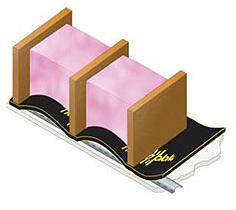
Acoustiblok Ceiling Applications
If you need to a superior soundproof ceiling solution, our advanced, super thin acoustic insulation Acoustiblok 3mm Isolation Membrane is easy to implement to your existing designs without redesigning the entire buildup / project.
In addition, QuietFibre® Open Cell or a similar type of dense acoustic open cell cavity stone wool/fibre should be fitted into all accessible cavities where appropriate prior to the fitting of Acoustiblok 3mm Isolation Membrane to the under side of the joist / frame followed by finishing board of choice.
The QuietFibre® Open Cell will offer absorbency / noise reduction coefficient as well as a thermal insulation value at the cavity but critically will reduce or prevent resonance within the cavity, which if left unfilled could lead to a potential amplification, resonance and regeneration of any sound wave.
The Acoustiblok 3mm Isolation Membrane will provide a staggering acoustic performance with the unique principle of conversion of acoustic energy followed by the ceiling board which provides deflection through its mass and density.
Soundproof Ceiling Material
Acoustical sealant would ideally be applied along the length of all joists prior to the installation of Acoustiblok 3mm Isolation Membrane being gently pulled across the joists and secured in way of mechanical fixings to hold in place.
All overlaps, joins and perimeters of Acoustiblok 3mm Isolation Membrane should be sealed with acoustic silicone sealant and tape jointed (please see accessories) to ensure an air tight seal to the entire area.
As an option and if tolerances allow, a resilient bar/channel or cross batten can be fitted perpendicular to the joist at this stage which will help in supporting the Acoustiblok Membrane. The use of a resilient channel is quite common as it will also offer a platform onto which to mechanically fix the finishing board.
The chosen finishing board system of either a single/double staggered board can then be installed to the ceiling, tape jointed and finished as a standard process.
Learn More
If you require detailed technical data or installation tips, please see our Technical Data section.