

Different Colours of Noise – What They Are & What They Mean
Wherever you are in day-to-day life, there’s always some form of noise being generated from different sources all around us.
Of those noises, each produces what is referred to as a unique wave form or ‘colour’.
In fact, noise can be categorised in order to differentiate between one type of noise and another.
Different colours are used for this classification which we uncover in greater detail below.
Table of Contents
What is Noise Colour?
The colour of noise, or noise spectrum, refers to the power spectrum of a noise signal.
Different types of noise colours have diverse properties and as a result they can be used in different circumstances and applications.
White noise for example, was the first to be named and subsequently noises with other spectral profiles were also given different colour references.

White Noise
White Noise
White noise is generally regarded as the most commonly known type of noise colour.
This type of noise which has equal power across all frequencies.
It is low, and often masked by other noises.
It can be described as the static or hissing sound.
Good examples of this are sounds similar to those produced by an old fashioned analogue aerial-based television set, an untuned FM/AM radio or a fridge.

Pink Noise. Image credit: Dvidby
Pink Noise
Pink noise has equal power per octave.
This means that it has more energy in the lower frequency ranges than white noise for example.
However it is lower than brown noise.
Types of pink noise sounds include the rain falling steadily or the sound of a waterfall or the ocean.
Pink noise is regarded as being very soothing.
Studies have shown that pink noise can help to improve memory, concentration and sleep quality.

Brownian Noise. Image credit: Dvidby0
Brownian Noise
Brownian noise is also sometimes referred to as brown noise or red noise.
This type of noise has a special distribution which decreases by 6 decibels per octave.
Thus it has more energy in the lower frequencies, and a lower energy at the higher end.
Brown noise is similar to a low rumbling sound, or a deep roar.
To better describe it we can imagine the sound of a thunderstorm in the distance, or the rumbling of waves.
Brown noise is often used for relaxation and meditation.
It is also ideal for masking other sounds which could be distracting.
Blue Noise
Blue noise or azure noise has more energy when it comes to higher frequencies.
It’s like a high-pitched hissing sound, such as the sound you hear when steam escapes from a pipe.
Blue noise is sometimes used in audio engineering in order to create a sense of depth or space.
At considerably high volumes blue noise can be quite harsh.
Violet Noise
Violet noise is basically a more extreme version of blue noise.
It has even more energy in the high frequencies.
Thus it can be described as being a very high-pitched sound.
A good example of this is the sound of a dentist’s drill.
Grey Noise
Grey noise is quite similar to pink noise because it sounds the same at every frequency.
Grey noise calibrates better with the human ear.
Grey noise is used to treat tinnitus or hyperacusis.
Velvet Noise
Velvet noise is characterised by the density in taps/second.
At very high densities it sounds very similar to white noise, but it is often described as being smoother, thus the reference to the velvet.
Velvet noise is useful in applications such as decorrelation filters and real-time reverberation algorithms.
Where Do Noise Colours Originate?
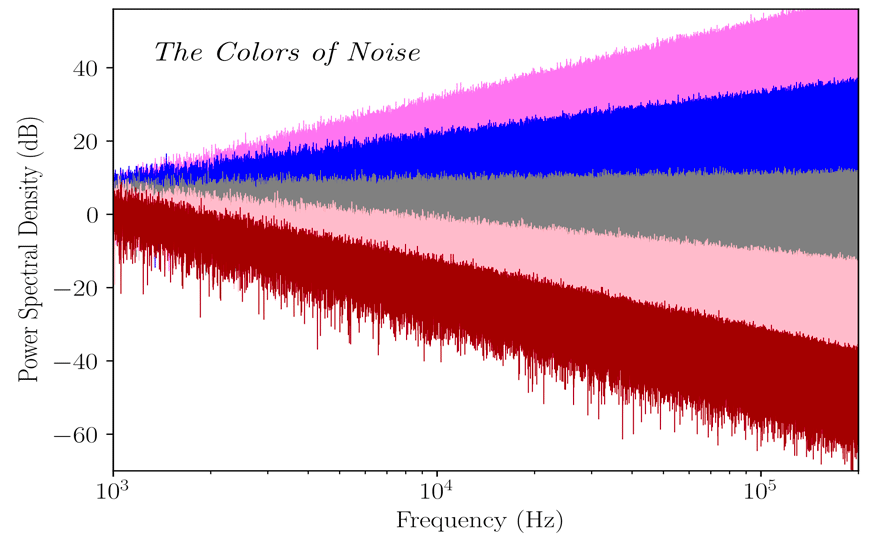
Colours of Noise. Image credit: AkanoToE
Different noise colours have their particular properties.
While we cannot hear or see a noise colour, our ears can hear multiple soundwaves infused in various frequencies.
This is mainly because noise is made up of infinite single-source frequencies.
You cannot measure the frequency amplitude of noise, and hence noise is typically divided into various bands, such as 0-1 kHz, 1-5kHz, 5-10kHz and so on and so forth.
These frequency bands are then measured with a spectral analyzer, and watt measurement is used to calculate the power of noise for each particular band, so as to assign a noise colour.
Can Noise Harm?
Regularly being subjected to excess noise can lead to stress, heightened anxiety, depression, elevated blood pressure, heart-related issues, and various other health concerns.
Certain individuals face an increased likelihood of experiencing hearing impairment, particularly those who encounter loud sounds within their household and community environments.
Hyperacusis for example, refers to a diminished tolerance to sound, where individuals often perceive ordinary noises as excessively loud, and exposure to loud sounds can evoke discomfort and pain.
The primary identified causes of hyperacusis include prolonged exposure to loud noise and the natural aging process.
In situations such as this, noise colour is neither relevant nor applicable since the type of noise inflicted is having a damaging effect.
Where these types of sounds are present in dwellings, buildings or structures, there are soundproofing solutions that can help to lessen or even fully eliminate noise ingress.
Whether it’s the constant hum of traffic outside, chatter or noise reproduced in the office, or machinery and equipment, all of them can have a detrimental effect on hearing and quality of life.
Can Noise Heal?

Certain noise colours can aid restful sleep. Image credit: Unsplash
Where certain noises can cause hearing loss, other types of noise can have healing properties if used effectively.
Certain kinds of noises can offer a relaxing and comforting atmosphere.
Others can help to promote better sleep, alleviate anxiety and stress, and even reduce memory loss.
Using the best type of noise colour under the particular circumstances can help a great deal to ease your mind, improve mood and motivation, and we can thus safely conclude that noise can actually be one of the best types of healing.
Frequently Asked Questions
Do Colours Have Noise?
Different colours have diverse noise properties. The ‘sense of colour’ which comes from different noise signals is very similar to the tone colour or the musical timbre. Each noise is essentially a soundwave, which comprises the type of noise and the frequency. The latter refers to how quickly the waveform vibrates every second.
What Colour Helps Reduce Anxiety?
White noise can be one of the best types of noise to help with anxiety. White noise is commonly described as being a steady droning sound, and this helps a lot to reduce anxiety and treat insomnia too. Pink noise is also helpful.
Can White Noise Help You Sleep?
White noise has a flat spectral density and it can offer several positive benefits. Studies have shown that white noise can help people who suffer from sleeplessness to sleep better. It can also help to block background noise, which is also great to improve sleep.
What Colour Noise Helps Concentration?
Pink noise is considered to be ideal to improve concentration. Since it has the ability to mask various sounds and most unwanted background noise, pink noise helps you to concentrate and focus more.
What Colour Noise is Most Relaxing?
White and pink noise are considered to be ideal to set a relaxing atmosphere, which also helps you to fall asleep more easily and to sleep better too.
Conclusion
The colours of noise are a useful way to categorise different kinds of noise we encounter around us.
They can be used to utilise the varying characteristics of noise effectively in diverse contexts.
Some noises are ideal to drown out distracting noises, create a calming environment, or improve sleep.
In fact noise if fused correctly, is one of the best ways to reduce stress, ease your mind, and improve wellness if used effectively.
Other types of noise however, can harm, so it’s crucial to understand when to take action against nuisance noise by speaking to an acoustical consultant.
Disclaimer
Acoustiblok UK Ltd / Thermablok Aerogel Ltd gives no warranty and accepts no responsibility or liability for the accuracy or the completeness of the information and materials contained in this website, blog or media content. Under no circumstances will Acoustiblok UK Ltd / Thermablok Aerogel Ltd be held responsible or liable in any way for any claims, damages, losses, expenses, costs or liabilities whatsoever (including, without limitation, any direct or indirect damages for loss of profits, business interruption or loss of information) resulting or arising directly or indirectly from your use of or inability to use this website, material, content or any website linked to it, or from your reliance on the information and material on this website, even if Acoustiblok UK Ltd / Thermablok Aerogel Ltd has been advised of the possibility of such damages in advance.