

How to Soundproof a Summer House
It’s not uncommon for some homes to have a summer house in the garden.
This small building is traditionally used to relax and unwind during the warmer months and enjoy the surroundings of the garden.
However, it’s not unusual for summer houses to be used as multipurpose spaces as well.
Since summer houses are a separate structure from the main home, they are ideal for entertaining, storing items, using as a games room or workout space or even a home office, rehearsal space or play area.
Depending on your activities, or simply to make the summer house more private and discreet, you may consider soundproofing it.
Insulating the structure to prevent noise ingress from the outside, or to prevent noise from escaping and disturbing your neighbours is a worthwhile consideration, especially if you plan to use it frequently.
Whatever your reasons, soundproofing a summer house may be seen as a DIY job which is easily achievable using some basic tools and suitable materials, along with a bit of helpful soundproofing knowledge of course!
This is exactly what we uncover in the chapters below.
Table of Contents
Tools Needed

Like any project, the task of soundproofing a summer house will be easier if you have the right tools to hand.
The tools required will depend greatly on the methods which you intend to use.
However, the following are common tools required for this type of project:
- Measuring tape
- Pencil
- Straight Edge
- Level
- Electric Drill
- Nail / Staple Gun
- Electric Screwdriver
- Caulk Gun
- Utility Knife
- Taping Knife
Materials Required
If you have absolutely no experience about soundproofing projects you may wish to consider hiring a professional.
Soundproofing and acoustic treatment are specialist skills and require a lot of technical expertise.
However if you are on a limited budget, you can soundproof your summer house yourself, just as long as you have the time and most appropriate soundproofing materials to hand.
It is not too difficult with a level of competency and this article should give you knowledge, some necessary thought processes, information and guidance to carry out such a DIY project successfully.
The final finish might not be to the highest grade, however considering that this is a summer house, the final aesthetic may not be your primary concern.
In this case, your main aim will be to apply effective soundproofing practices, whilst ensuring structural integrity and, since it is an outdoor structure, protection from all weathers!
The materials required to soundproof a summer house are relatively easy to acquire as well as to work with.
However, do bear in mind that over the counter DIY products will not be able to perform as well as professional grade soundproofing materials.
That said, you will need to factor in the costs involved and your budget.
To do this project you will need the following materials, with some variances depending on the method which you intend to apply when soundproofing your summer house:
Plywood

Plywood helps to add additional mass and density and possible strength to the original structure.
Moreover, thanks to its stiffness, you would be applying the decoupling principle, which is important for effective soundproofing.
Plywood is an incredibly versatile material, so it can be used on the walls, ceiling and floors.
Open Cell Wall Cavity Insulation

This material has a two-fold purpose – it allows for acoustic absorption as well as thermal resistance.
It can be installed into the existing space created by the frame of the summer house.
Hydrophobic versions are generally recommended for better results.
Acoustic Isolation Membrane

Acoustic isolation membrane is the ideal material to line the walls, floors and ceiling.
A high performance material offers the highest level of acoustic insulation and is ideal for such a project.
At just 3mm thick, Acoustiblok’s Sound Insulation Membrane is perfect for this application.
Breathable Membrane
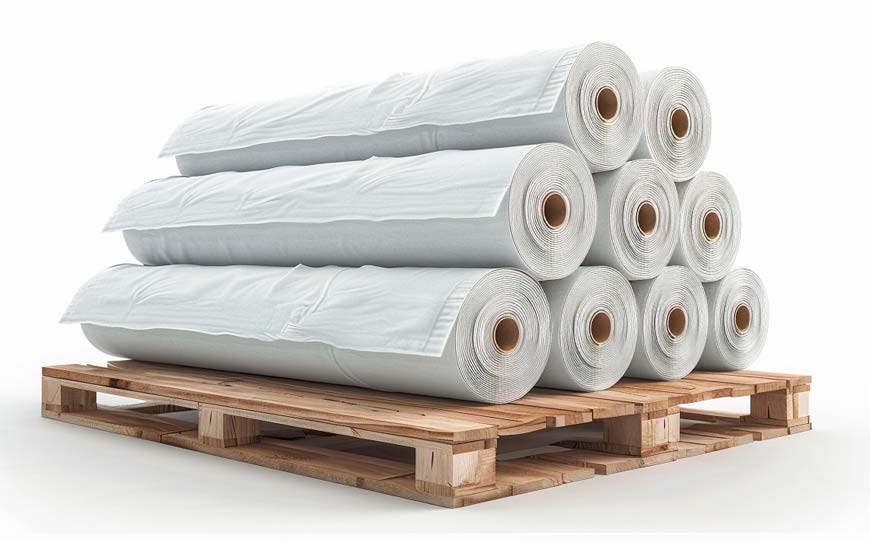
A layer of breathable membrane can be installed independently across the summer house’s frame or within finishing boards.
This material is ideal for helping to control moisture and humidity.
OSB, Plasterboard, Drywall & Particle Board

These are essential construction materials for projects such as this.
By installing OSB, plasterboard, drywall and particle board, you would be adding an essential finishing board whilst putting into practice the principles of density and mass.
They work together to deflect sound which will contribute hugely towards successfully soundproofing the summer house.
You will find various thicknesses and densities to choose from, and there are also varieties that comprise a vapour control layer on the rear of the boards.
Screws, Adhesives, Caulks & Sealants

These are materials that you cannot do without to soundproof your summer house.
You will be using them to fix the Acoustiblok’s Sound Insulation Membrane, drywall and other paneling to the existing frame.
Acoustical sound sealant will not only help to affix items to the summer house structure, but also reduce sound resonance and vibrations.
Acoustical dampening adhesives and acoustical caulk are highly recommended for the same reason.
The latter will help to seal gaps in the summer house, especially along the door and window frames and in case of any small gaps and cracks.
Secondary Glazing
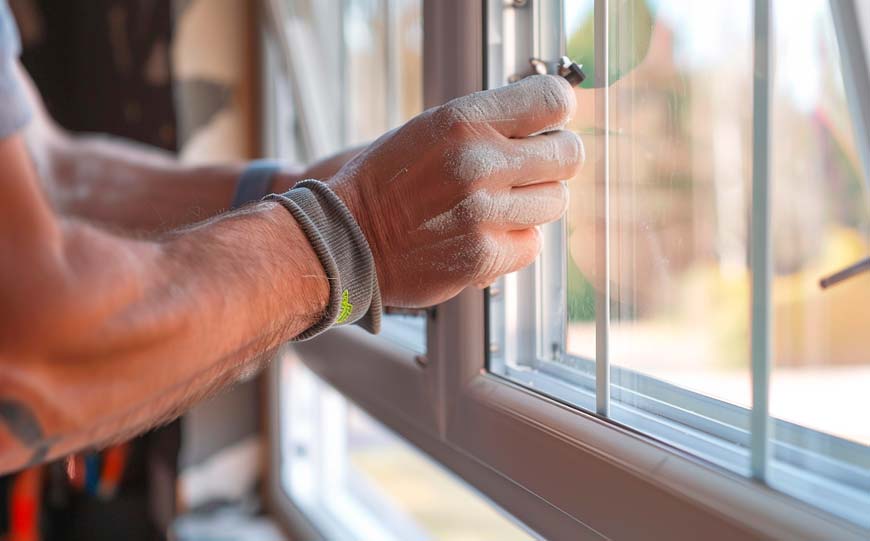
Secondary glazing will add an extra layer to the summer house’s existing glazing, especially if you decide not to replace the existing windows with better performing glazing units.
Soundproofing a Summer House

Soundproofing the Floors
A very common misconception is that one only needs to treat the walls to effectively soundproof a space.
In reality, you will need to deal with the floors, along with the walls, ceilings/roof to improve the effectiveness of soundproofing.
You would also need to give special attention to windows, doors and any gaps or holes that might be present in the structure.
It’s crucial to bear in mind that sound will always find a means of escape and as a result any weak points need to be tackled.
We have said it before and we will say it again, ‘one is only as strong as the weakest point’.
Sound and acoustic energy will find a way through the floor of the summer house, and into the space below.
Sound and vibration may pass through anything connected to the floor in way of flanking transmissions leading to the connecting walls.
Hence, sound will escape through the floor, so it should usually be considered for effective treatment.
Ensure the existing floor structure and subfloor is in good condition.
If required, you can add an additional layer of dense board to the floor to strengthen.
This will help to increase the thickness and density of the base.
A good way to start is to install an Acoustiblok’s Sound Insulation Membrane prior to a floor finish onto the existing floor.
If you are on a limited budget, you could opt for an old carpet underlay or even some thick fabric that can be tacked down to the existing or new sub floor.
This will greatly help to reduce impact noise as well as any vibrations.
The thicker the carpet, the more effective it will be to minimise impact noise.
It would also help with the internal absorption of sound waves, reducing reverberation and therefore soften the internal acoustics leading to a better environment.
If you want to aim for a higher level of acoustic performance, you should invest in a high grade acoustic insulation membrane Acoustiblok’s Sound Insulation Membrane, which can be applied to any surface, including the floors, as well as the walls and ceilings.
This type of material can be applied directly to the floor substrate or subfloor.
If installed in conjunction with an underlay material, the final soundproofing performance will be even better.
Finally, you can lay your preferred choice of floor covering on top.
Considering that the summer house is an exterior building, it’s important to point out that dampness and moisture need to be considered to prevent becoming an issue.
A carpet could easily become damp and an unpleasant musty smell could develop.
Mould and mildew could also become an issue.
If left untreated, this could potentially become a serious health risk – so only fit carpets where you have determined damp will not be an issue.
Instead of a fabric carpet, it may be better to invest in interlocking rubber gym mats.
These are easy to install and will help to dampen the internal acoustics.
Soundproofing the Walls
The walls are of critical importance when it comes to soundproofing projects.
Most summer houses tend to be constructed of a simple wooden frame clad with timber.
As a result, the thickness of the frame offers rigidity and strength as well as a decoupling principle to the structure which is a very useful principle to mitigate passage of sound.
However this frame will also create a cavity which can house an acoustic absorptive membrane.
If left untreated / without cavity batt insulation it will most likely amplify rather than reduce noise.
So, this cavity is an ideal place to install open cell absorptive slab insulation.
This method is ideal to soundproof your summer house as you would have applied a basic principle of acoustic soundproofing, that is, absorption.
However it’s important to ensure that your construction is water tight to prevent water ingress to the absorbent core.
There are various types of insulation materials, thicknesses and densities which you can use as the cavity fill and some of these are also hydrophobic.
A mid density open cell mineral wool material like AcoustiFibre is sensible.
Although all these stages are important, now comes a critical part / process to achieving the highest levels of success in our opinion.
Lining the walls with an advanced high grade acoustic Acoustiblok 3mm Sound Insulation Membrane will increase acoustic mitigation greatly and to higher levels, whilst reducing the thickness of the overall depth of wall and therefore maximise gross internal area.
Usually quite an important factor in such projects.
Achieving higher levels of soundproofing performance may often be seen to increase construction depths.
Acoustiblok 3mm Sound Insulation Membrane can achieve increased acoustic levels and maintain optimum dimensions to the size of the room.
Following this it is also a good idea to consider installing a breather membrane or vapour control layer on the walls.
This material can be attached to the timber frame and taped thoroughly in order to control humidity from moving into the walls.
OSB or a dense board can now be affixed over the top to tie everything together.
This offers a finishing principle and increases the insulation, mass and density, further reducing sound emissions.
A standard application would see these boards being affixed through into the framework to tie everything together.
However where required and especially where defending proposed higher levels of ignition from within, a cross batten, sometimes known as a resilient bar, with acoustic mounts can be secured through into the frame, subsequently providing a platform into which the boards can then be affixed.
By doing this, vibrations through the structure can be further reduced.
Installing two layers of dense finishing boards on a staggered junction is also quite common and desired where possible.
A damping compound / silicone can also be used between them.
Gaps and cracks of all types should be prevented however, where the smallest gaps are in evidence, acoustic silicone and acoustic caulk can help to fill.
Soundproofing the Roof & Ceiling
Often when it comes to sound insulating roofs and ceilings, it is common to follow the same principles used to treat the walls.
Having said that, the final finish might look rather unsightly.
Hence, for the roof structure, it may be better to use osb or plywood due to the fact that it is considerably lighter, structurally stronger and additionally it is better able to hold into place.
Once again it is quite sensible to install a high grade material like an Acoustiblok 3mm Sound Insulation Membrane for better results – it is only as strong as the weakest point and ceilings can be a huge area of leakage and / or sound ingress.
Soundproofing the Windows
Needless to say, windows are responsible for a considerable amount of sound escaping from summer houses, as well as sound making its way in.
The problem is even bigger if the glass and frames are thin or poorly fitted.
In such cases, it is better to consider replacing such windows with new window units that have thicker glass or multiple glazing layers.
In some cases where appropriate one may consider simply removing them from design but this has to be considered carefully.
If you are not on a restricted budget, you may also consider investing in acoustic frames / glass windows which are very effective.
Such windows are made up of two thick sheets of glass, comprising a thinner sheet sandwiched between them.
Alternatively if you do not want to spend much, you could purchase thick plastic sheets from a DIY store however, these are quite obviously not going to perform anywhere near the same levels.
By affixing them to the windows you would be increasing the thickness of the glass while also reducing the sound that makes its way out.
Ideally, use rubber seals around the windows if none are present.
If the current ones are not in a good condition, it’s best to replace them or make sure that they reseal completely.
Another good alternative option is acrylic windows – they offer relatively better sound control than normal glass typically found in most windows.
You may also wish to consider hanging soundproofing blankets or curtains over the windows.
The heavier the drapes, the better the results.
Soundproofing the Doors
Any door inevitably allows for a lot of sound escaping or making its way in.
Chances are that the door of your summer house is full of gaps and does not have any rubber seals or gaskets.
Moreover, if it is not properly fitted or not flush to the surrounding frame, sound will easily escape.
While such gaps might seem insignificantly small, you need to bear in mind that sound easily makes its way through the tiniest gaps.
Therefore, you need to tackle this by making sure that there is proper sealing.
Increasing the depth of the timber bead / door stop can be sensible as this allows an increased surface contact area of door to frame.
Finish this off with rubber seals.
You may wish to consider installing an acoustic membrane to the door or to the door frame.
If there is a key lock, it should also have a cover.
Sealing and Finishing
While a small gap or crack may seem insignificant, it can actually compromise the effectiveness of a soundproofing project.
One cannot over-emphasise enough just how important it is to effectively seal all gaps, both internally and externally.
Even if a small crack or gap is present, sound will pass through it!
Sealing all gaps in your summer house should be a starting point, as well as a final step in your soundproofing project.
So make sure to check for any gaps that may have been overlooked.
As a general rule of thumb, you need to aim for a structure that is essentially airtight.
Check every surface from top to bottom, and examine each space for any possible cracks, holes or gaps.
It is also important to check the spaces around the door and window frames.
If there are any cables or pipes make sure to seal those areas too with acoustic sealant / caulk / acoustic putty pads.
Sealing gaps is best done by applying a professional grade flexible acoustic caulk.
Conclusion
Soundproofing a summer house can be a rather challenging project, especially if it has an old and rather flimsy construction.
Striking the right balance and planning ahead is important.
You should avoid using inferior materials, while also refrain from spending too much as at the end of the day this is an outdoor construction.
While hiring a professional that deals in acoustics may be your first thought, you should also give some thought to doing the project yourself, especially if you have a limited budget.
You should at least seek advice on the most suitable materials and applications to purchase as there are several options on the market.
Preferably opt for specialist soundproofing materials that can allow you to achieve the best possible results.
Disclaimer
Acoustiblok UK Ltd / Thermablok Aerogel Ltd gives no warranty and accepts no responsibility or liability for the accuracy or the completeness of the information and materials contained in this website, blog or media content. Under no circumstances will Acoustiblok UK Ltd / Thermablok Aerogel Ltd be held responsible or liable in any way for any claims, damages, losses, expenses, costs or liabilities whatsoever (including, without limitation, any direct or indirect damages for loss of profits, business interruption or loss of information) resulting or arising directly or indirectly from your use of or inability to use this website, material, content or any website linked to it, or from your reliance on the information and material on this website, even if Acoustiblok UK Ltd / Thermablok Aerogel Ltd has been advised of the possibility of such damages in advance.