

How to Soundproof a Dog Cage or Kennel
Many dog owners would do practically anything for their beloved furry friend.
Let’s face it, dogs are so endearing and lovable, and they become a part of your family.
However, as owners of nervous, anxious or aggressive dogs know full well, you may face the problem of persistent barking which can become a nuisance, especially to neighbours.
Training of the hound is the easiest way to remedy this although can be seen as being quite difficult by many.
One of the ways to reduce the likelihood of barking or loud whimpering becoming a nuisance or problem is to consider soundproofing where your dog cage or kennel is located.
For obvious reasons, you cannot soundproof the dog cage itself since it is essentially an open structure with several gaps through which air can pass.
However there are practical ways you can use a wide variety of soundproofing materials which we shall be discussing in more detail below.
Table of Contents
Why Soundproof a Dog Cage or Kennel?

Stop Barking Noise from Escaping
Constant barking and whining can be very tedious, and neighbours can start to complain.
By soundproofing where the dog cage or kennel is situated, you will be able to reduce or possibly even stop the barking noise from escaping to neighbouring residences, as well as your own home.
Hence, you will be able to benefit from a quieter environment at home too, because even if you love your dog dearly, too much barking can drive anyone crazy eventually.
In the case of dog daycare facilities and veterinary surgeries, soundproofing dog kennels and crates is very important.
The productivity of the business will improve if the sound level of barking from several dogs is reduced.
The volume level produced by several dogs barking can exceed as much as 100 decibels, so it can be very bothersome.
Reduces Stress & Anxiety to Dogs
Besides reducing unwanted nuisance noise, it may not have occurred to you that there are benefits for your dog as well as yourself.
If you soundproof the dog cage or kennel, you will also be creating a more peaceful environment from external noise for the dog itself.
Too much noise is not good for dogs, and even their own barking can end up being too much for them to handle, thereby leading to stress and anxiety.
Physiological responses are common to distress.
Common examples include a suppressed immune system and intestinal issues.
By soundproofing, you will actually help the dog to relax and alleviate their stress as it will not feel overstimulated by constant barking, resulting in less barking as a consequence.
In reality, dogs are sensitive to sound and reducing it can be very beneficial to them.
Prevents Hearing Damage to Dogs
Dogs have a similar auditory system to those of humans, despite the fact that they have a sharper sense and wider audible range.
Consequently dogs can easily experience hearing damage if they are frequently exposed to very loud noise levels.
Hearing damage is thus common if dogs are being exposed to around 90dB for several hours a day.
A prime example is a dog daycare facility, where there are several dogs barking simultaneously.
Even a single dog can reach 100dB when barking, so just imagine the noise levels produced by several dogs all barking at once!
Things to Consider

The following are some points to take into consideration when soundproofing a dog kennel.
The materials that you will be using are critical to ensuring the kennel can be kept clean while also being able to reduce noise levels as much as possible.
Water & Mildew Resistance
The materials should be water resistant to prevent problems relating to mould and mildew.
Easy to Clean
It is crucial that the material is easy to clean.
The materials used should thus be wipeable as you will need to clean and sanitise the kennel or crate on a daily basis to prevent the spread of disease and nasty odours.
Ideally the materials that you opt for should be cleanable using a high pressure hose.
With the mess that dogs create when defecating and with hair shedding, you really need to opt for a material that is both water resistant as well as strong enough to handle jet cleaning.
Durable
Needless to say you will need to take into account the durability of the materials used.
A dog is messy as well as rather demanding if it chews or scratches the material of the kennel.
By way of the fact that the materials are easy to clean and durable it invariably means that they will be highly reflective which can also create a load of new problems – more about this in a moment.
Things to Avoid
Acoustic Foam
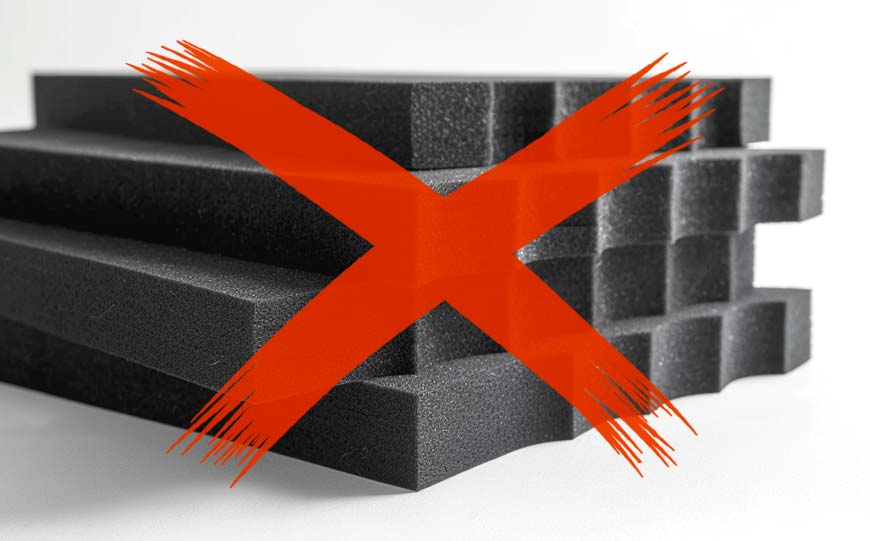
Acoustic foam is not recommended for soundproofing a kennel because it is not dense enough to block the loud sounds of barking effectively.
Acoustic foam is merely a sound absorption material, and so it will only absorb reverberations.
Moreover, the foam can be hazardous if a dog starts to chew on it.
Foam is also absorbent, so will deteriorate and degrade when it gets wet.
Heavy Blankets and Absorbent Materials

Weighted blankets are not such a great idea at all when it comes to soundproofing dog kennels.
While they have more density than acoustic foam, heavy blankets are not going to block sound well enough.
They will also get very smelly, dirty and moldy if used outside exposed to the elements.
Soundproofing a Dog Cage or Kennel
Soundproof the Surrounding Room or Space
 The initial and main points to bear in mind when considering soundproofing dog kennels or dog runs are the importance of acoustic isolation and acoustic calibration.
These principles are very different and both will need to be implemented if effective results are to be achieved.
So what are the basic differences?
In basic terms, Acoustic isolation is the need to prevent the leakage (outward) or even ingress (inward) movement of sound-waves through the structure.
In the case of kennels this usually means a breakout of noise which if allowed, would lead to propagation away from the source.
Acoustic calibration on the other hand is the need to reduce resonance, regeneration, echoes and reverberations within the space as much as possible.
In the case of kennels this usually means controlling the initial source as much as possible, such as the dog’s barking from bouncing around the internal space, leading to amplification and an increased cacophony of noise.
You can never eliminate the noise completely, but you will be able to soften soundwaves to make the area considerably more tolerable, and by doing so, reduce the sound power and pressures of the original source.
When soundwaves hit against hard surfaces such as floors or walls, they will reflect back and bounce around until they ultimately dissipate.
These are called reverberations, and there is a reverberation time until the sound energy eventually fades.
Hence your goal should be to reduce reverberations as much as you can internally.
Easier said than done in such an environment as a kennels, but possible with the use of high end soundproofing materials
To achieve this goal you will need to opt for materials that will reduce some of the soundwaves from reflecting back and forth and instead being diffused, absorbed and in some cases converted.
There are various kinds of sound absorbing principles that you can use.
Whilst constructing a solid flat structure of mass and density will always help toward the practicality of such an environment and also for blocking and reducing breakout, it will also undoubtedly deflect sound back into the room creating the increased resonance that we don’t want.
Adding soft and absorbent materials to the surface of the structure may well add to the absorption of soundwaves, but are not really very practical in the given environment for durability, wear and tear and of course the functionality for cleaning and hygiene.
So what’s the answer?
As for the differing types of mitigation – isolation and calibration, there are differing approaches and solutions with a little bit of cross over.
Of course it is also very dependent on the type of construction and structure one is starting with.
A masonry or block construction will already provide a good level of mass and density.
However, it may be a timber frame which will obviously be nowhere near as good a starting point.
If the latter or incorporating a framing system to the internal face of a masonry wall, this will start to bring into play a principle of decoupling by way of frame, absorption by way of cavity fill, thermal conversion by way of an advanced material Acoustiblok Sound Insulation membrane.
A finishing board of choice, potentially lined to provide the durable, hygienic finish will also be required.
Acoustic Membrane on Interior Walls

It is crucial to choose the right internal materials for the kennel’s walls and ceilings.
Acoustiblok’s own 3mm sound insulation membrane is one of the industry’s leading products.
With a thickness at just 3mm, you will be amazed at the acoustic performance that it offers.
Indeed, it has a sound reduction index rating of 26dBA, which is 6 decibels more than lead of the same thickness.
The soundwaves will be converted into thermal energy which is ideal for outdoor kennels where insulation is needed during colder months.
Thus this acoustic membrane is ideal to reduce sound transmission through a building structure to mitigate ingress or breakout.
By installing acoustic membrane to the walls you will be effectively increasing the levels of acoustic mitigation through the structure quite considerably.
Seal Doors and Windows
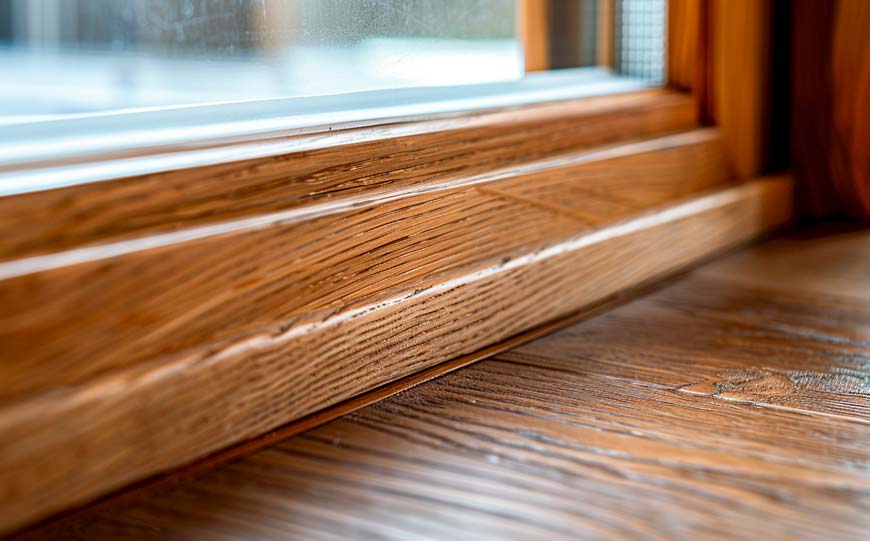
It’s important to seal the doors and windows in the room where the dog crate or kennel is located, because sound manages to escape from even the tiniest of gaps.
Any work is only as strong as its weakest point.
The space around doors and windows thus needs to be tackled well by means of acoustic sealant.
You may also be able to find adjustable door and window seal kits in different sizes to seal the airspace round the doors and windows to reduce sound transmission.
So to recap, that is the structure isolated to give the desired acoustic isolation.
In terms of internal applications, acoustic calibration will reduce resonance and regeneration whilst maintaining practical and suitable surfaces for the environment.
Invariably, very little can be done to soften a floor for obvious reasons although certain tiles and certain suitable resins can offer some reduction of reflection whilst being practical for wear and washing.
In terms of the walls, if any, this can be a similar argument as the above.
However, certain wall finishes such as thicker PVC Wall Liners can offer a reduction of resonance whilst also being practical for wear and washing.
PVC Wall Linings
Wall linings and fascia cladding is a good option providing a durable and hygienic finishing, and offers reduced acoustic reverberation due to the flexible but rigid materials.
Usually based around a modular type design, these flexible lining materials can be cut and adhered to existing finishing board, such as marine ply for example, and then sealed to fit all shapes and sizes on new or refurbishment projects.
AcoustiClouds Acoustic Panels – Metal Perforated
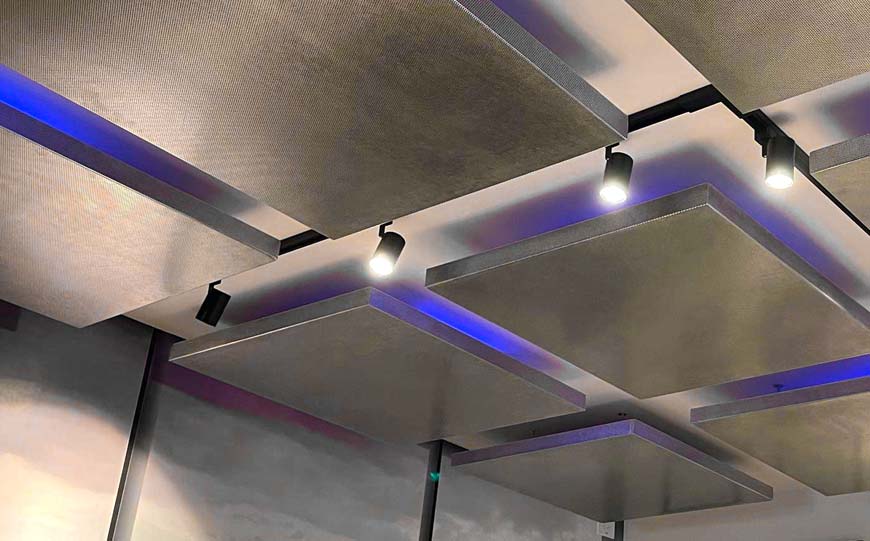
A more industrial and robust system is AcoustiCloud Sound Panels.
They are a high performance, sustainable and versatile solution for reflection build-up and reflection control.
A sound panel that can withstand harsh environments whilst absorbing increased sound and noise reflections.
These are manufactured with a hydrophobic absorption core.
Lightweight but with a heavy gauge, they appear as a perforated aluminium exterior shell (powder coated available), and can be installed horizontally or vertically as desired
Wall or vertical applications are usually applied to the surface with adhesive and mechanical anchor, whilst ceiling or horizontal applications can be installed with Clevis Pins and D Rings.
Acoustic Panels on Interior Ceilings – Fabric
Acoustic ceiling panels are the less industrial type of absorber panels which can be used in ceiling applications usually at increased height.
These are fabric lined where a less harsh appearing solution and environment is required.
They can greatly reduce the sound that escapes from the kennel by means of sound absorption.
They come in a variety of colours and sizes, and have a Class A and Class 0 sound absorption rating.
Moreover, they are easy to install.
Ceiling panels can either be mounted onto the ceiling or suspended on adjustable wire hangers.
When hung vertically, they offer a broad surface area that absorbs and deflects sound effectively.
And the great thing about them being hung from above is your dog cannot reach or damage them unwittingly.
All Weather Acoustic Panels

All Weather Acoustic Panels are ideal to soundproof kennels.
They can withstand the elements, be it direct sunlight, rain and other extreme weather conditions.
These panels are made from materials that are able to achieve very high STC and NRC ratings.
These acoustic panels also incorporate a perforated facia that helps in the diffusion of sound’s energy, and an internal layer of sound isolation membrane which allows for excellent acoustic conversion.
Alternative Acoustic Panels and Tiles
These rigid and impact resistant panels or tiles are made from recycled glass using crumb technology, instead of traditional open cell core to absorb energy.
They are robust and weather resistant enabling them to be used in outdoor spaces or areas that need to be washed, cleaned and hygienically treated.
The panels and tiles can be adhered and mechanically anchored to the surface of a wall or ceiling, acting as an absorber and impact barrier and are ideal for both inside and outside use.
Acoustic Fencing in Garden

It’s important to make sure that the area surrounding the kennel is also treated with soundproofing to reduce noise escaping.
If the kennel is situated in a garden or yard, you can install acoustic fencing to effectively create an acoustic barrier, and limit the noise that makes its way to neighbouring areas and properties.
AcoustiFence Perimeter Barrier Membrane is a high performance soundproofing material that is available in rolls.
Despite being 3mm thick, it has an outstanding sound reduction index rating and is thus ideal for the perimeter of your garden.
Furthermore, since it’s impervious to water and UV tolerant, it’s ideal for outdoor kennel runs and surrounding barriers.
It is also flexible and easy to install onto an existing structure such as a feather edge on post and rail for example, which is structurally sound but lacks acoustic properties due to holes and cracks.
Conclusion
Soundproofing your kennel or the space where your dog’s crate is located has many added benefits.
As well as reducing unwanted noise, the net result could mean a calmer, more relaxed dog, a more cordial homelife and better relations with neighbours.
You may also find you’ve made the space more energy efficient, thus making conditions more comfortable for the dog all year round.
So investing in high quality soundproofing for your kennels really is worthwhile.
Disclaimer
Acoustiblok UK Ltd / Thermablok Aerogel Ltd gives no warranty and accepts no responsibility or liability for the accuracy or the completeness of the information and materials contained in this website, blog or media content. Under no circumstances will Acoustiblok UK Ltd / Thermablok Aerogel Ltd be held responsible or liable in any way for any claims, damages, losses, expenses, costs or liabilities whatsoever (including, without limitation, any direct or indirect damages for loss of profits, business interruption or loss of information) resulting or arising directly or indirectly from your use of or inability to use this website, material, content or any website linked to it, or from your reliance on the information and material on this website, even if Acoustiblok UK Ltd / Thermablok Aerogel Ltd has been advised of the possibility of such damages in advance.