

What is Airborne Sound?
Sound is all around us.
It varies in type and loudness, and is measured in decibels and hertz.
Yet, besides these technicalities, sound is essentially vibrations that are transmitted through a medium, until they reach the human ear or a device that detects sound.
Airborne sound is just one type of noise, which we explain in greater detail below.
Table of Contents
Understanding Airborne Sound

Image credit: Unsplash
Airborne sound, as the name suggests, refers to the sound waves which travel through air and atmosphere to reach the ear.
Airborne sound travels through the air in longitudinal waves.
When a sound is produced it creates a disturbance in the air molecules which move back and forth transmitting the energy from the source to our ears.
Here they are transformed into electrical impulses, which are interpreted by the brain as sound.
The speed of sound in air is approximately 343 metres per second (at room temperature) however this can vary greatly at different altitudes.
Typical sources of airborne sound are traffic noise, crowds of people talking, a dog’s bark, music, or sound from a television or radio, which then travels through the air and into the inner ear.
Airborne Sound vs Structure-borne Sound – What’s the Difference?
The main difference between airborne and structure-borne sound is that in the case of the latter, it refers to the consequence of impact on a structure.
Some examples include a door slamming shut or footsteps on a floor.
Hence the sound waves travel through a solid structure prior to reaching the ear.
At times airborne sound and structure-borne sound can be linked or related to each other.
For instance, airborne sound could have an impact on a part of a building when it travels through the air.
Also, structure-borne sounds, such as footsteps could radiate in the air, thus resulting in airborne sound.
What Causes Airborne Sound to Become a Noise Nuisance?

Image credit: Unsplash
Airborne sound can result in being a noise nuisance if it is able to penetrate a building for example due to any gaps or cracks in walls, around windows and doors, and any crevices, that will allow airborne sound to travel through the air and into the building.
Such weak points should ideally be addressed as soon as possible to prevent continued sound ingress and is also beneficial in minimizing poor thermal values lost via drafts and gaps.
Furthermore, a property exhibiting these issues may not be in compliance with building regulations with regards to noise levels.
So it’s recommended to speak with a specialist acoustic consultant in this regard.
Also remember that any doors and windows which open out onto spaces where there is a lot of source of noise will lead to airborne sound ingress.
The Importance of Sound Insulation
Airborne sound can be problematic between neighbouring households when sounds can travel between party walls where there is inadequate sound insulation or mass.
Another common problem is when a building is situated on a busy road, or within close proximity to a noisy area or building, such as schools, playgrounds or construction sites.
Traffic noise, kids playing and shouting and similar loud noises can easily penetrate poorly insulated buildings which are within close proximity.
Hence airborne noise can prove to be a considerably problematic and unpleasant nuisance over the longer term.
Over time it could also lead to health problems, as routinely having to endure unwanted loud noises is not ideal for one’s wellbeing or mental health.
In fact, there are many preoccupying studies and statistics which demonstrate that noise pollution is a very big problem for many people.
Sometimes one may prefer to leave the windows and curtains closed to try to lower the sound that makes its way into the building.
Consequently, this can lead to poor ventilation, which is also very unhealthy.
How to Reduce Airborne Sound
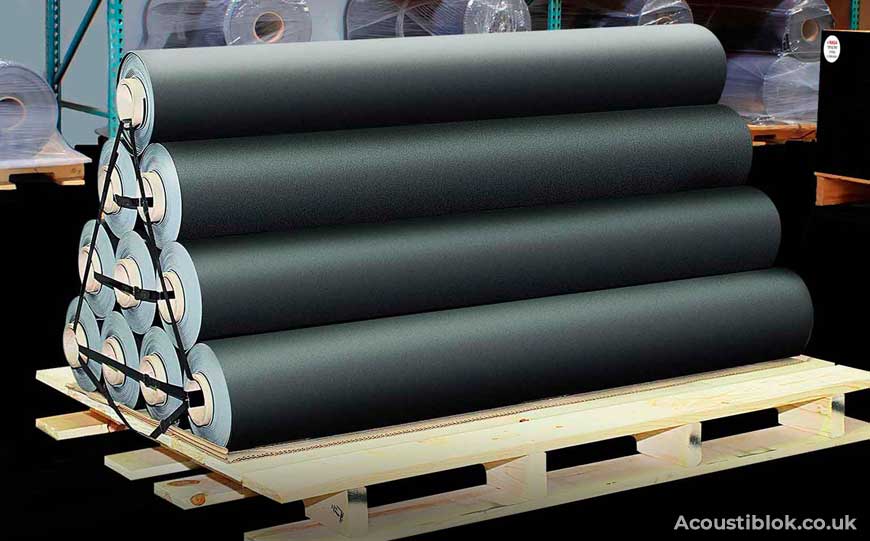
In order to reduce airborne sound, there are numerous factors that need to be considered.
First off, planning in this regard should be done prior to commencing the construction of a building.
This is the ideal way to minimising how much airborne sound waves will make its way into the structure.
Poor workmanship is one of the main reasons for airborne noise.
Weak points such as cracks, holes and gaps in walls or around windows and doors will allow sound waves to travel very easily.
Thus any such issues should be identified and addressed.
Whenever there are issues with noise levels in a building, it’s important to speak to a soundproofing insulation product supplier as they will be able to carry out professional testing and offer advice and possible solutions to reduce the noise.
The type of sound pollution and the sources will need to be identified, so as to evaluate the best possible ways to reduce the unwanted noise ingress.
One of the ways to reduce airborne sound is through acoustic absorption.
This method helps to reduce the amount of sound that is reflected back into the air when it hits a solid surface.
Acoustic treatments can be carried out on party walls, ceilings and floors.
It also seeks to eliminate any gaps which could lead to direct sound transmissions.
Another method that can be used to decrease airborne sound is sound insulation.
This is quite similar to acoustic absorption, but rather than absorbing sound, it focuses on blocking it from travelling to a connected space in a building.
Preventing Airborne Sounds During Construction

During the design and construction phases of a building, it’s of paramount importance to place emphasis on preventing airborne sounds as much as possible.
If the walls, ceilings and floors of a building are built and treated to absorb sounds, airborne sound will be minimised greatly from the very start.
There are various ways through which airborne sound can be reduced, but it is not a single solution that will be suitable for all buildings and structures.
Hence it is recommended that a professional is sought to identify the types of sound, carry out specialised testing, and then proceed to choose the most effective techniques to minimise the emergence and transmission of airborne sound in that particular building.
Having said that, it’s better to address a possible problem such as airborne sound, prior to having it occur, rather than having to deal with and rectify it later.
Thus minimising airborne sound at the design and construction phase is recommended.
Conclusion
While planning a new building, converting or making any improvements or renovations to an existing structure, it’s important to give due importance to sound insulation.
Noise pollution is a very real problem nowadays.
Statistics show that a lot of homeowners suffer from this problem as it can result in a series of health related issues, from difficulty sleeping, to an ongoing disruption or nuisance, that ultimately impacts one’s well being negatively.
Disclaimer
Acoustiblok UK Ltd / Thermablok Aerogel Ltd gives no warranty and accepts no responsibility or liability for the accuracy or the completeness of the information and materials contained in this website, blog or media content. Under no circumstances will Acoustiblok UK Ltd / Thermablok Aerogel Ltd be held responsible or liable in any way for any claims, damages, losses, expenses, costs or liabilities whatsoever (including, without limitation, any direct or indirect damages for loss of profits, business interruption or loss of information) resulting or arising directly or indirectly from your use of or inability to use this website, material, content or any website linked to it, or from your reliance on the information and material on this website, even if Acoustiblok UK Ltd / Thermablok Aerogel Ltd has been advised of the possibility of such damages in advance.