

What is Noise Reduction Coefficient (NRC Ratings)?
Imagine sitting in a busy open-plan office, a concert hall, or even a modern home theatre where sound clarity is paramount.
The design of these spaces is often underpinned by one critical measurement: the Noise Reduction Coefficient (NRC).
In simple terms, the NRC quantifies how effectively a material can absorb sound.
This article aims to provide a comprehensive overview of the Noise Reduction Coefficient – what it is, how it is measured, its history, the factors affecting it, and how it compares to other acoustical metrics.
Whether you’re an architect, interior designer, a design professional, contractor or simply curious about how your favourite spaces manage sound, this guide is for you.
Table of Contents
What is Noise Reduction Coefficient?
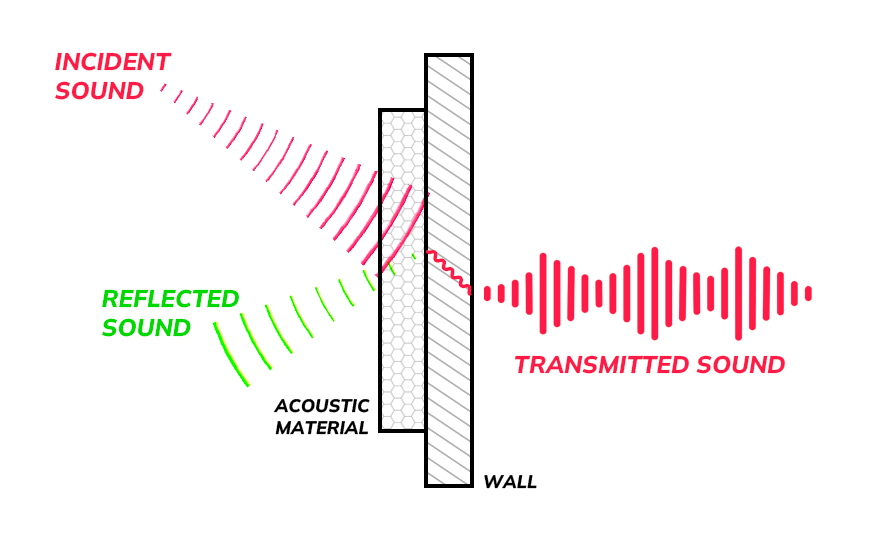
The Noise Reduction Coefficient, commonly abbreviated as NRC, is a single-number rating that indicates the average sound absorption performance of a material.
Typically expressed on a scale from 0 to 1, the NRC value represents the proportion of sound energy that a surface absorbs rather than reflects.
An NRC of 0 means the material reflects all sound, while a value of 1 means it absorbs nearly all the sound that strikes it.
The NRC is calculated by averaging the sound absorption coefficients of a material at four key frequencies:
- 250 Hz
- 500 Hz
- 1000 Hz
- 2000 Hz.
These frequencies are chosen because they fall within the range most critical for human speech and everyday noise.
In essence, the NRC offers a simplified way for architects, acousticians, and engineers to compare the performance of different types of soundproofing materials in terms of their sound absorption capabilities.
What is the NRC Scale?
The term “NCR scale” refers to the measurement scale used to denote the Noise Reduction Coefficient.
This scale typically ranges from 0.0 to 1.0:
- 0.0 – Indicates no sound absorption; the material reflects all sound.
- 1.0 – Denotes near-total sound absorption; the material captures almost all incident sound energy.
While the NRC value gives a useful snapshot of a material’s acoustic performance, it’s important to understand that it is an average measure.
It doesn’t account for the nuances of sound behaviour at frequencies outside the selected range, nor does it detail how a material might perform in real-world conditions where installation methods and environmental factors come into play.
History of Noise Reduction Coefficient (NRC)
The development of the Noise Reduction Coefficient rating has its roots in the mid-20th century when the science of acoustics was becoming increasingly important for architectural design and public health.
Early acoustic research focused on understanding how different materials interacted with sound waves.
As the need for improved sound management in public spaces and industrial environments grew, standardised methods for measuring sound absorption were developed.
Originally, acoustic measurements were complex and required elaborate testing in specially designed reverberation rooms.
Over time, as testing methodologies evolved and became more accessible, the NRC emerged as a practical and simplified metric.
It allowed designers and engineers to compare materials quickly without delving into the intricate details of acoustic frequency response curves.
Today, the NRC is widely recognised in building codes and industry standards.
Its simplicity has made it a favoured tool for those looking to enhance acoustic performance in a variety of settings, from educational establishments and offices, to theatres and recording studios.
How is Noise Reduction Coefficient (NRC) Calculated?
Calculating the Noise Reduction Coefficient involves measuring a material’s sound absorption coefficients at specific frequencies.
Here’s a step-by-step outline of the process:
- Laboratory Testing: The material sample is placed in a reverberation room or an impedance tube – a controlled environment where sound can be precisely measured.
- Frequency Measurements: Sound is directed at the material, and its absorption is measured at four standard frequencies: 250 Hz, 500 Hz, 1000 Hz, and 2000 Hz. As previously referenced, these frequencies are critical as they represent the range most important for human hearing.
- Averaging the Results: The individual absorption coefficients at these frequencies are averaged to give a single NRC value. For example, if a material has absorption coefficients of 0.70, 0.75, 0.80, and 0.85 at the four frequencies, its NRC would be the average of these values.
It is worth noting that while the NRC provides a convenient and widely accepted metric, it does have limitations.
It does not reflect how the material performs at frequencies below 250 Hz or above 2000 Hz, nor does it consider the directional properties of sound in a real-world setting.
Nevertheless, for most practical purposes, the NRC offers a reliable guide for material selection in acoustic design.
Factors that Affect Noise Reduction Coefficient (NRC)

Several factors can influence the measured NRC of a material.
Understanding these factors is essential for both accurate testing and optimal material selection in practical applications.
Mounting & Installation
How a material is mounted or installed can have a significant impact on its sound absorption properties.
Materials are often tested in ideal, laboratory conditions where they are flat and unimpeded.
However, in real-world applications, the mounting technique can alter a material’s performance. For example:
- Flush Mounting: When a material is applied directly against a wall or ceiling, there is little to no air gap, which might limit low-frequency absorption.
- Suspended or Air-Gap Mounting: Introducing a small gap between the material and the supporting surface can enhance absorption, particularly at lower frequencies, by allowing the material to vibrate and dissipate sound energy more effectively. This can also increase the levels of absorbency achieved as the surface area of the rear of each panel is brought into play (rear effect).
Sample Size
The size of the sample used in testing can also affect the measured NRC.
Standardised tests typically use samples of a specific size to ensure consistency and comparability.
However, in practice, the acoustic performance of a material can vary with the size of the installation.
Smaller samples might exhibit edge effects that can either boost or diminish the overall absorption, while larger installations might behave differently due to the cumulative impact of these effects.
Thickness
Thickness is one of the most critical factors influencing a material’s NRC rating.
In general, thicker materials tend to absorb more sound, especially at lower frequencies.
This is because a greater thickness allows for a longer path through which sound energy can be dissipated.
Conversely, thinner materials might be effective at higher frequencies but perform less well at absorbing bass or lower frequency sounds.
Designers must consider the trade-off between thickness, weight, and installation requirements when selecting materials for acoustic applications.
Acoustiblok Absorber Panels for wall mounting or Acoustiblok AcoustiCloud Panels for ceiling mounting are available in all shapes and sizes but typically available in two differing thicknesses of either 25mm or 40mm.
What’s Considered a Good NRC Rating?

In the context of the NRC scale, a higher value indicates better sound absorption.
Materials with NRC ratings above 0.70 are generally considered effective for most acoustic applications. For instance:
- Moderate Performance: An NRC of around 0.5 to 0.6 might be acceptable in environments where complete sound control is not critical, such as in some commercial or residential spaces.
- High Performance: An NRC rating of 0.8 or higher is typically sought after for spaces that demand high levels of sound absorption, such as recording studios, theatres, and conference rooms.
Acoustiblok QuietFibre for example, displays the highest levels of NRC ratings which means there are no or minimal reflections.
It is important to remember that what constitutes a “good” NRC rating can vary depending on the specific acoustic needs of a space.
A material with an NRC of 0.7 might be perfect for one application, while another scenario might demand a material with an NRC closer to 0.9.
Is a High NRC Rating Better?
At first glance, a higher NRC might seem inherently better, but the answer isn’t always straightforward.
While a high NRC indicates superior sound absorption, several other factors must be taken into account:
- Design Requirements: In some spaces, complete absorption might not be the desired outcome. For example, certain rooms may require a balance between absorption and reflection to maintain a lively acoustic environment.
- Cost and Practicality: Materials with very high NRC ratings may be more expensive. The cost-benefit ratio should be carefully evaluated taking into account absorbency / effect over the available tolerances / depths of solutions that can be tolerated.
- Additional Properties: Acoustic performance is just one aspect of a material’s suitability. Factors such as fire resistance, durability, aesthetics, and ease of maintenance also play a crucial role in material selection.
In summary, while a high NRC rating is generally desirable for maximizing sound absorption, it is not the only consideration when designing an acoustically treated space.
Typical Applications

Image credit: Solid State Logic
The Noise Reduction Coefficient is an essential metric in a wide range of applications.
Here are some common scenarios where NRC is particularly important:
- Recording Studios and Theatres: High NRC-rated materials are used to control reverberations in studio soundproofing to ensure clear, high-quality sound.
- Offices and Conference Rooms: In open-plan offices and meeting rooms, materials with appropriate NRC ratings help reduce background noise and improve speech intelligibility.
- Educational Institutions: Classrooms and lecture halls benefit from acoustic treatments that prevent sound from becoming overwhelming, thus enhancing learning.
- Restaurants and Public Spaces: Ensuring a comfortable acoustic environment in busy restaurants or public areas can improve the overall experience for visitors.
- Industrial and Commercial Environments: In spaces where noise control is critical for safety and productivity, materials with effective NRC ratings are essential for industrial soundproofing.
By selecting materials with the appropriate NRC rating for each application, designers and engineers can create environments that are both functional and acoustically pleasing.
NRC vs SAA: What’s the Difference?
At times, you may encounter the term Sound Absorption Average (SAA) alongside NRC.
While both metrics aim to provide a single-number representation of a material’s sound absorption capabilities, there are subtle differences between them.
Measurement Methodology
The SAA is often derived from a broader range of frequency measurements or alternative averaging methods.
While NRC is based on four standard frequencies, SAA might include additional frequency bands, offering a slightly different perspective on a material’s performance.
Application Context
Different regions or industries may prefer one metric over the other based on historical practices or specific regulatory requirements.
Despite these differences, both NRC and SAA serve as useful guides for comparing acoustic materials.
NRC vs STC: What’s the Difference?
It’s important not to confuse NRC with Sound Transmission Class (STC), as they measure entirely different aspects of acoustical performance:
Noise Reduction Coefficient (NRC) focuses on how much sound a material absorbs within a space.
It provides a single-number rating that reflects the material’s ability to reduce sound reflections and reverberations.
Sound Transmission Class (STC) on the other hand, measures how well a building partition, wall, or barrier blocks the transmission of sound from one room to another.
This is where the super thin, advanced and unique Acoustiblok 3mm Isolation Membrane or Acoustiblok 6mm Isolation Membrane materials would be the choice to easily incorporate into a stud wall, ceiling or floor for example to mitigate sound leakage or ingress whilst saving space and without the need to redesign the entire buildup /project.
STC values are particularly relevant in evaluating the effectiveness of walls, floors, and ceilings in preventing sound leakage.
Acoustiblok Isolation Membranes have staggering STC level.
While both NRC and STC are vital for acoustic design, they serve different purposes.
An ideal acoustic design might require a careful balance between materials with high NRC ratings to manage internal sound quality and high STC ratings to control sound transmission between spaces.
Conclusion
The Noise Reduction Coefficient (NRC) is a fundamental metric in the field of acoustics, serving as a key indicator of a material’s sound absorption capabilities.
From its straightforward 0 to 1 scale to its critical role in shaping environments – from recording studios to modern open-plan offices – the NRC helps designers and engineers create spaces that are both comfortable and functional.
Understanding the factors that influence the NRC, such as mounting type, sample size, and thickness, is essential for making informed choices about acoustic treatments.
Moreover, recognising the differences between NRC, SAA, and STC ensures that the right material is chosen for the specific acoustic needs of any project.
By grasping these concepts, you can better appreciate how sound is managed in the built environment and make smarter decisions when it comes to designing spaces that cater to both form and function.
Whether you are a seasoned professional or a curious newcomer to the field of acoustics, the Noise Reduction Coefficient offers a window into the science of sound absorption – one that can make a significant difference in how we experience our everyday environments.
For further guidance and advice about NCR, contact a reputable soundproofing professional for help.
Disclaimer
Acoustiblok UK Ltd / Thermablok Aerogel Ltd gives no warranty and accepts no responsibility or liability for the accuracy or the completeness of the information and materials contained in this website, blog or media content. Under no circumstances will Acoustiblok UK Ltd / Thermablok Aerogel Ltd be held responsible or liable in any way for any claims, damages, losses, expenses, costs or liabilities whatsoever (including, without limitation, any direct or indirect damages for loss of profits, business interruption or loss of information) resulting or arising directly or indirectly from your use of or inability to use this website, material, content or any website linked to it, or from your reliance on the information and material on this website, even if Acoustiblok UK Ltd / Thermablok Aerogel Ltd has been advised of the possibility of such damages in advance.