

What is Decoupling in Construction?
In construction, decoupling refers to the process of physically separating structural components such as walls, ceilings and floors to break the path that sound vibrations use to travel through a building’s structure.
By introducing separation between materials, you dramatically reduce the amount of noise that can pass from and through one material to another and one side of construction to the other.
These are commonly recognised as flanking transmissions.
In simple terms, decoupling is about creating a line break or barrier that stops vibrations in their tracks.
It’s one of the most effective methods for soundproofing framed cavity walls, especially in modern buildings using timber or aluminium stud construction.
Table of Contents
How Does Decoupling Work?
Sound travels through materials in two ways:
- airborne noise: through the air to the point it strikes a solid material
- structure-borne or impact noise: by vibrating solid surfaces
In framed wall cavities, particularly in timber stud or metal stud walls, vibrations can pass directly from one side of the wall to the other.
If the plasterboard or sheathing is fixed to a shared stud frame, this is especially true.
Where plasterboard is attached to masonry in way of a principle called ‘dot and dab’ it is highly likely vibration and resonance of the board will travel into the structure.
This is where decoupling can help.
When you decouple a wall, you effectively interrupt this direct connection.
Think of it like cutting a plank in half and inserting a sponge between each piece.
Vibrations can’t move through the sponge as easily, and that’s what decoupling does, just on a larger scale.
By isolating surfaces and adding damping and absorption layers (like mineral wool in a cavity where space permits or acoustic membranes typically Acoustiblok 3mm Isolation), the system dissipates vibrational energy before it can radiate as sound on the other side.
How to Decouple a Wall

There are several effective ways to decouple a framed cavity wall to reduce sound transmission.
These techniques are particularly valuable in home theatres, recording studios, bedrooms, flats and apartments, or offices.
Basically, anywhere privacy and acoustical comfort are required.
Build a Double Studded Wall
One of the most effective decoupling methods is to construct two separate stud frames; one for either side of the wall, with a gap between.
This creates a completely broken path for vibration.
Each frame supports its own layer of plasterboard, and because the frames don’t touch, sound struggles to pass through.
To further enhance performance, the cavity should be filled with dense mineral wool, such as Acoustiblok QuietFibre, which absorbs airborne sound energy and reduces echo within the space.
Fitting Resilient Channels

Resilient channels are thin metal strips that attach horizontally across studs.
Plasterboard is then screwed into the channel rather than directly into the stud.
This floating effect adds flexibility and weakens the vibration pathway.
Although cost-effective, performance can drop if not installed carefully.
For greater performance and reliability, combine resilient channels with Acoustiblok’s 3mm Sound Insulation Membrane, which adds substantial acoustic mitigation via thermal conversion in only 3mm additional depth behind the plasterboard.
Fitting Isolation / Acoustic Sound Clips

Sound isolation clips take things to another level.
These rubberised mounts fix to the stud wall and hold metal furring channels onto which plasterboard is hung / installed.
This system offers superior decoupling because the rubber absorbs and dampens vibrations to greatly reduce flanking transmissions through solid construction.
Isolation clips are ideal in both domestic and commercial settings and pair exceptionally well with Acoustiblok QuietFibre mineral wool and Acoustiblok’s 3mm Sound Insulation Membrane to increase overall sound absorption and acoustic isolation within the wall.
Add Mineral Wool for Absorption
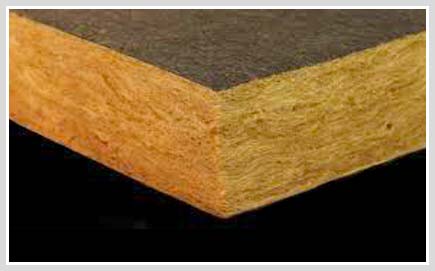
Regardless of your decoupling method, soundproofing performance is always improved by filling the cavity with dense, fibrous insulation.
Not all mineral wool is created equal and there are differing densities achieving differing levels of absorption and noise reduction coefficiencies.
Acoustiblok QuietFibre’s high-density mineral wool greatly increases the acoustic absorption and reduces the inevitable resonance that would occur within an open / hollow cavity.
Add Specialist Sound Insulation Membrane
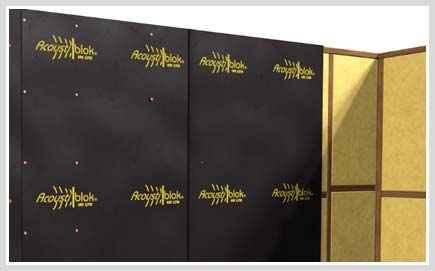
Even with a decoupled wall made up of mass and dense board and cavity insulation for absorption, vibrations can still find their way through the rigidity of its own construction in way of flanking transmissions.
This is where Acoustiblok 3mm Sound Insulation Membrane comes into its own as a unique visco elastic converter of acoustic energy.
With this NASA inspired, unique, advanced and flexible material installed behind plasterboard, it will significantly increase levels of isolation via thermal conversion.
This is the process of converting a problematic acoustic energy into a less problematic heat energy via friction and molecular movement.
While not a decoupling solution in itself, damping significantly enhances sound reduction by breaking down energy that would otherwise resonate through the wall.
Super effective across frequencies, safe, non toxic and recyclable, it increases the acoustic values greatly whilst reducing the overall depths of the construction to save space and maximise all important gross internal areas within.
For maximum results, installation across entire wall, floor or ceiling buildups / designs will create high-performance, decoupled and super thin assemblies.
Additionally, accessories like Acoustiblok AcoustiGrip Tape can be used to seal joints and reduce vibration transmission across seams.
Similarly, using Acoustiblok Acoustical Sound Sealant around wall perimeters and gaps ensures a continuous and integral system.
How to Tackle Resonance
While decoupling interrupts vibration paths, resonance can still occur inside cavities, especially if air gaps remain unfilled.
Resonance is like the humming you hear when you blow across the top of a bottle.
Within a wall cavity, those low-frequency booms can make even well-insulated rooms feel noisy.
To prevent this, always ensure cavities are packed with dense acoustic insulation like Acoustiblok QuietFibre.
This traps airborne energy and eliminates the hollow, drum-like effect that contributes to mid and low-frequency resonance.
Additionally, accessories like Acoustiblok AcoustiGrip Tape can be used to seal joints and reduce vibration transmission across seams.
Similarly, using Acoustiblok Acoustical Sound Sealant around wall perimeters and gaps ensures a continuous sound barrier with no flanking paths.
Hints and Tips
- Always decouple before adding insulation or plasterboard – decoupling is a structural decision, not an afterthought.
- Ensure resilient channels or clips are not short-circuited by screws that reach the studs behind them.
- Fill every cavity fully with dense mineral wool to eliminate resonance and air gaps.
- Add increased mass where possible – double layers of plasterboard with staggered junctioning can be highly effective to double up mass / deflection and mitigate weakness at junctions.
- Always add Acoustiblok 3mm Sound Insulation Membrane into any buildup to greatly increase performance without the associated increase in buildup depth.
- Seal every edge and joint with acoustic sealant to prevent airborne leaks that compromise soundproofing performance.
Key Takeaways
Decoupling in construction means separating layers in a structure to stop vibrations from travelling directly between them.
It’s one of the most powerful ways to reduce sound transfer in framed cavity walls.
Techniques like double stud walls, resilient channels, and isolation clips help break the vibration path.
For best performance, combine principles of ‘decoupling’ with the usual principles of ‘deflection’ (mass and density), ‘absorption’ (mineral wool insulation) and critically the unique ‘thermal conversion’ (Acoustiblok 3mm Sound Insulation Membrane).
Additional accessories such as acoustic sealants and tapes are also essential.
Acoustiblok UK offers a professional range of products specifically designed to maximise sound isolation in decoupled walls.
Speak to us today for further guidance and help on choosing the right products and applications to decouple your walls.
Disclaimer
Acoustiblok UK Ltd / Thermablok Aerogel Ltd gives no warranty and accepts no responsibility or liability for the accuracy or the completeness of the information and materials contained in this website, blog or media content. Under no circumstances will Acoustiblok UK Ltd / Thermablok Aerogel Ltd be held responsible or liable in any way for any claims, damages, losses, expenses, costs or liabilities whatsoever (including, without limitation, any direct or indirect damages for loss of profits, business interruption or loss of information) resulting or arising directly or indirectly from your use of or inability to use this website, material, content or any website linked to it, or from your reliance on the information and material on this website, even if Acoustiblok UK Ltd / Thermablok Aerogel Ltd has been advised of the possibility of such damages in advance.