
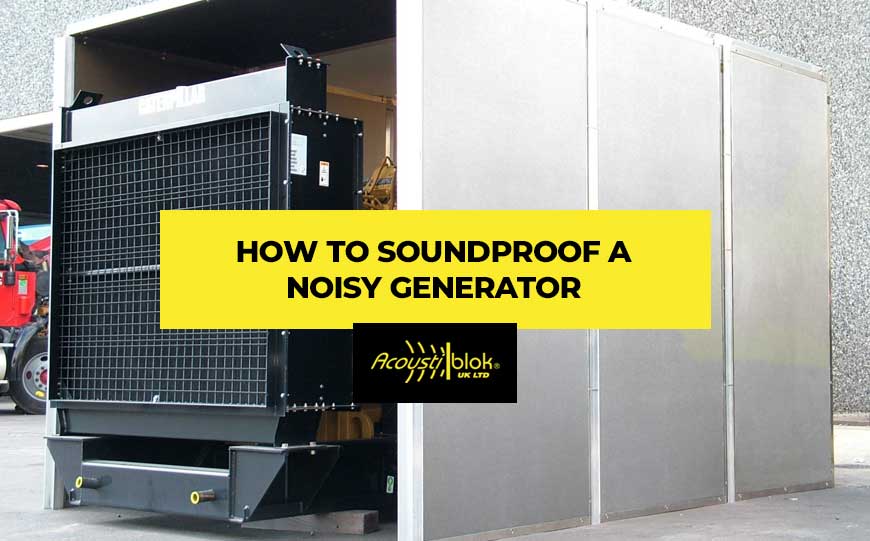
How to Soundproof a Noisy Generator
In a number of scenarios, generators can be a life saver.
If you live or work in an area where power outages are frequent, they are invaluable. If you enjoy the great outdoors, they are a great way to get quick, easy power whilst camping or travelling.
Or if you need a portable source of power for a variety of means, they are by far the best option.
Generators do however come with a rather annoying problem – noise!
All generators produce a vigorous buzzing or mechanical noise which can be prominent and a nuisance.
The noise they produce can reach high decibel levels and travel a fair distance, leading to complaints from nearby neighbours or adjacent buildings.
So to help tackle the noise generators create, here’s a number of ways which can greatly reduce or even eliminate the noise produced.
Table of Contents
Why Are Generators Noisy?
Before going into the detail about how to reduce generator noise, it is important to understand the problem you are addressing.
What makes a generator so noisy?
First of all, the generator technology plays a central role in this.
Some generators use inverter technology whereas others do not.
Inverter generators tend to be a bit quieter than those which do not use such technology.
There are also some generators which have a noise-reducing shell which makes them substantially less noisy than others.
Modern generators make use of advanced electronics as well as specialised magnets with the main intention to supply a steady stream of power, without being as noisy as older models of generators.
There are also some later designs which incorporate mufflers and other noise reducing features which are built into their design.
Having said that, you will not manage to find large conventional generators that place as much importance on such designs and noise reducing features, as the main importance is placed on high power output in these cases.
So in a nutshell, the more powerful a generator is, the more noisy it is going to be.
Reposition the Generator
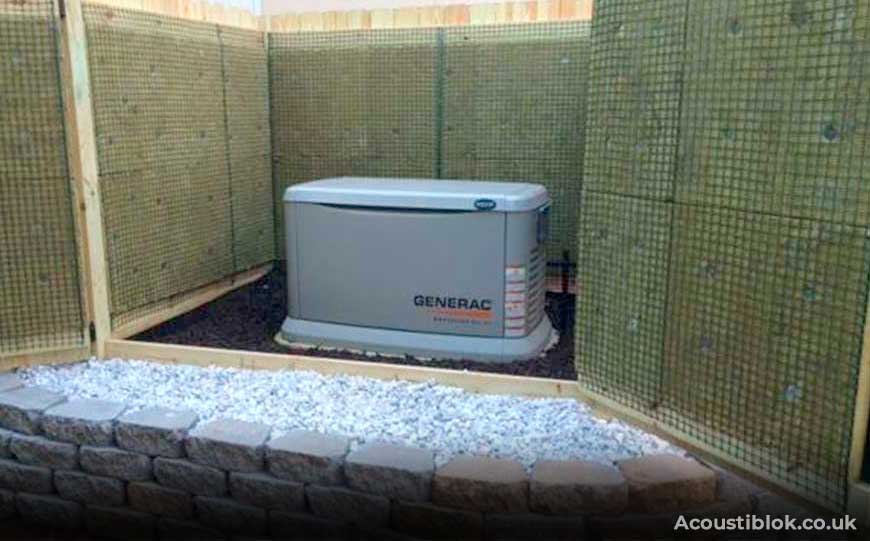
The place where a generator is positioned is going to have a considerable impact on the noise one will end up hearing.
Obviously, the further away you position your generator, the less noise you are going to hear from it.
So you need to carefully consider where you should place your generator.
It needs to be a practical spot, which does not inconvenience neighbours in a bid to be far away from you.
Do bear in mind that when placing a generator between two adjacent houses or next to any type of wall, the chances are the sound generated will in fact worsen.
It also needs to be a place where there is sufficient electrical cable from the generator to where the power it supplies is required.
Another point worth mentioning is that the generator should be placed on a firm and stable surface.
If the surface area is uneven, then the noise is going to be even more substantial as more vibrations will occur, which will in turn amplify the noise from the generator.
Reposition the Exhaust Pipes
It is a good idea to consider repositioning the exhaust pipes.
Most standard generators will have horizontal exhaust pipes.
However, if these were changed to a vertical position, the noise generated from them will be significantly reduced.
This is because rather than being directed to the surrounding area, the sound waves will be directed up into the air.
Otherwise, make sure that at least you point the exhaust pipes away from the house, nearby building, or campsite.
Upgrade the Exhaust Muffler
The generator’s motor generates most of the noise.
Most of this noise is expelled through the exhaust.
So you can greatly reduce this noise by upgrading the exhaust muffler of your generator.
Reduce Vibrations

In order to reduce the noise that is coming from a generator, it is very important to tackle the vibrations, which contributes greatly to nuisance noise.
As already mentioned, it is important to place the generator on a firm and stable surface because if there is any play, this will produce a greater amount of vibrational soundwaves.
Hard surfaces such as concrete will end up strengthening the reverberation, and this will increase noise.
If possible, you should place your generator on soft ground, such as grass or dirt.
Alternatively you could place a rubber mat underneath to soften or muffle the sound.
Sound deadening materials can also reduce vibrations, so you may wish to consider installing such a product so as to reduce the generator box vibrations.
Install a Sound Deflector
A very good way to reduce noise is to install a sound deflector.
A sound deflector will work by diverting sound waves in another direction.
So rather than allowing the noise to reach you, the sound waves will be deflected or diverted away from you.
You can make use of various materials to act as a sound deflector.
This could be anything from some barriers or specific products that are made with the intention to deflect sound.
You may wish to seek professional advice from a soundproofing consultant to advise you on the most suitable sound deflector for your generator.
Build a Soundproof Baffle Box

When it comes to tackling a noisy generator, the chances are that most builders or property managers will resort to a fence, louvered walls, or a line of bushes.
However in reality, none of these measures work effectively in reducing noise levels.
A great way to reduce noise from generators is to build a soundproof baffle box to act as an enclosure around the generator.
Naturally, the goal is to have the noise coming out from the generator remain trapped within the outer box surrounding it, rather than escaping into the environment where it would end up bothering you or your neighbours.
Building such a box is not that challenging either.
The key is to make sure you use suitable materials that will make the box more effective.
Soundproofing materials are ideal for this project and will make the end result more effective.
Acoustiblok’s 3mm sound insulation membrane is one such material which is extensively used to combat high levels of noise from industrial-sized generators and plant rooms.
It is perfect for making a sound isolation box for your generator.
The material is easily cut with a box knife, and can be fitted to a rigid structure such as a baffle box.
Do bear in mind that generators produce a lot of heat.
So you will need to take into account the need for proper airflow if you build a baffle box.
Allow for sufficient height and width, so as not to allow too much heat to be built up around the generator as it could damage it or even overheat.
You may also wish to add extra insulation.
An alternative to building a baffle box lined with Acoustiblok sound insulation membrane is to position Acoustiblok’s All Weather Sound Panels.
This comprises several layers of very different types of materials to give the best of both worlds, with filtering materials, absorption materials and blocking materials in terms of attenuating noise.
The panels are only 50mm thick and can be shaped into a square or rectangle around the generator, again taking into account the generator’s airflow.
Conclusion
By using one or more of the above methods, you can greatly reduce the noise that your generator creates, reducing the inconvenience both for you as well as for anyone close by.
Disclaimer
Acoustiblok UK Ltd / Thermablok Aerogel Ltd gives no warranty and accepts no responsibility or liability for the accuracy or the completeness of the information and materials contained in this website, blog or media content. Under no circumstances will Acoustiblok UK Ltd / Thermablok Aerogel Ltd be held responsible or liable in any way for any claims, damages, losses, expenses, costs or liabilities whatsoever (including, without limitation, any direct or indirect damages for loss of profits, business interruption or loss of information) resulting or arising directly or indirectly from your use of or inability to use this website, material, content or any website linked to it, or from your reliance on the information and material on this website, even if Acoustiblok UK Ltd / Thermablok Aerogel Ltd has been advised of the possibility of such damages in advance.