How to Soundproof a Party Wall
Party walls are very prone to noise transmission.
Such walls are generally not as thick or as solidly constructed as structural load-bearing walls.
In most cases, party walls are often used to offer a basic separation of dwelling, typically found in terraced, semi-detached homes and flats.
As a result, noise transference can be a common issue.
For this reason, it’s a good idea to explore various soundproofing materials to discover the best ways to reduce noise ingress coming through a party wall.
In the following chapters, we set out how to soundproof a party wall effectively to reduce as much noise transference as possible.
Table of Contents
Identify Weak Points
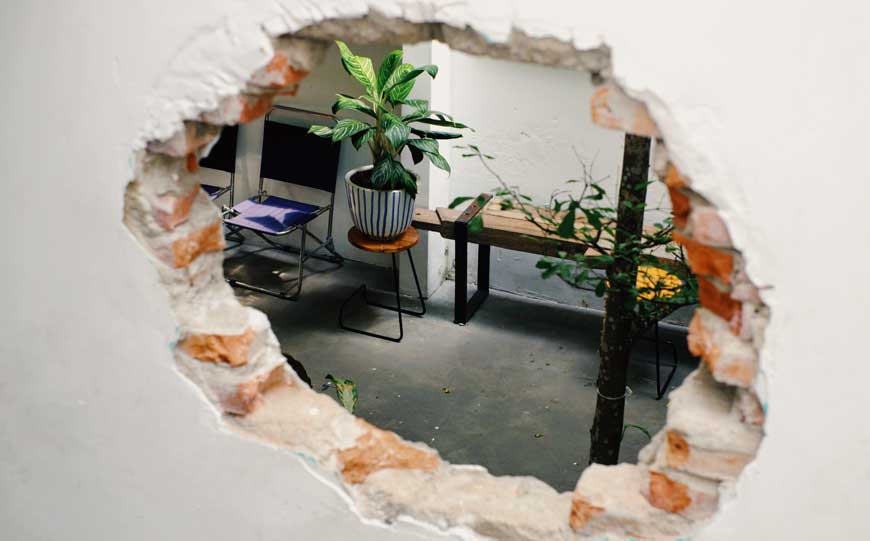
Image credit: Unsplash
Before opting for any kind of soundproofing strategy, it’s important to identify the party wall’s weak points in order to be better able to address noise transference as effectively as possible.
Sound will pass easily where there’s minimal resistance.
Hence your approach needs to address such weak points where sound transmission occurs most.
For example, this may be at the position of an alcove either side of a fire place or chimney breast.
Even the tiniest gaps or cracks can make a big difference when it comes to sound transmission, as well as flanking noises.
Types of Noise

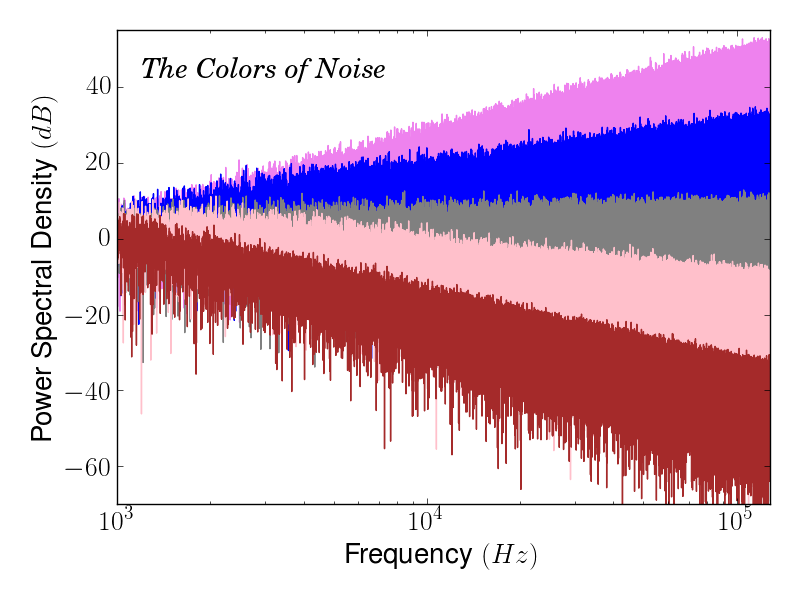
Image source: Wikipedia
Sound travels through materials where resistance is not present.
Hence, when two properties are connected via a wall, it’s easy for noise to transfer from one side to the other through the building’s own structure.
In order to reduce noise effectively, you will need to consider the type of noise that you’re dealing with.
Also consider how sound is likely to travel from the point of source to wherever it is being heard.
You will also need to take into account the fact that there’s a distinct difference between soundproofing and sound absorption.
Therefore, what you choose in way of a mitigation strategy will be affected by the type of noise that you wish to reduce.
Airborne
Airborne noise is the term used to describe sounds which are transmitted through air.
So this could include any of your neighbour’s conversations, music or an overly loud television for example.
Sound waves propagate through the air, eventually colliding with a surface.
Whenever the sound waves collide with a surface, vibrations occur resulting in both airborne as well as structural noise.
This can lead to vibrations passing through a structure of a wall.
For example, into the space beyond that wall, such as into a neighbouring dwelling, which is commonly known as flanking transmission.
Structural
Structural or structure-borne sound is the noise that occurs as a result of some form of impact of a soundwave onto a surface such as a building’s fabric.
It also includes any vibrations that result from such an impact.
The sound gets radiated from a surface, leading to vibrations.
The vibrations will be transferred through the structures, such as through the floors or ceilings, and be heard from another part of the property due to flanking transmission.
Impact
Impact noise is very similar to structural noise.
However, rather than noise being transferred through the structure, it refers to the sound that results when two objects impact one another such as footfall.
Subsequently, transmission to the other surface occurs.
Understanding Party Wall Structures
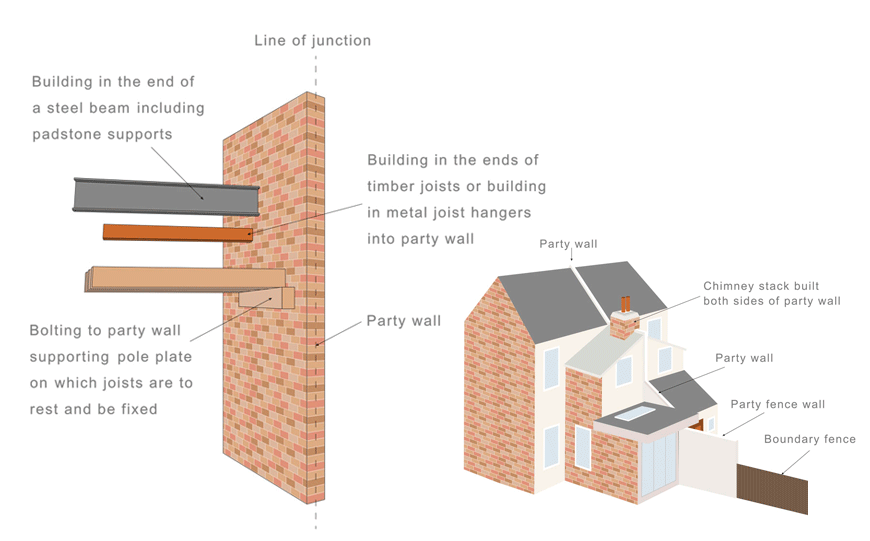
Image credit: Home Approved
Party walls are often used in residential as well as commercial settings, such as terraced homes, flats and apartment units, and retail outlets in shopping malls.
Its main purpose is essentially a partition dividing two adjoining dwellings or spaces to create a separation as well as a fire break or firewall.
Hence the party wall will be shared with a neighbouring property or room.
Whilst a party wall is considered structurally sound, its soundproofing properties can typically be poor, so it will not stop sound from passing through.
This is because soundwaves move through the rigidity of the wall itself, causing vibrations and sound transmission.
This is even more the case in older properties where building standards differed from levels that apply to more modern, present day builds.
Although in some cases older walls may be thicker than modern designs.
Equally it may be found that other walls may not be as thick and the older they are the more unlikely to have any noise reduction materials in place.
That said, even building standards and compliance levels of today with modern building methods do not necessarily provide any guarantee.
A common issue to cause increased noise transfer is via structural changes within a building.
As an example, where walls or chimneys have been removed and supported by steel supports, commonly known as RSJ’s, to create an open plan design or increased space.
Soundproofing a Party Wall

When it comes to soundproofing a party wall, it’s important to be realistic.
While there are options to soundproof a party wall to a reasonable degree, none of them are likely to stop sounds completely.
The following are some ways to soundproof a party wall:
Reduce Flanking Noise
One of the most important considerations is the need to reduce flanking noise.
Flanking sound transfer will occur easily through the rigidity of a building structure.
The more gaps, cracks and cavities that are present, the worse this will be.
Dividing walls that tie or junction into the party wall at 90 degrees can offer a very real and difficult flanking pathway.
In the case of a party wall and joisted floors, there will generally be cavities between floor joists for instance.
Hence, when embarking on a project of soundproofing a party wall, you will need to carefully analyse areas where flanking noise will occur in order to address such points as effectively as possible.
You may start by checking in which direction the floorboards are installed, which in turn will dictate the direction of the structure underneath.
Where floorboards run towards the party wall, the joists below will be running perpendicular to the floorboards and therefore parallel to the party wall.
Where floorboards run parallel to the party wall, the joists obviously run into the party wall which will be more likely to result in increased flanking transmission.
In such cases, it’s even more important to ensure that sound insulation is added between the floor joists to reduce flanking noise transmission there as well.
Flanking noise reduction is challenging, as the sound or vibration will find any route it can to travel from where it originates through the structure.
Examples are the wall, floor, ceiling, beams, dividing walls and joists, steels, air bricks and so on.
Naturally, structural connections cannot be removed, but at least with the right approach and correct use of materials it’s possible in most cases to greatly reduce acoustic values.
Apply Decoupling Principles
Decoupling principles have to be kept in mind when soundproofing a party wall.
The main idea where possible is to use materials, or a system, which will be able to separate the mechanical linkage that is present in the structure.
In this case, you would be aiming to separate the party wall as much as possible to remove the direct connection that is present with the rest of the structure.
Decoupling can be done by installing a framing system with battens attached to the wall.
Better still, decoupled studs attached away from the wall by means of being attached with a floor plate and ceiling track.
The separation should begin at the floor joists, and ideally where possible, run all the way to the roof.
Acoustic hangers or clips, a batten or brackets perpendicular to the initial frame should also be used to further decouple the structure, and offer a platform onto which to attach the chosen finishing board.
Apply Acoustiblok 3mm Isolation Membrane
When soundproofing a party wall, applying soundproofing materials such as Acoustiblok 3mm Insulation Membrane onto the chosen framing system is practically a must.
This would then be boarded over with a finishing board.
Once the chosen type of framing is installed, firstly apply an open cell acoustic insulation in between the framing system.
This is available in varying thicknesses and densities for a part fill or full fill as required.
This adds a base principle of acoustic insulation – absorption.
Secure and fix the flexible Acoustiblok Insulation Membrane onto the framing system.
Acoustiblok 3mm Insulation Membrane is generally the most suitable in the case of party wall soundproofing projects, although Acoustiblok 6mm Insulation Membrane can also be specified.
Acoustiblok technology works by converting acoustic energy into a less problematic trace heat energy by a process of thermal conversion.
This principle adds a huge uplift in acoustic performance and actually helps all other materials within the assembly work much more effectively.
Ideally and where feasible, material should be applied to both sides of the wall.
But in cases of party walls, this is most likely impractical.
Joists could be insulated by using an isolation membrane to reduce vibrations and flanking transmissions.
Apply Plasterboard (Drywall) Layer
Finishing the new stud wall assembly with a dense plasterboard is essential to finish the wall for decoration.
This adds a layer of mass and density which itself is a base principle of acoustic insulation – deflection.
A secondary batten or resilient channel with sound isolation clips should be installed to further increase noise attenuation.
It’s also very important to ensure that the heads of the plasterboard fixings are countersunk and a small nib of acoustic sealant applied to soften the head.
It’s a small job with limited effect per fixing however, when adopted across multiple fixings every little counts.
An alternative and less invasive option to the above is to apply only a plasterboard or drywall layer to the existing wall, but this is rarely promoted and seldom achieves the desired outcome.
This may well be a quicker and cheaper way to go about increasing mass to a party wall, but it hardly achieves suitable increases.
It may help in reducing some frequencies and decibels of noise from passing through the wall.
If installed poorly, it could actually accentuate the problem by increasing vibrations, resonance and regeneration passing through the board’s own rigidity.
Additional layers of plasterboard can be adhered in place with certain adhesives and mechanical fixings.
Finishing Touches

Image credit: Unsplash
Finishing touches are always very important.
Not just in terms of aesthetics, but even more to ensure that the soundproofing results are as good as can be.
You want to make sure that the soundproofed party wall is air and sound tight in its entirety.
Thus, suitable products should be used for finishing to further improve soundproofing capabilities.
Which products you use is down to your own discretion.
Acoustic sealants, caulks, jointing tapes and putty will serve their purpose well when it comes to ensuring the party wall is sound tight and without any tiny holes, cracks or areas where sound could pass.
Sealants & Caulks
Acoustical sound sealants and caulks should be used in order to seal around the perimeters and adhere to the wall structure to help in further reduce sound transmissions.
These sealants and caulks are easy to apply and can maintain a good STC.
We recommend Acoutiblok’s Acoustical Sound Sealant for this particular job..
Jointing Tapes & Putty
Jointing tapes and putty may also need to be used to finish up.
There are specialised jointing tapes which are made from materials that can improve soundproofing qualities.
This is also the case with putty or acoustical putty pads, which when applied can offer an effective acoustic barrier to unavoidable penetrations.
Any minor holes or cracks can thus be filled up properly.
You can then cover any joins with Acoustiblok AcoustiGrip Tape.
Conclusion
When it comes to soundproofing party walls, no method will completely stop sound transfer, so it’s important to be realistic and manage expectations.
Adopt as many principles as possible to the assembly for maximum effect within minimum tolerances.
However, you can reduce noise significantly to acceptable levels.
Above we’ve discussed some ways to soundproof party walls effectively, but as always, it’s recommended to consult with a soundproofing specialist prior to embarking on such a project.
They may well be able to help identify the most suitable method and supply the most appropriate materials for your property’s party wall construction.
Disclaimer
Acoustiblok UK Ltd / Thermablok Aerogel Ltd gives no warranty and accepts no responsibility or liability for the accuracy or the completeness of the information and materials contained in this website, blog or media content. Under no circumstances will Acoustiblok UK Ltd / Thermablok Aerogel Ltd be held responsible or liable in any way for any claims, damages, losses, expenses, costs or liabilities whatsoever (including, without limitation, any direct or indirect damages for loss of profits, business interruption or loss of information) resulting or arising directly or indirectly from your use of or inability to use this website, material, content or any website linked to it, or from your reliance on the information and material on this website, even if Acoustiblok UK Ltd / Thermablok Aerogel Ltd has been advised of the possibility of such damages in advance.