

What’s an Acoustic Fence & The Best Alternatives
Environmental noise pollution is known to be a serious problem for many people, especially those who live near motorways, airports, railways and industrial or commercial sites.
A whole series of health problems can arise as a result of being continuously exposed to environmental noise pollution, including loss of hearing, stress, hypertension and even heart problems.
There are various ways to block unwanted sound, and what you opt for depends on a wide range of factors.
Besides your budget, there is also the need to take into account the type of sound you are dealing with, its intensity and related aspects such as sound power, sound pressure as well as dB levels and frequency values.
However in the case of loud external noise from adjoining land, acoustic fencing is one of the most commonly used methods of soundproofing.
Table of Contents
What is Acoustic Fencing?
Acoustic fencing systems are installed to reduce environmental sounds which are generated by high vibrational levels and other excessive noise.
Quality acoustic fencing is reasonably effective against noise pollution created by heavy traffic, noisy machines and commercial activities that generate a lot of loud sounds, such as sports venues, railways and factories.
It can reduce such noises by up to approximately 28 decibels, but of course this very much depends on being in the correct place to do the job intended.
Most acoustic fences can be classified into two main categories:
- those that are reflective
- those which are absorptive
The latter tends to be more effective against environmental noise but certain solutions can have associated issues with certain weather conditions and moisture ingress.
What Makes It Different From Standard Fencing?

Image source: https://pixabay.com/photos/wall-wooden-wall-wall-boards-boards-463978/
In order to appreciate why an acoustic fence is better than a run of the mill standard fencing, it is important to understand the key differences.
In most cases, an acoustic fence is classified as such as long as it has a surface mass density of at least 10kg per square metre.
This is based around the principles of deflection through sufficient mass and density which is the primary reason conventional solutions have increased thickness and weight.
At these levels, it is anticipated that a noise would be deflected back rather than continue travelling straight through the material it impacts.
A standard fence, such as one typically made from timber slats, will only have a mass of about 4kg per square metre and invariably will have gaps or holes, however slight.
Hence it’s fairly ineffective as an acoustic barrier.
Moreover, an acoustic fence is invariably constructed with an interlocking type system that eliminates potential gaps, to ensure that no sound manages to pass through any weak points.
These fences are also thicker and more dense, as this is extremely important when it comes to acoustic fencing.
A traditional fence may have gaps and weak points in several places, and generally is only meant to act as an aesthetically pleasing visual screening rather than used for noise reduction.
That said, in cases where a standard boundary fence is already in place, it’s quite feasible and much quicker to line the existing fencing structure with a professional grade acoustic membrane such as AcoustiFence Perimeter Barrier Membrane.
Replacing an entire fence is expensive, time consuming and in a lot of cases, wholly unnecessary.
Rather than replacing it completely, you could opt to install an acoustic membrane onto it in order to make it far more effective as an acoustic barrier.
How Effective Is It At Blocking Sound?
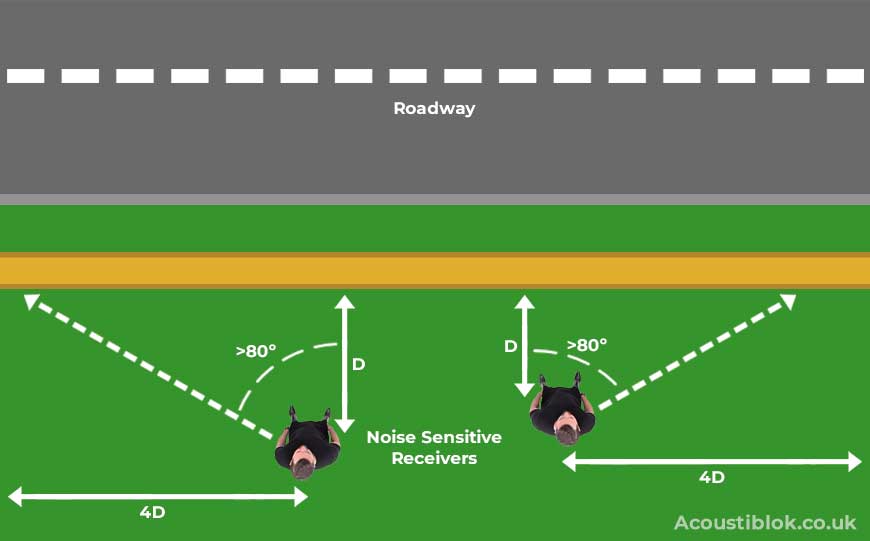
As previously mentioned, it is recognised as a general rule of thumb that for any conventional type of acoustic barrier to manage and block sound effectively, it needs to have a surface mass density of at least 10kg per metre squared to enable its mass and density to block and deflect.
Acoustiblok manufactures and supplies a unique AcoustiFence Perimeter Barrier Membrane, which is a flexible soundproofing fencing material made from super thin high performance acoustic membrane and is easily attached to an existing structure or support such as a fence.
At just 3mm thick, this material reduces sound ingress and reverberations.
As a result, with a product like AcoustiFence you will be able to deal with noise in a relatively quick, easy and comprehensive manner as distortions, vibrations and reverberations are tackled effectively.
Rather than having an acoustically rated fence erected, a standard fence covered by a specialised soundproofing membrane that has been specifically produced to deal with noise pollution, will be able to reduce noise effectively.
AcoustiFence can be installed easily onto an existing fence.
It can also be attached to rails, chainlink, posts or hoardings.
It is also equally important to establish the positioning and height of any acoustic fence or acoustically treated fence and ascertain how the sound is passing from point of source or ignition to the receiving point.
For example, a certain amount of sound may well be travelling towards and through an existing fencing system.
However, some of the sound waves most definitely will be travelling over the structure as well.
Depending on the angle of incidence, which in simplistic terms are angles the sound waves travel over or around a barrier, it may well still be audible even with an acoustically treated fence.
Alternatives to Acoustic Fencing

Whilst installing an acoustically rated fence is a good way to combat your noise issue and can be aesthetically pleasing, such solutions can be time consuming to install and ultimately expensive and cost prohibitive.
However, if there’s an existing structure in place, there are now more innovative materials on the market which can be a quicker and more effective solution when attached to the existing boundary.
Acoustic insulation membrane is specially designed to combat sound, so that sound transmission is reduced.
Uniquely with Acoustiblok’s technology this is done by means of thermal conversion.
For example, when soundwaves hit Acoustiblok’s sound insulation membrane, they are converted and dispersed into the material as trace heat.
Acoustiblok’s Acoustifence is a variation of its 3mm sound insulation membrane, which has been developed into a durable external acoustic screen solution ideal for external use since it is not negatively affected by UV rays, moisture, water, or extreme weather.
It’s also extremely easy to install onto an existing perimeter fence or standard substrate such as post and rail, chainlink, hoarding or heras fencing and is available with or without grommets.
Multiple sections can also be overlapped to ensure that there are no gaps that may allow sound to pass through.
So when it comes to installation, it’s effortless and as simple as can be.
Furthermore, Acoustiblok’s AcoustiFence Perimeter Barrier Membrane is conveniently available in rolls.
Acoustic Panels

Acoustic panels can also be used where there are high sound power and sound pressure values.
Acoustiblok’s All Weather Soundproof Panels can be used for this reason.
They are specifically designed to offer a number of differing principles of sound mitigation.
Diffusion, absorption and conversion of acoustic energy which in combination offers the very highest performance.
Used in all environments and conditions, they are able to withstand extreme weather conditions such as high winds and hurricanes, sunlight and moisture.
These acoustic panels have a very high sound absorption rating, are tough and last for many years.
They include Acoustiblok 3mm isolation membrane and specifically engineered 50mm Acoustiblok QuietFibre hydrophobic open cell sound absorbing material as part of their structure.
Their sound isolation and absorption capabilities are regarded as second to none.
Conclusion
If you’re looking for an effective solution to blocking sound from passing through your existing boundary fences, then the easiest option is to overlay the existing fence with an acoustic membrane, such as AcoustiFence.
While you may have thought installing an acoustically rated fence is the only way to reduce sound, there is an alternative solution such as acoustic fencing membrane, which can combat soundwaves passing through traditional fencing systems.
A fence lined with Acoustiblok AcoustiFence will be able to block sound, and offer a quieter environment and greater value for money longer term.
Remember, the higher the barrier, the longer the barrier and correct positioning of any barrier is going to play a significant part in the success of any external installation.
Disclaimer
Acoustiblok UK Ltd / Thermablok Aerogel Ltd gives no warranty and accepts no responsibility or liability for the accuracy or the completeness of the information and materials contained in this website, blog or media content. Under no circumstances will Acoustiblok UK Ltd / Thermablok Aerogel Ltd be held responsible or liable in any way for any claims, damages, losses, expenses, costs or liabilities whatsoever (including, without limitation, any direct or indirect damages for loss of profits, business interruption or loss of information) resulting or arising directly or indirectly from your use of or inability to use this website, material, content or any website linked to it, or from your reliance on the information and material on this website, even if Acoustiblok UK Ltd / Thermablok Aerogel Ltd has been advised of the possibility of such damages in advance.