Blog

Studio Soundproofing
Blog

11 Best Types of Studio Soundproofing

In the exciting world of writing and recording music, getting optimum sound production is a hugely important goal.

In the studio environment, there’s always certain difficulties that crop up.

One of these challenges is making sure the studio is quiet, soundproofed and acoustically calibrated.

It’s not only about stopping different types of noise, it’s about making sure the room sounds perfect for the music / audio you’re creating.

This article explores the best types of Intelligent Insulation for studio soundproofing.

From acoustic wall panels to bass traps and sound diffusers, these soundproofing methods can transform your recording space into something really special.

Let’s take a closer look at each of them.

Why is Studio Soundproofing Needed?

Music production and recording is a delicate world where even the smallest details matter.

In this complex craft, studio soundproofing becomes a hidden hero, a must-have element in the quest for great sound.

Beyond blocking external noises, soundproofing has another vital role – it affects how your recordings sound.

Imagine a situation where noise from outside sneaks into your recording, affecting your carefully created music.

On the other hand, think about when even the softest voice or instrument sound reverberates too much, changing how it truly sounds.

Both of these scenarios show why soundproofing and acoustic treatment is important.

Studio soundproofing acts like an isolation barrier, carefully shaping the sound in your recording space.

By stopping sounds from bouncing around, reducing echoes, and controlling how things resonate, soundproofing makes sure each note and lyric sounds just like it should.

This is especially vital in home studios.

These spaces have tons of potential, but they often struggle with outside noise ingress like a neighbour’s barking dog, heavy traffic, or clatter from other rooms or adjoining buildings.

These sounds can mess up your creative flow and sneak into your recordings, affecting what you’re trying to produce.

Soundproofing a studio turns these problems into chances for pure creativity.

It makes a strong barrier against outside distractions, letting you focus on your music and audio production.

At the same time, it keeps your music from escaping the studio, making sure the energy of your singing or the special sound of your instruments remain inside.

Basically, studio soundproofing captures what your recording is all about.

It keeps the emotions in your lyrics and melodies safe from outside interference.

It guarantees your sound stays clean, keeping your creative ideas as clear as they deserve to be.

1. Acoustic Isolation Membrane
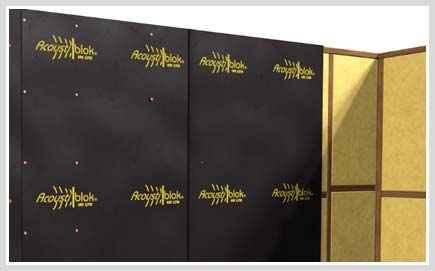
Acoustic MembraneIn the world of acoustic solutions, various types of acoustic membranes are available, each offering differing ranges of performance.

Among these options, Acoustiblok Isolation Membrane stands out as a pinnacle of advancement and efficiency.

The Acoustiblok Isolation Membrane boasts an impressive combination of thinness and exceptional performance.

Despite its slender profile, this membrane excels in soundproofing effectiveness, setting it apart from its counterparts.

One of the distinctive attributes of the Acoustiblok Isolation Membrane is it is only 3mm in thickness.

Moreover when the 3mm membrane is installed into a standard 100mm single stud wall assembly, it can provide more sound reduction than 300mm of poured concrete.

Acoustiblok Isolation Membrane also has the benefit of weighing considerably less than materials which rely solely on mass for sound reduction, making it a practical, thin and manageable choice for soundproofing applications.

Additionally, the membrane exhibits a unique capability – the conversion of sound into trace heat energy, thus mitigating the potential for problematic sound transmission.

When it comes to sound attenuation, the Acoustiblok Isolation Membrane reigns supreme, outperforming even old fashioned soundproofing materials like lead sheeting.

This remarkable trait underscores its efficacy as a robust barrier against sound transfer.

The construction of the Acoustiblok Isolation Membrane is centred around flexibility, as it is crafted from a polymer base.

This design choice not only ensures its effectiveness but also simplifies its installation process.

The material’s adaptability allows it to be seamlessly incorporated into various spaces, eliminating the constraints that rigid solutions might impose.

One of the commendable attributes of the Acoustiblok Isolation Membrane is its capacity to deliver substantial sound insulation benefits without necessitating the enlargement of walls or the addition of significant weight.

This stands in contrast to traditional methods that often require structural modifications, and thicker details or assemblies to achieve the end result.

This aspect highlights the practicality and efficiency of this advanced acoustic solution.


2. Decoupling

Decoupling Resilient ChannelsDecoupling products play a pivotal role in soundproofing by introducing a strategic separation between various structural elements.

This separation is specifically designed to counteract the transfer of sound vibrations.

Through this innovative approach, decoupling products effectively curtail the propagation of sound through physical connections, resulting in a significant reduction of unwanted noise transmission.

This sound absorption principle of using decoupling disrupts the direct physical pathways that sound vibrations can follow.

In traditional building structures, sound vibrations can travel through connected surfaces, such as walls, ceilings, and floors, and are referred to as flanking paths or flanking transmission.

This often results in the unwanted transmission of noise from one space to another.

However, with the introduction of decoupling products, these pathways are effectively dismantled, preventing the seamless transfer of sound energy.

Decoupling solutions are particularly valuable in scenarios where maintaining acoustic separation between spaces is paramount.

This is especially relevant in environments such as recording studios, home theatres, and multi-unit buildings, where ensuring a quiet and undisturbed atmosphere is essential.

These products often utilise a combination of resilient materials and strategic design to achieve their soundproofing objectives.

Resilient channels, isolation clips, and specialised acoustic hangers are common examples of decoupling mechanisms.

These elements are strategically integrated into the construction or retrofitting process, creating a physical gap between structural components.

This gap effectively minimises the direct contact points where sound vibrations can travel, ensuring that the majority of the energy is dissipated or absorbed within the materials.

Decoupling products offer a versatile solution for a wide range of soundproofing needs.

Whether it’s preventing footfall noise from travelling through floors, mitigating airborne noise transmission through walls, or isolating ceilings to reduce impact noise, these products provide an effective barrier against the unwanted movement of sound energy.

Furthermore, the incorporation of decoupling solutions can significantly contribute to the overall acoustic comfort of a space.

By preventing sound vibrations from easily transferring from one area to another, decoupling helps create an environment that is conducive to concentration, relaxation, and creativity.


3. Acoustic Absorber Panels
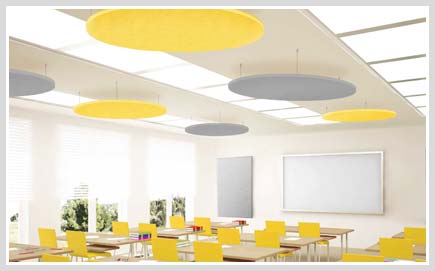
Acoustic Absorber PanelsAcoustic absorber panels stand as a cornerstone within the realm of studio soundproofing, playing a crucial role in the pursuit of optimal acoustic environments.

These panels are meticulously designed to address one of the most significant challenges in soundproofing – managing sound reflections and echoes.

One of the primary functions of acoustic wall panels is to absorb sound energy.

When sound waves encounter a surface, they can bounce off and create reflections.

These reflections can lead to the buildup of echoes, which in turn can compromise the clarity and purity of the sound in a recording or listening space.

Acoustic panels are expertly crafted to intercept these sound waves through the process of absorption.

This absorption effectively minimises the potential for reflections, resulting in a more controlled and balanced acoustic environment.

The design of acoustic absorber panels is rooted in the science of acoustics and are constructed using a variety of soundproofing materials.

These absorber panels not only prevent sound reflections but also contribute to the overall reduction of ambient noise levels, creating a more sonically pleasing environment.

Beyond their functional attributes, acoustic absorber panels are available in a variety of designs and styles, allowing for customization to suit the aesthetic and acoustic requirements of different spaces.

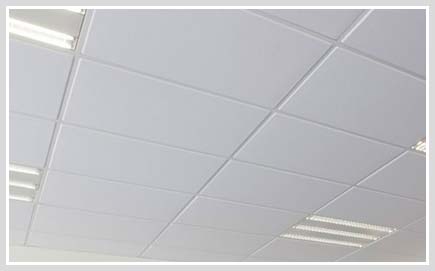
Wall mounted acoustic panels and acoustic ceiling panels can be combined to improve the efficiency of the sound proofing.

Wall mounted acoustic absorber panels are normally surface mounted to offer absorption from the front surface and edge of each panel.

Ceiling acoustic absorber panels like AcoustiClouds can be surface mounted however, where ceiling heights and environments allow they can be suspended away from the ceiling surface.

In doing so, additional absorption can be achieved from each panel – the front surface, edge and in addition the rear surface almost doubling the effectiveness of each panel.

This versatility in placement ensures that the acoustic characteristics of a room can be effectively tailored to achieve the desired sound quality.

Acoustic panels find their application not only in recording studios but also in a wide array of environments.

Home theatres, conference rooms, restaurants, office spaces and even residential living spaces can benefit from the improved acoustic quality that these panels provide.

Their ability to enhance sound clarity, minimise unwanted echoes, and create a more immersive auditory experience makes them an essential tool for anyone seeking to optimise their sonic environment.


4. Acoustic Foam

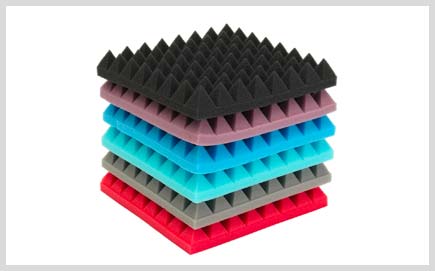
Acoustic FoamAcoustic foam stands as a versatile and additional tool within the acoustic calibration and acoustic treatment of a space.

This material is designed to effectively manage sound waves, ensuring a controlled and optimal auditory experience within various spaces.

The effectiveness of acoustic foam lies in its intricate structure.

Characterised by its distinctive pyramid-like or wedge-shaped design, acoustic foam panels are strategically crafted to harness the power of sound absorption across a wide spectrum of frequencies.

The geometric arrangement of these pyramid shapes serves to create pathways for sound waves to enter and dissipate within the foam’s dense internal structure.

The strategic arrangement of the pyramid shapes within the foam not only facilitates sound absorption but also minimises the potential for sound reflections and echoes.

When sound waves hit a flat, hard surface, they tend to bounce off, creating reflections, resonance and regeneration that can compromise the overall acoustic quality of a space.

Acoustic foam acts as an effective barrier against these reflections by intercepting and absorbing the sound waves before they can reverberate and create unwanted echoes.

This results in a more controlled, calibrated and balanced auditory environment.

The versatility of acoustic foam lies in its ability to address a broad range of sound frequencies.

Different frequencies of sound, from low bass tones to high-pitched trebles, interact with surfaces and materials in distinct ways.

Acoustic foam’s pyramid-like structure is meticulously designed to address this complexity, making it an effective solution for managing a wide array of sound frequencies.

This adaptability ensures that the acoustic foam remains effective across various environments, from recording studios to home theatres and even commercial spaces.

These foam panels can be strategically placed on walls, the corners of walls, ceilings, or other surfaces prone to sound reflections.

They can also be used to construct vocal booths or to enhance the acoustic quality of a room.

Their lightweight nature and ease of installation make them a practical choice for both professionals and enthusiasts seeking to optimise their sound environments.


5. Acoustic Caulk & Sealant

Acoustic SealantAcoustic caulk, also known as soundproofing caulk or acoustic sealant, is a type of flexible sealant that is designed to reduce sound transmission through gaps and openings in building structures.

It’s commonly used in construction and soundproofing projects to seal gaps around windows, doors, electrical outlets, walls and other areas where sound could leak through.

The unique properties of acoustic caulk make it effective in reducing both airborne and impact noise.

However it is really important to remember that the installation is only as effective as its weakest points.

That said, ensure an integral and correct fitting of all insulation and materials in the first place to minimise gaps, thus removing weaknesses.

Acoustic caulk is typically formulated to provide flexibility, adhesion, and sound-dampening capabilities.

When applied, acoustic caulk adheres to surfaces and fills gaps, forming an airtight seal.

The primary purpose of acoustic caulk is to prevent sound waves from passing through gaps and cracks in a building’s structure.

Airborne sound, such as voices or music, can easily travel through these openings, diminishing the effectiveness of soundproofing efforts.

Acoustic caulk fills these gaps, preventing sound from escaping or entering a room, thus enhancing overall sound insulation.

In addition to its soundproofing properties, acoustic caulk can also help improve energy efficiency by sealing drafts and preventing air leakage.

This can contribute to maintaining a comfortable indoor environment and reducing energy costs.

Acoustic caulk should typically be used in conjunction with other soundproofing materials, such as Acoustiblok Isolation Membrane, resilient channels and acoustic panels to create a comprehensive soundproofing solution to achieve maximum sound reduction.

It’s applied to gaps and joints before finishing materials like drywall are installed.

When selecting acoustic caulk, it’s essential to choose a product that is specifically designed for soundproofing purposes.

These sealants are formulated to have the right balance of flexibility and density to effectively block sound while maintaining durability over time.


6. Acoustic Flooring
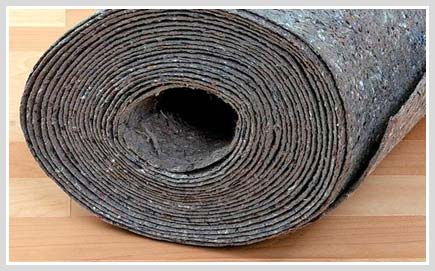
Acoustic FlooringAcoustic flooring materials play a pivotal role in soundproofing, particularly within recording spaces and studios.

But it is important to establish what type of room is to be created and what acoustic levels are required.

When creating a live music room for a grand piano for example a reflective floor can be used to enhance and create necessary reverberation.

A recording studio for one type of application may differ greatly from another.

In environments where precise acoustics are paramount, the impact of noise goes beyond just what’s audible to the ear.

It extends to the vibrations that instruments, equipment, and even footsteps can generate.

These vibrations can easily translate into unwanted noise that interferes with the pristine recording environment.

This is where the significance of differing acoustic flooring materials can help either within the construction buildup to reduce flanking issues, or as surface mounted to control internal reflection.

At the heart of the matter is usually and predominantly the concept of impact noise, but not always the only concern.

Impact noise arises from physical impacts, such as footsteps or the dropping of objects, and has the potential to reverberate through a space, causing disruptions and compromising the clarity of recordings.

In recording studios, where every sound is meticulously captured, these vibrations and resulting flanking transmissions through the construction and into the studio can be particularly problematic.

Acoustic flooring materials, specifically engineered for their sound-dampening properties, serve as a buffer against impact noise.

These materials are designed to absorb and dissipate vibrations, preventing them from transmitting through the structure of the building.

This means that when footsteps or other impacts occur, the transfer of vibration to the other parts of the building is minimised by way of absorption, deflection or in some cases thermal conversion.

The construction of acoustic flooring involves a combination of specialised materials that work in harmony to achieve sound reduction.

These materials often include layers of resilient underlayments, Acoustiblok Isolation Membrane or combinations of dense foams and board to add a cushion and deflection.

These layers work together to create a cushioning effect that absorbs and disperses impact vibrations.

Where much bigger increases in thicknesses and depths to floor height can be tolerated, systems such as Acoustic Cradles can be employed to create an isolated and decoupled floor, further reducing likely flanking transmissions.

In a recording space, where even the slightest vibrations can be captured by sensitive microphones, acoustic flooring becomes a crucial component of maintaining sonic purity.

By effectively minimising impact noise, acoustic flooring ensures that the only sounds recorded are intentional, eliminating the potential for unintended vibrations to interfere with the final product.

Furthermore, acoustic flooring can contribute to a comfortable and conducive environment for musicians and recording professionals.

The absorption of impact noise not only benefits the recording quality but also creates a quieter and less distracting atmosphere.

This is particularly relevant in situations where musicians may be recording live instruments that are sensitive to external vibrations.


7. Acoustic Cavity Insulation

Acoustic Cavity InsulationOpen cell cavity insulation material is commonly used in many types of construction and especially in soundproofing where structural cavities are present.

The concept of open cell cavity insulation hinges on the principle of filling, or part filling, the empty spaces within walls and floors.

This results in the prevention of transmission of sound waves and an enhancement of overall acoustic performance.

When sound waves encounter these materials, they are absorbed and in doing so reduce the transmission through walls and other structures.

This absorption plays a pivotal role in reducing the transmission of sound, ensuring that it does not travel beyond the intended space.

Open cell cavity insulation is an important soundproofing function and is ultimately possible due to its increased depth and density.

These materials, such as Acoustiblok QuietFibre, are characterised by their porous and open-cell structure, which enables them to effectively trap and dissipate sound waves.

As sound waves travel through the insulation material, they encounter a network of tiny air pockets that absorb their energy, slowing down and diminishing their intensity.

These materials need to be utilised in association with other critical materials already touched on such as decoupling framing, Acoustiblok Isolation Membrane, resilient channels or cross battens and density such as finishing board.

This process significantly reduces the potential for sound waves to pass through walls and emerge on the other side.

Furthermore these types of materials also prevent unnecessary reverberation and potential amplification within cavities which would otherwise occur if not in evidence.

In a studio environment, where precision and accuracy are paramount, open cell cavity insulation works in conjunction with other core insulation materials such as Acoustiblok Isolation Membrane.

Musicians can perform with confidence, knowing that the subtleties of their music will not inadvertently infiltrate adjacent recording areas or disturb neighbouring rooms.

Moreover, the benefits of open cell cavity insulation extend beyond soundproofing alone.

These insulation materials often have thermal insulating properties, contributing to temperature regulation and energy efficiency within the studio space.

This dual functionality adds an extra layer of value to their application.


8. Soundproof Windows
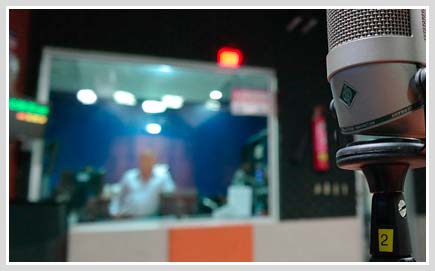
Soundproof WindowsWindows, although they provide a visual connection to the outside world, are often a significant source of sound infiltration in recording spaces.

Again, establish the key drivers for the particular project and the specifications required which are fit for purpose and within the assigned budgets.

Establish if they are actually required?

Any structure or envelope is only as strong as its weakest point.

A mantra to remember at all times.

The delicate balance between a view and a light source versus acoustic isolation becomes apparent when considering the impact of external noise on the recording quality.

Ventilation is always of major importance and such a key issue we should look at this extensively at another time, but effective ventilation is invariably achieved in other ways rather than open windows in a studio setting for obvious reasons.

Soundproof windows emerge as a vital solution, offering a specialised approach to mitigating sound leakage and maintaining the integrity of the studio environment.

Soundproof windows are engineered with the primary objective of creating a robust barrier against unwanted sound transmission.

Unlike standard windows, which are primarily designed for visual and ventilation purposes, soundproof windows are specifically constructed to address the complex dynamics of sound waves.

These windows are a culmination of advanced materials, design principles, and engineering techniques, all meticulously crafted to minimise sound infiltration.

One of the hallmark features of soundproof windows is the utilisation of multiple layers of glass.

The principle behind this design is to create an air gap between the layers, serving as an effective buffer against sound waves.

The larger the air gap, the more effective the window is at impeding sound transmission.

Additionally, the use of differing thicknesses and compositions of glass layers contributes to the window’s soundproofing capabilities.

These variations in glass properties help to disrupt and block sound waves before they can penetrate into the interior space.

Incorporating sound-absorbing materials into the window’s construction further enhances its soundproofing effectiveness.

These materials are strategically placed within the window frame to absorb and dampen sound waves that might pass through the glass layers.

This approach serves as an extra layer of defence against external noise, preventing it from impacting the acoustic environment within the recording space as well as leakage from within.

Beyond their soundproofing function, these windows also offer additional benefits.

Their construction often includes features that improve energy efficiency and thermal insulation.

The multiple layers of glass, along with the air gaps, create a barrier against temperature exchange, contributing to a more comfortable and energy-efficient studio environment.

Moreover, soundproof windows come in a variety of designs and styles, ensuring that aesthetic considerations are not compromised.

From traditional to contemporary, these windows seamlessly integrate into the overall design of the studio space without sacrificing their primary function.

The impact of soundproof windows on the recording experience is significant.

By effectively blocking external noise, these windows maintain the purity of the recording and allow for optimal sound isolation.

Musicians and recording artists can work with confidence, knowing that the external environment will not intrude upon their creative process.

This level of isolation is especially vital in home studios or urban settings, where external disturbances can be particularly disruptive.

Equally to prevent leakage of acoustic energy from within.


9. Soundproof Doors

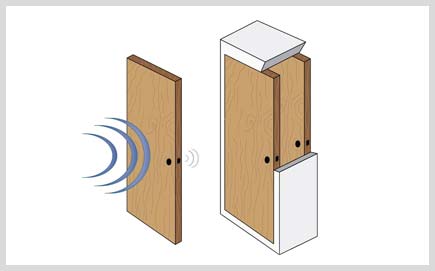
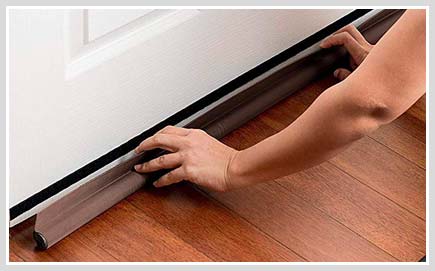
Soundproof DoorsMuch like windows, doors play a significant role in the potential leakage of sound from one space to another.

In the context of soundproofing a studio, the design and construction of doors become pivotal in maintaining the integrity of the acoustic environment.

Unlike a window which may be removed from a design, a door is invariably seen as somewhat more important.

Soundproof doors stand as a powerful tool in controlling sound transmission, ensuring that the music and recordings created within the studio stay enclosed within the designated space.

The concept of soundproof doors goes beyond the traditional function of doors as mere entry and exit points.

While standard doors are primarily focused on providing physical access, soundproof doors are engineered to create an effective barrier against sound leakage.

This is achieved through the integration of specialised materials and sealing mechanisms that work in unison to prevent sound waves from passing through the door and surround to infiltrate other areas.

One of the key elements of soundproof doors is the use of heavy and dense materials in their construction.

These materials are chosen for their ability to effectively absorb and block sound waves.

By incorporating materials with higher mass and density, such as solid wood, composite materials, or metal layers with Acoustiblok Isolation Membrane, soundproof doors create a formidable obstacle that sound waves struggle to penetrate.

The heavier and denser the material, the greater its capacity to act as a barrier against sound transmission.

In addition to the choice of materials, soundproof doors often feature purpose-built seals and gaskets.

These sealing mechanisms are strategically placed around the door’s edges and t the frame to create an airtight seal when the door is closed.

This seal minimises the gaps through which sound waves could potentially escape.

Furthermore, some soundproof doors are equipped with acoustic insulation materials within their core or additional materials such as Acoustiblok Isolation Membrane can be added to them to increase acoustic values.

These materials serve to further absorb sound energy, preventing it from reverberating through the door and into adjacent spaces.

Designing a double door aperture into the build may be a consideration where feasible if purpose made acoustic doors are not within a particular budget.

This design is much deeper in assembly therefore reduces gross internal area and nowhere near as user friendly but can achieve the all important desired effect.

The impact of soundproof doors on the studio environment is multifaceted.

Firstly, they contribute significantly to maintaining the acoustic isolation of the recording space.

Musicians and recording artists can perform without concern, knowing that their music will not inadvertently permeate into other areas.

In turn, this level of containment is essential in achieving the highest quality recordings free from external disruptions.

Moreover, soundproof doors enhance the overall comfort and experience within the studio.

The effective reduction of external noise ensures a focused and immersive environment conducive to creativity and concentration.

It eliminates the distractions that external sounds can introduce, allowing artists to immerse themselves fully in their musical endeavours.


10. Bass Traps

Bass TrapsLow-frequency sound waves, often referred to as bass, present a unique challenge in studio soundproofing.

These deep and powerful sound waves can be particularly challenging to control due to their longer wavelengths and the way they interact with the physical environment.

In the pursuit of pristine sound quality, the use of bass traps emerges as an essential strategy, addressing the specific complexities of low-frequency sound management.

Bass traps are acoustic treatment devices designed to address the issues arising from low-frequency sound propagation within a recording space.

These traps effectively mitigate the problems associated with bass frequencies, offering a tailored solution that contributes to a more balanced and accurate acoustic environment.

The primary function of bass traps is to absorb the energy of low-frequency sound waves, preventing them from creating unwanted resonances or muddiness in the recording.

These resonances, often referred to as “room modes,” occur when sound waves reflect off surfaces within a room and reinforce or cancel each other out, resulting in uneven frequency response and muddled bass reproduction.

Bass traps are typically placed in specific locations known as bass-heavy areas.

One of the most common placement strategies involves positioning bass traps in room corners.

Corners are particularly prone to the accumulation of low-frequency energy due to sound wave reflections that bounce off the intersecting surfaces.

By placing bass traps in corners, these devices effectively target the concentration of low-frequency energy and absorb it before it can create undesirable resonances.

These materials are designed to have a high absorption coefficient at lower frequencies, making them effective at taming the powerful and long-wavelength bass waves.

Bass traps come in various designs and forms, each optimised for specific frequency ranges and room dimensions.

Broadband bass traps are designed to absorb a wide range of low-frequency frequencies, while tuned bass traps are engineered to address specific problem frequencies at specific locations within a room.

Helmholtz resonators, a type of bass trap, work by exploiting the principle of air resonance to absorb specific frequencies.

The integration of bass traps into a studio’s acoustic treatment strategy yields numerous benefits.

Most notably, it contributes to a more accurate and controlled low-frequency response, allowing recordings and mixes to translate more accurately across different playback systems.

The reduction of resonances and muddiness in the bass region results in a cleaner and more defined sound, enhancing the overall listening experience.

Furthermore, the implementation of bass traps enhances the versatility of a recording space.

Musicians and recording professionals can confidently work with bass-heavy instruments, such as drums and bass guitars, knowing that the room’s acoustics will not negatively impact the sound quality.

This level of control extends to mixing and post-production stages, where accurate bass reproduction is crucial for achieving a balanced and well-defined final product.


11. Sound Diffusers

Sound DiffusersSound diffusers play a pivotal role in shaping the acoustic landscape of recording spaces.

As sound waves travel within a room, they encounter various surfaces and boundaries that can lead to reflections and unwanted echoes.

These acoustic phenomena, if left unaddressed, can result in an uneven and coloured listening experience that affects the accuracy and fidelity of sound recordings.

Sound diffusers are acoustic treatment devices designed to mitigate these reflections, creating a more balanced and immersive acoustic environment.

The primary function of sound diffusers is to scatter sound waves in a controlled manner.

Unlike absorbers, which absorb sound energy, diffusers redirect sound waves in various directions, reducing the concentration of reflections and minimising their impact on the overall sound quality.

This diffusion process works to break up the direct path of sound waves, preventing them from reflecting directly back to the listener or recording equipment.

One of the key advantages of sound diffusers is their ability to maintain the natural liveliness of a room’s acoustics while still controlling unwanted reflections.

Unlike complete absorption, which can lead to an overly dead and dry acoustic environment, diffusion strikes a balance between absorption and reflection.

This preserves the sense of space and ambiance within a room while simultaneously improving the clarity and definition of sound.

Sound diffusers come in a variety of shapes, sizes, and designs, each optimised for specific frequency ranges and room dimensions.

The arrangement of the diffuser’s surface elements plays a crucial role in determining the diffusion pattern and its effectiveness.

Well-designed diffusers ensure that sound waves are scattered evenly across different angles, preventing the formation of focused reflection points.

Diffusers are particularly effective in larger rooms or spaces with parallel walls, where reflections can be more pronounced and detrimental to sound quality.

By introducing controlled diffusion, these reflections are dispersed, leading to a more balanced and coherent acoustic response.

This is especially important in recording and listening environments where accuracy and clarity are paramount.

The benefits of sound diffusion extend beyond technical sound quality improvements.

When properly integrated into a recording space, diffusers create a more immersive and engaging listening experience.

Music and sound recordings become enveloping, with a sense of depth and spaciousness that enhances the emotional impact of the content.

This level of sonic engagement enhances the overall enjoyment of music and contributes to a more satisfying auditory experience.

Additionally, sound diffusers offer an artistic dimension to acoustic design.

Their aesthetic qualities can complement the visual aesthetic of a recording studio or listening room, making them both functional and visually appealing.

Some diffusers even incorporate unique patterns and designs that not only improve acoustics but also contribute to the overall atmosphere of the space.

Conclusion

The world of music production and recording is a delicate and intricate one, where every detail matters.

Studio soundproofing emerges as a hidden hero, playing a vital role in the pursuit of perfect sound and in turn preventing leakage from within to the outside or in many cases to a neighbouring back to back studio.

Soundproofing is not merely about blocking external noises; it’s about shaping the acoustic environment within a studio to ensure that the music created within its confines sounds its best.

This is a complex task, given the challenges studios face, from external noise ingress to unwanted vibrations and sound reflections.

The types of studio soundproofing discussed in this article offer a comprehensive toolkit for addressing these challenges.

From the innovative Acoustiblok Isolation Membrane, to the strategic use of decoupling products, to bass traps and sound diffusers, each method serves a specific purpose in enhancing the acoustic integrity of a recording space.

If you’re considering building your own recording studio or applying the studio soundproofing principles explained but are unsure where to start, speak to an acoustical consultant for professional guidance and help.

Our team at Acoustiblok have decades of combined experience in soundproofing studios, as well as acoustic calibration and construction methods for sound attenuation.
Sound Transmission Classes
Blog

Sound Transmission Classes Explained

In our bustling modern world, noise pollution has become an inevitable part of our daily lives.

Whether it’s the constant hum of traffic, the clamour of construction sites, or the disruptive sounds within shared spaces, unwanted noise can be a significant source of annoyance and distraction.

Thankfully, architects, engineers, and designers have developed techniques to mitigate noise transmission and enhance acoustic comfort.

One crucial element in this specialism is Sound Transmission Classes (STC).

In this blog post, we will delve into the fascinating world of Sound Transmission Classes and unravel the critical principles behind them.

We’ll explore what sound transmission classes represent, how they are measured, and what are the best measurements for them.

Whether you’re an aspiring architect, a homeowner seeking peace and quiet, or simply intrigued by the science of sound, this article will provide valuable insights into understanding and controlling noise transmission.

Sound Transmission Explained

Sound transmission refers to the propagation of sound waves from one space to another through building elements for example, such as walls, floors, ceilings, doors, and windows.

It occurs when sound energy is transmitted through the physical structure of a building, allowing it to be heard in adjacent rooms or areas.

Sound Transmission in Buildings

There are three primary mechanisms of sound transmission in buildings:

Airborne Sound Transmission

Airborne Sound Transmission

Image credit: Wikipedia

Airborne sound is the most common type of sound transmission and occurs when sound waves travel through the air from a sound source to a receiver.

It can pass through openings, gaps, or penetrations in building elements.

When airborne sound encounters a building element such as a wall, part of the sound energy is transmitted through the material, while another part is reflected or absorbed.

The transmitted sound can then be heard on the other side of the wall in a different space.

Impact Sound Transmission

Structure Borne Sound Transmission

Image credit: Wikipedia

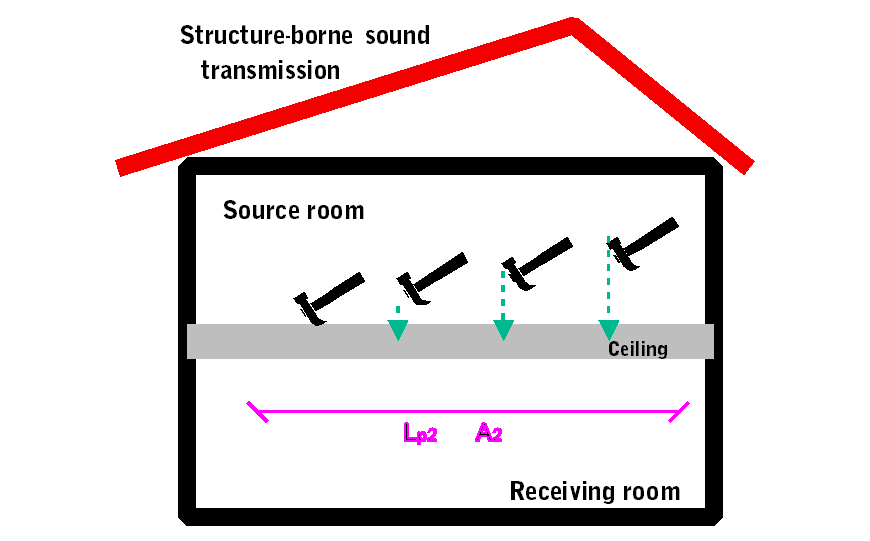
Impact sound transmission happens when an object or surface is struck or impacted, transmitting vibrations through the building’s fabric.

Examples include footsteps on a floor, an object dropping, or machinery’s operation.

These vibrations can travel through walls, floors, and ceilings and be heard as noise in adjacent areas.

Impact sound insulation measures, focus on minimising the transmission of vibrations through the structure.

Flanking Sound Transmission

Flanking sound transmission occurs when sound energy bypasses or circumvents a direct barrier by travelling through alternate pathways or building elements.

For example, sound can travel through openings around pipes, ductwork, electrical outlets, or through poorly sealed joints and gaps.

Flanking paths can significantly affect the overall sound insulation performance, so it’s crucial to identify and address them during construction or renovation.

How Sound Travels Through Different Materials?

Sound travels through different materials in various ways, depending on the characteristics of the material.

Here are some common materials and how sound travels through them:

Air

Sound waves travel through the air as longitudinal waves.

When a sound is produced, it creates a disturbance in the air molecules.

These molecules vibrate back and forth, transmitting the sound energy from the source to our ears.

The speed of sound in air is approximately 343 metres per second at room temperature.

Solids

Sound waves can travel through both longitudinal and transverse waves in solids, such as metals or dense materials.

Longitudinal waves involve compression and rarefaction of the material, similar to how sound travels through the air.

Transverse waves occur when the particles move perpendicular to the direction of the sound wave.

The speed of sound in solids is generally higher than in liquids or gases.

Liquids

Sound waves travel through liquids similar to how they travel through solids, primarily as longitudinal waves.

The molecules in a liquid transmit the sound energy through compression and rarefaction.

The speed of sound in liquids is higher than in gases but lower than in solids.

Water

Water is a unique medium for sound propagation due to its higher density than air.

Sound travels about four times faster in water than in air, at around 1,480 meters per second.

Underwater sound is crucial for marine life and is used in various applications, including sonar and underwater communication.

Vacuum

Sound waves require a medium to travel through, so in a vacuum (an area devoid of matter), sound cannot propagate.

This is because no particles can vibrate and transmit sound energy.

However, electromagnetic waves like light can still travel through a vacuum.

What is Sound Transmission Class (STC)?

Speaker Transmitting Colourful Sound

Image credit: Pixabay

The Sound Transmission Class plays a crucial role when understanding sound transmission.

STC is a numerical rating system that measures how well a building partition, such as a wall, floor, or ceiling, can reduce sound transmission from one space to another.

In simpler terms, it quantifies how effective a material or construction is at blocking sound.

How to Measure Sound Transmission Class Rating?

Sound Transmission Class, is a rating system used to measure the sound insulation performance of building materials, such as walls, doors, windows, and partitions.

The STC rating indicates how effectively a material or assembly can reduce sound transmission from one space to another.

The sound transmission classes rating is determined through laboratory testing by the ASTM E90 standard.

Here’s a general overview of the measurement process:

Test Setup

A large reverberation room and two smaller rooms (source room and receiving room) are used for the test.

The source room contains a loudspeaker system to generate sound, while the receiving space is where the sound is measured.

Test Frequencies

The sound transmission class rating is calculated for a range of frequencies from 125 Hz to 4,000 Hz, which covers the typical human hearing range.

Sound Transmission

A steady noise source is generated in the source room, and the sound levels are measured in both the original and receiving rooms.

The difference in sound levels between the two rooms determines the sound transmission loss.

Octave Band Analysis

The sound transmission loss is measured in octave bands at various frequencies.

These measurements allow for the calculation of the Transmission Loss Curve (TLC) for the tested material or assembly.

Sound Transmission Classes Calculation

The sound transmission class rating is derived from the Transmission Loss Curve.

It represents the average sound reduction across the tested frequency range and is determined by comparing the transmission loss values to a standard contour curve specified in the ASTM E413 standard.

The contour curve represents typical human hearing sensitivity.

Practical Applications of Sound Transmission Class

Office Space

Image credit: Unsplash

The Sound Transmission Class is a rating system that measures how well a building partition, such as a wall or floor, reduces sound transmission.

Here are some practical applications of the Sound Transmission Class:

Building Design

Architects and engineers use the STC rating to design spaces with appropriate acoustic properties.

By considering the sound transmission classes rating of various materials and assemblies, they can choose suitable combinations to achieve desired sound insulation between different building areas.

Residential Construction

In residential buildings, the sound transmission classes rating helps determine the effectiveness of interior walls in reducing sound transmission between rooms.

It is essential to soundproof bedrooms, bathrooms, home offices, studios, media rooms, cinemas and other areas where privacy and reduced noise are desired.

Commercial Spaces

STC ratings are crucial in commercial settings where noise control is essential, such as office buildings, conference rooms, hotels, and hospitals.

By selecting appropriate building materials and partition systems with higher sound transmission classes ratings, acoustic privacy between different spaces can be improved.

Music and Recording Studios

Recording studios require high acoustic isolation to prevent sound leakage into or out of the studio.

The sound transmission class rating helps studio designers choose appropriate soundproofing materials and construction techniques to minimise external noise intrusion and internal sound leakage.

Is a Higher or Lower STC Rating Better?

The STC rating is reported as a single number, such as STC 40 or STC 60, indicating the sound insulation performance of the material or assembly.

A higher sound transmission class rating corresponds to better sound insulation.

The sound transmission classes scale ranges from approximately 15 to 60 or more.

A higher sound transmission classes rating indicates better sound insulation capabilities, meaning it can effectively reduce sound transmission between spaces.

For example, a material with a sound transmission classes rating of 50 will provide more sound reduction than a material with an STC rating of 30.

In practical terms, a higher sound transmission classes rating means less sound will pass through the material, resulting in a quieter environment on the receiving side.

It’s important to note that the specific requirements for an application may vary.

Different environments may have extra sound insulation needs, depending on factors like the purpose of the space and the desired level of privacy or noise control.

Therefore, the appropriate sound transmission classes rating will depend on the specific requirements and regulations applicable to the project.

How to Improve STC Ratings?

Contractors Installing Acoustiblok Membrane

Improving Sound Transmission Class (STC) ratings can be beneficial in reducing noise transmission between spaces, whether for residential, commercial, or industrial purposes.

Here are several ways to improve sound transmission classes ratings:

Add Mass

Increasing the mass of a wall or partition is one way to improve sound transmission classes ratings.

Consider using thicker and denser materials, such as adding additional double layers of drywall to build up the mass to deflect.

Seal Air Gaps

Air gaps can significantly reduce the effectiveness of a wall or partition in blocking sound.

Ensure all gaps, cracks, and openings are correctly sealed using flexible acoustical caulk or weatherstripping.

Use Insulation

Install specialist sound converting and dampening insulation materials within the wall buildup.

This converts the acoustic energy into trace element heart energy providing huge benefit and further preventing flanking transmissions through vibration.

Consider Resilient Channels

Resilient channels are metal strips or bars attached to the framing before installing drywall.

They decouple the drywall from the underlying structure, reducing the direct transfer of sound vibrations.

Opt for Double Stud Walls

Constructing double stud walls with a gap between them lined with specialist sound-converting and dampening insulation materials can create an exceptional sound barrier.

This design prevents sound vibrations from quickly travelling through the wall structure.

Upgrade Doors

Standard doors are often a weak point regarding sound insulation. A proposed design is only as effective as its weakest point.

Replace them with solid core doors, or add a door sweep to minimise gaps at the bottom.

Enhance Windows

Windows are another weak point for sound transmission.

Install double or triple-pane windows with thick glass to improve their soundproofing capabilities.

Use Soundproof Curtains or Blinds

Hanging sound-absorbing curtains or installing soundproof blinds can help reduce noise transmission through windows.

Acoustic Panels

Install acoustic panels on the walls and acoustic ceiling panels to absorb sound reflections within a room, improving its overall acoustics.

What is STC 45 Rating?

The STC 45 rating refers to a building material or assembly’s Sound Transmission Class (STC) rating.

The STC rating measures how well a material or assembly can reduce airborne sound transmission from one space to another.

An STC rating of 45 indicates a moderate level of sound insulation.

While it offers some reduction in sound transmission, it may not provide complete privacy or insulation from loud noises.

At this rating, conversations and speech can still be faintly heard through walls, and louder sounds may be somewhat audible.

What is STC 50 Rating?

A Sound Transmission Class (STC) rating of 50 is the minimum requirement for multi-family constructions specified by the International Building Code.

This rating signifies a significant reduction in noise, providing residents with a sense of sufficient insulation from external disturbances.

At an STC of 50, conversations and speech cannot be heard through the walls, while loud sounds become barely perceptible.

As an example a single stud incorporating Acoustiblok 3mm Isolation Membrane will achieve an STC 53. Please see more details as examples

This level of soundproofing effectively minimises noise-related complaints, as reported by respondents in surveys.

What STC Rating is a Quiet Wall?

The Sound Transmission Class (STC) rating measures how well a building material, such as a wall, reduces sound transmission from one area to another.

The higher the STC rating, the better the material is at blocking sound.

The term “quiet wall” is not a specific product or material, so it has no standard STC rating.

The STC rating of a wall depends on various factors, including the construction materials, thickness, density, and additional soundproofing techniques.

If you consider soundproofing a wall to achieve a quiet environment, you can use materials with higher STC ratings to improve sound insulation.

What Sound Transmission Class Rating is Soundproof?

The Sound Transmission Class (STC) rating measures how well a building partition, such as a wall or floor, can reduce sound transmission.

The higher the sound transmission class rating, the better the soundproofing capabilities of the partition.

While no specific STC rating defines a partition as “soundproof” in an absolute sense, higher STC ratings generally indicate better soundproofing performance.

A standard guideline is that a sound transmission class rating of 40 or above is adequate for most residential applications, where everyday speech can barely be heard through the partition.

Loud speech can be heard but invariably not understood.

However a sound transmission class rating of 45 tends to be recognised as a key point where privacy is started.

A sound transmission class rating of 50 moves towards loud noises bein g heard but quite faintly.

To put this into context as an example, a single stud wall design achieves approximately STC 36 which as can be seen from above, is acoustically weak and speech can be easily deciphered.

Incorporating Acoustiblok 3mm Isolation Membrane into this same wall design will provide a very thin buildup whilst achieving an impressive STC 53. Please see more details as examples

However, it’s important to note that achieving complete soundproofing, where absolutely no sound is transmitted through a partition, is extremely challenging and often impractical.

Soundproofing is a complex process that involves various factors, including the construction materials used, the design of the partition and adjoining construction, as well as the specific sound frequencies you want to block.

What is the STC rating of double-glazed windows?

The Sound Transmission Class (STC) rating of double-glazed windows can vary depending on several factors, such as the windows’ specific construction, the glass’s thickness, the insulating materials’ presence, and the window system’s overall design.

Double-glazed windows typically have an STC rating of 28 to 32 on average.

This means they can reduce exterior noise levels by around 28 to 32 decibels, providing reasonable sound insulation.

However, it’s important to note that the actual sound transmission rating can vary depending on the specific manufacturer and product.

To achieve higher soundproofing performance, manufacturers may incorporate additional features in their windows, such as laminated glass, thicker glass panes, or specialised acoustic insulation.

These enhancements can increase the STC rating and provide improved sound reduction properties.

Conclusion

In conclusion, Sound Transmission Class (STC) is a critical rating system in architecture and construction.

It allows professionals to assess and improve the acoustic performance of building partitions, ultimately creating spaces that prioritise privacy, comfort, and optimal sound control.

Acoustiblok offers a wide range of soundproofing materials and solutions that can significantly enhance the STC ratings of varying types of building partitions, walls, floors etc.

Our products are designed to effectively block, absorb, and isolate sound, ensuring minimal noise transfer between rooms and spaces.

From residential buildings to commercial complexes, Acoustiblok provides practical and efficient solutions that align with the objectives of STC ratings.

Feel free to contact us to soundproof your space today!

Types of Noise
Blog

What are the Different Types of Noise?

The different types of noise in our lives come from sources of all different kinds.

As an integral part of the world we live in, it’s important to learn about what different types of noise there are to fully understand them and how they affect us.

Where certain types of sound can heal, certain types of noise can harm.

So it’s important to understand the distinct differences between them.

In this article, we’re going to explore the various types of noise, how they impact us negatively or positively, and get a greater understanding of how noise has colour as well as form.

What is Noise?

Understanding the distinction between noise and sound is crucial.

Noise is a specific category of sound characterised by unwanted, disruptive, or undesired sounds that interfere with our ability to hear or communicate effectively.

It’s typically characterised by irregular or chaotic vibrations in the air or other medium, causing a sense of disturbance or discomfort.

Noise can come in various forms, including but not limited to loud sounds, random frequencies, background chatter, mechanical hums, or any other audible disturbance that hinders the perception or enjoyment of desired sounds or signals.

The perception of noise is subjective and can vary from person to person based on individual sensitivity, perceived levels and context.

Types of Noise

Gaussian White Noise Waveform

Gaussian White Noise Waveform. Image source: Morn

Here’s a summary of the most common types of noise that may negatively impact us:

Low Frequency Noise

Low-frequency noise is an integral component of our everyday environment.

Whether it emanates from the distant murmur of a nearby factory or the low rumbles of a large diesel generator, in the modern world we find ourselves constantly exposed to low-frequency noise.

This particular type of noise is particularly challenging when it comes to blocking or reducing at source, resulting in its propensity to spread vast distances in all directions.

Impulsive Noise

The construction and demolition industry is often associated with impulsive noise.

This noise is characterised by sudden and startling bursts of sound.

These high-intensity disruptions can be caused by various sources, such nearby construction sites, heavy machinery or explosives, or even a neighbouring property undergoing an extension or remodeling work.

The fast and unexpected nature of impulsive noise can be jarring and potentially hazardous, impacting our auditory system and causing a range of health effects.

Intermittent Noise

Intermittent noise refers to sound levels that exhibit rapid fluctuations, alternating between periods of increases and decreases.

This type of noise can arise from a range of sources.

Typical examples being a passing train, a car whizzing by, a machine at a local factory operating in cycles, or a plane flying overhead.

Continuous Noise

As the name suggests, this is a type of noise that’s constant, such as factory equipment, a motor or generator, an HVAC system or compressor.

A few minutes of measurement using a sound level meter is generally adequate to obtain a solid assessment of the noise level in continuous scenarios.

However, for a more in-depth noise analysis, utilising a calibtrated sound level meter with octave band analysis becomes essential.

Octave bands enable you to segment the noise into individual frequencies, providing precise information about the specific frequencies contributing to the overall noise produced.

To delve even deeper into frequency content, investigating the noise using 1:3 octave bands offers greater detail.

What is Noise Colour?

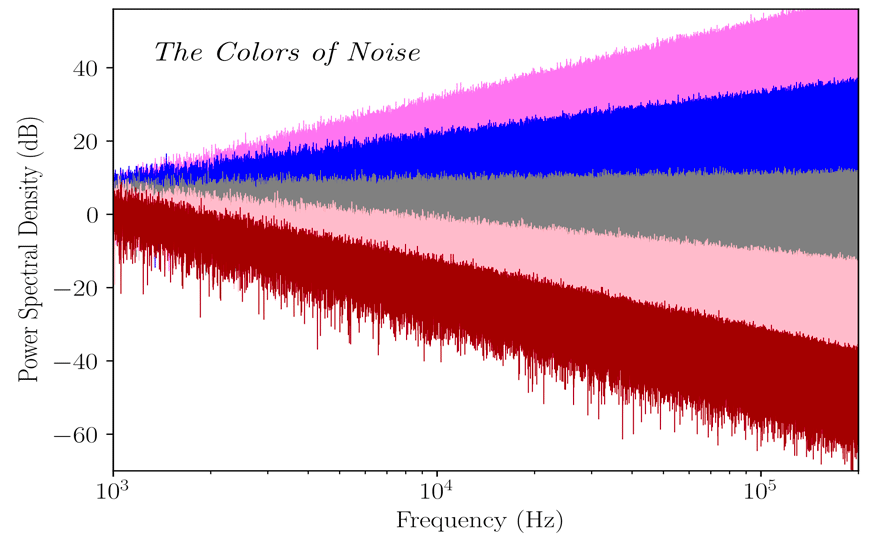
Colours of Noise

Colours of Noise. Image credit: AkanoToE

In various fields like audio engineering, electronics, and physics, the term “colour of noise” is used to describe different types of noise signals.

It’s like having different flavours or styles of noise.

Just as colours can look different to the human eye, different colours of noise can sound different to the human ear, and even have a different appearance as visual patterns.

Each colour of noise has its own specific characteristics and qualities.

Although humans cannot directly perceive the “colour” of noise, we can hear a combination of sound waves that consist of different frequencies.

Frequencies refer to the vibrations of waveforms that occur within a specific time frame.

It’s important to note that this concept differs from synesthesia, where individuals may perceive specific colours associated with certain sounds or frequencies.

Noise, on the other hand, consists of an infinite range of single-source frequencies.

One interesting aspect of noise is that it’s impossible to precisely measure the amplitude of each frequency, even with modern advanced hardware.

To better understand the characteristics of different noise types, we can categorise them into various frequency bands, such as:

  • 0 to 1 kHz
  • 1 to 5 kHz
  • 5 to 10 kHz
  • 10 to 15 kHz
  • 15 to 20 kHz

By using a spectral analyzer, we can measure the intensity of each frequency band.

This information, along with watt measurements, allows us to determine the power of noise within each band, and subsequently assign names to different “colours” of noise.

Where Do Noise Colours Originate?

The idea of naming different kinds of noise using colours originated with “white noise.”

White noise is a signal that has an equal amount of power across all frequencies.

The name “white” was chosen because it was thought to resemble white light, which was at the time, inaccurately believed to have a similar flat power spectrum across the visible range.

After the term “white noise” was established, other colour names like pink, red, and blue were applied to describe noise with different spectral profiles.

Sometimes these names were chosen based on the colour of light that had similar spectra, although not in every instance.

Some of these colour names have specific definitions in certain fields, while others are more informal and not as well-defined.

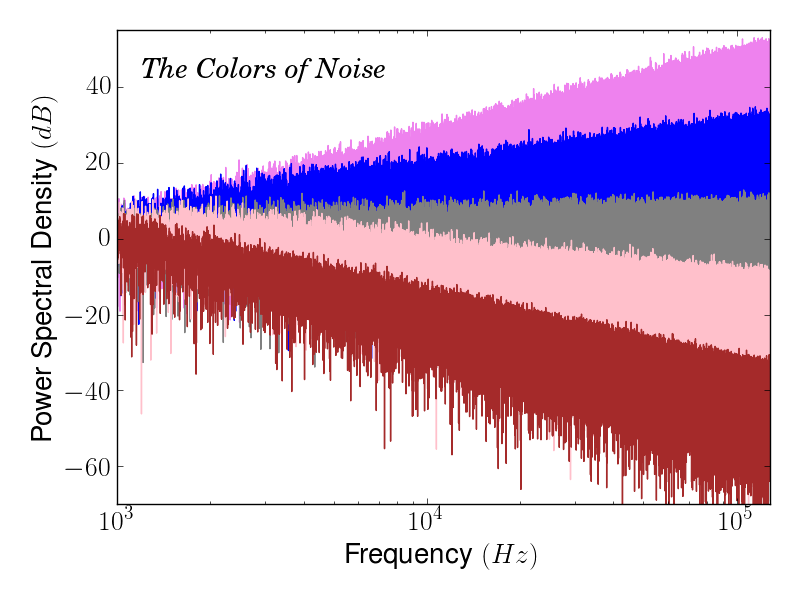
In many cases, these definitions assume that the noise signal contains components at all frequencies, and the power spectral density per unit of bandwidth follows a power-law relationship of the form 1/f β.

This means that the noise is characterised by a certain exponent β.

For example, white noise has a flat spectral density (β = 0), pink or flicker noise has β = 1, and Brownian noise has β = 2.

It’s important to note that these colour names are used in different contexts and disciplines, and their precise definitions may vary.

What is White Noise?

White noise refers to a type of noise signal that contains equal power across all frequencies within a given range.

It’s often described as having a flat power spectrum, meaning that every frequency within the range is represented with equal intensity.

White noise is characterised by its random and continuous nature, resembling the sound of static or the hiss of a television or AM/FM radio tuned to a non-existent station.

White noise encompasses a wide range of frequencies, including both audible and inaudible.

It’s commonly used in various applications, such as audio engineering, sound masking, and scientific research.

Its equal distribution of energy across frequencies makes it useful for testing and calibrating audio equipment, providing a reference signal, or creating a background sound that can help mask other noises.

Due to its consistent and uniform properties, white noise can help promote concentration, relaxation, and sleep by masking distracting sounds and creating a soothing ambiance.

It’s also frequently used in sound therapy, where it can help individuals with tinnitus or other auditory disorders.

What is Pink Noise?

Pink noise is a type of noise signal that has equal energy per octave across the frequency spectrum.

Unlike white noise, which has equal energy per frequency, pink noise exhibits a characteristic decrease in power as the frequency increases.

This means that as the frequency doubles, the power decreases by half.

Pink noise is often referred to as “1/f noise” or “flicker noise” due to its spectral profile.

It gets its name from the resemblance to the colour pink, which has a similar distribution of energy across the visible spectrum.

In terms of perception, pink noise is often described as having a balanced and soothing quality.

It’s considered less harsh and more natural-sounding than white noise.

Many people find pink noise to be relaxing and use it for various purposes such as improving sleep, enhancing focus, or creating a calming background sound.

Pink noise occurs naturally in various phenomena, including ocean waves, wind, and heartbeat rhythms.

It’s also utilised in audio engineering, scientific research, and sound therapy applications.

In audio engineering, pink noise is used for equipment testing, room equalisation, and speaker calibration.

In sound therapy, it can help mask tinnitus, aid relaxation, and promote a sense of tranquility.

What is Brownian Noise?

Brownian noise, also known as random walk noise or random telegraph signal (RTS) noise, is a type of noise that exhibits a specific pattern of variation over time.

It’s named after the Brownian motion, which describes the random movement of particles suspended in a fluid.

Brownian noise is characterised by its random fluctuations that resemble a rapid and irregular switching between two distinct levels.

These fluctuations occur due to the random movement and collisions of electrons or other charge carriers within a material or electronic component.

The behavior of Brownian noise can be observed as a series of abrupt transitions or “jumps” between different voltage levels.

It’s often associated with electronic devices, such as resistors, where the thermal agitation of electrons creates the random voltage fluctuations.

In terms of its spectral profile, Brownian noise follows a 1/f^2 power-law relationship, which means that the power decreases as the frequency increases.

This characteristic gives Brownian noise a unique frequency distribution, with more energy concentrated in the lower frequency range.

Brownian noise has applications in various fields, including electronics, physics, and telecommunications.

It’s used in some electronic circuits for random number generation, as well as in certain measurement techniques and scientific research.

What is Blue Noise?

Blue noise, also known as azure noise or gradient noise, is a type of noise signal that exhibits a specific spectral characteristic.

It’s named “blue” because it’s analogous to the colour blue, which is associated with higher frequencies in the visible light spectrum.

Unlike white noise, which has equal energy across the entire frequency range, blue noise has a power distribution that increases as the frequency increases.

It’s characterised by a higher concentration of energy in the higher frequencies, with the energy decreasing as the frequency decreases.

Blue noise is often described as having a “hissing” or “crackling” quality, similar to the sound of rainfall or rushing water.

It’s considered to be more “balanced” than white noise, as it lacks the low-frequency emphasis found in pink noise.

Blue noise finds applications in various domains, including digital image processing, computer graphics, and audio engineering.

In image processing, blue noise is used for dithering, which is a technique to reduce the visibility of artifacts when converting images to lower bit depths or displaying them on certain devices.

In computer graphics, blue noise is used for anti-aliasing, texture synthesis, and distribution of elements like points or particles.

In audio engineering, it can be used for dithering during digital audio processing or as a reference signal in testing audio equipment.

The specific characteristics and uses of blue noise may vary depending on the context and application.

But in general, it represents a type of noise signal with increased energy in higher frequencies, providing a balanced and visually pleasing distribution of frequencies.

What is Violet Noise?

Violet noise, also known as purple noise or ultraviolet noise, is a type of noise signal that exhibits a distinct spectral characteristic.

It’s named “violet” due to its analogy to the colour violet, which corresponds to higher frequencies in the visible light spectrum.

Violet noise is characterised by an increasing power distribution as the frequency increases.

It’s often considered the opposite of pink noise, as pink noise has a decreasing power distribution with increasing frequency.

Violet noise is sometimes described as having a sharper or more pronounced emphasis on high-frequency components compared to white or pink noise.

The energy in violet noise is concentrated in the higher frequency range, making it sound more “hissy” or “sharp” compared to other types of noise.

It can be perceived as having a high-frequency hissing sound or a rapid series of high-pitched bursts.

In certain applications, violet noise is utilised for specific purposes.

For example, it’s employed in some forms of acoustic testing, where its emphasis on high frequencies can help reveal flaws or irregularities in audio equipment or systems.

It can also be used in some audio synthesis techniques or as a test signal in audio engineering.

It’s important to note that the terminology and usage of violet noise may vary across different fields and contexts.

In general, violet noise represents a noise signal with an increasing power distribution as frequency increases, emphasising higher frequencies and producing a distinct sound characteristic.

What is Grey Noise?

Grey noise, also known as neutral noise or balanced noise, is a type of noise signal that exhibits a balanced energy distribution across the entire frequency spectrum.

Unlike white noise, which has equal energy per frequency, grey noise aims to provide an equal loudness perception across different frequencies.

The goal of grey noise is to create a noise signal that sounds equally loud or balanced to human ears, regardless of the frequency content.

This is achieved by adjusting the power or amplitude of each frequency component to match the equal loudness contour of the human auditory system.

In other words, the amplitude of each frequency is adjusted to compensate for the variations in human hearing sensitivity at different frequencies.

Grey noise is often used in sound engineering, particularly in acoustic testing, psychoacoustic studies, and audio calibration.

It can be employed to analyze the frequency response of audio equipment, assess the masking properties of sounds, or conduct experiments related to auditory perception.

Compared to other types of noise, grey noise may sound more balanced and pleasant to the human ear.

It lacks the sharpness or emphasis on specific frequencies found in some other types of noise.

However, it’s important to note that the perception of noise can still vary from person to person, and individual hearing characteristics can influence the subjective experience of grey noise.

Noises That Harm

Excessive or prolonged exposure to certain types of noise can have detrimental effects on human health and well-being.

Here are some examples of noise types that are known to cause harm:

Workplace Noise

Noise generated at the workplace, such as factories, construction sites, and airports, can reach high levels and pose a risk to workers’ health.

Constant exposure to loud machinery, equipment, or tools without proper hearing protection can lead to noise-induced hearing loss and other auditory problems.

Traffic Noise

Noise produced by road traffic, including cars, lorries, motorcycles, and public transportation, can be a significant source of environmental noise pollution.

Living near busy roads or motorways exposes individuals to constant traffic noise, which can cause sleep disturbances, increased stress levels, and even cardiovascular issues in the long term.

Aircraft Noise

Airports and areas near flight paths experience significant aircraft noise due to takeoffs, landings, and aircraft engine noise.

The high noise levels generated by aircraft can have negative effects on communities, including sleep disruption, annoyance, impaired cognitive performance, and potential health impacts related to chronic exposure.

Construction Noise

Construction sites are known for producing loud and disruptive noise.

Heavy machinery, pile drivers, jackhammers, and construction activities generate high levels of noise that can be harmful to nearby residents and workers.

Prolonged exposure to construction noise can lead to stress, sleep disturbances, and reduced quality of life.

Recreational Noise

Recreational activities such as concerts, sporting events, nightclubs, and personal listening devices can expose individuals to excessive noise levels.

These recreational noise sources can cause temporary or permanent hearing damage, especially when proper precautions, such as earplugs / ear defenders, aren’t taken.

It’s important to note that the harmful effects of noise can vary depending on the intensity, duration, and individual sensitivity.

How Can I Reduce Harmful Noise?

Room Soundproofed with Acoustiblok

Room Soundproofed with Acoustiblok

Whilst it’s almost impossible to stop the source of many of the external noises described above, there are ways to reduce its negative impact.

Firstly, contacting an acoustical consultant where required is an important step.

They can assess your home and see where improvements can be made to prevent noise ingress and reduce the negative impact noise is having on your life.

An acoustics expert can offer complete measurement and testing services, generate reports, and provide guidance on meeting the Building Regulations Approved Document E requirements for both airborne and impact sound concerns.

As part of their testing and analysis service, acoustic consultants can utilise advanced equipment such as the Norsonic Nor 848 acoustic camera.

This cutting-edge technology enables acoustic consultants to identify sound leaks originating from buildings, machinery, and the surrounding environment.

Whether you want to reduce unwanted noise in the home or in your garden, there’s always a solution that can have a dramatically positive effect.

Nowadays, there’s cutting edge NASA developed soundproofing materials that have proven to be extremely effective against unwanted noise.

Ranging from ultra-thin acoustic membrane, to specially developed acoustic fence coverings, there’s several ways to help improve your quality of life with Acoustiblok products.

To find out more and seek professional assistance, contact Acoustiblok for help today.

Conclusion

In conclusion, many people are unaware that noise can have both shape and colour.

While most individuals are familiar with the physical characteristics and intensity of noise, they often overlook the fact that different types of noise exhibit unique spectral profiles.

Understanding types of noise and the concept of noise colour adds another dimension to our perception and analysis of sound, offering a deeper understanding of its diverse properties and impact on our daily lives.

Sound Absorption
Blog

Sound Absorption Principles Explained

Sound absorption is the process by which sound waves are reduced in intensity as they encounter an absorptive material.

When sound passes through a material, some of the energy waves are converted into heat or other forms of trace energy, causing the sound to become quieter or less noticeable.

In certain settings, sound can prove to be troublesome since it can travel easily.

In larger buildings with high ceilings for example, echoes and reverberations are commonplace.

In controlled environments such as recording studios, sound needs to be controlled and calibrated to create an acoustically viable setting, optimise acoustic performance and maximise the recorded sound quality.

In both instances, sound absorption can help to improve the overall impact of sound and how it travels.

In the following chapters, we outline how sound absorption occurs, how absorptive materials are used to improve sound and how to apply them.

What is Sound Absorption?

Sound absorption is the term used to describe ways with which sound reverberation and echoes in a space are reduced via absorption, in order to enable a cleaner sound quality.

By means of sound absorption, there will be a noticeable loss of sound energy due to the soundwaves being absorbed by the material in question.

These materials can be porous or non-porous, and may include things like foam, open cell mineral, fiberglass, fabrics, cushions, throws, curtains or carpets.

Sound Absorption vs Soundproofing

Foam & Sponge

Image credit: Unsplash

Sound absorption and soundproofing are often thought to be one and the same, but this is far from being the case.

There are actually very distinct differences between these two terminologies.

As noted above, sound absorption refers to reducing echoes and reverberations.

By doing so, the overall volume of noise is reduced, and consequently clarity is increased.

As a general rule, sound waves bounce off solid surfaces.

While the direction of the sound may change, the echo will sound the same as the original sound but with an amplified effect.

As a result, the louder the source is, the more energy the soundwaves will have.

The longer the reverberation time is, the louder and more noisy a room will become.

That is why in some settings, sound absorption is very important, as the acoustic value in the space can become uncontrollable and unusable if it isn’t dealt with.

Some common examples where sound absorption is important include school classrooms, sports halls, concert venues, cinemas, theatres and recording studios.

Generally sound absorption is applied where possible or feasible – floors and walls, as well as ceilings and partition surfaces.

Soundproofing on the other hand refers to isolating and blocking noise from being transferred through the structures.

The sound energy is stopped from making its way to another room for instance.

With soundproofing, the main aim is to prevent as much sound energy as possible from being transferred by whatever means to the outside of the subject space.

This may be in way of varying principles of decoupling of the structure, absorption, deflection and thermal conversion.

Thermal conversion (Acoustiblok 3mm Isolation Membrane) is where the energy is converted into trace heat energy via vibration, or else, transmitted away from the location.

What Happens When Sound is Absorbed?

When sound is absorbed, the sound energy is transformed into heat energy.

This conversion is partly transmitted through the absorptive material.

If the sound is not absorbed it would be reflected or transmitted, thereby causing reverberations and echoing.

Generally, soft and pliable materials are good acoustic insulators as they manage to absorb more sound than hard and impenetrable materials.

The ability of a material to absorb sound is measured by its sound absorption coefficient or noise reduction coefficient, which ranges from 0 (perfectly reflective) to 1 (perfectly absorbing).

The coefficient is a function of the frequency of the sound wave, the angle of incidence, and the thickness and density of the material.

Material Sound Absorption Coefficients

Materials

Absorption Coefficients by Frequency (Hz)

Acoustic Ceiling Tile .80 .90 .90 .95 .90
Brick .03 .03 .03 .04 .05
Carpet on Concrete .08 .25 .60 .70 .72
Heavy Curtains .15 .35 .55 .75 .70
Marble .01 .01 .01 .01 .02
Painted Concrete .10 .05 .06 .07 .09
Plaster on Concrete .10 .10 .08 .05 .05
Plywood on Studs .30 .20 .15 .10 .09
Smooth Concrete .01 .01 .01 .02 .02
Wooden Floor .15 .11 .10 .07 .06

Type of Sound Absorbers

Sound absorbers can be divided in three categories, namely;

Porous Absorbents

Porous absorbents can be subdivided in two types, which are:

a) Fibrous

Such materials absorb soundwaves because as soon as they make contact with the material, the fibres will bend and generate heat energy.

Since the acoustic energy is converted to heat energy, the sound will be absorbed effectively.

b) Open-cell

In this case, air movement is generated as the soundwaves push through air particles.

This results in a viscous loss and heat is generated too.

Resonance Absorbents

Resonance absorbents, such as membrane absorbers, are composed of an acoustic or mechanical oscillation system.

This consists of a solid plate behind which there is an airtight space.

The sound absorption will reach its maximum at the resonance frequency.

The cavity might also be filled with a porous material in order to further broaden the absorption over the various frequency ranges.

Single Absorbents

Acoustiblok Ceiling Panels

Single absorbers can be any objects in the room or space, such as tables, chairs and bookcases.

Hence the sound absorbing characteristics of such materials will vary significantly.

Low frequency sounds which are lower than 500 Hz will be more difficult to absorb.

Conversely, high frequency sounds in excess of 500 Hz can generally be absorbed more easily by single absorbers.

Acoustic ceiling panels and acoustic wall panels are also classified under this category of sound absorbers.

Acoustiblok AcoustiClouds and Acoustiblok Absorber Panels can be used as ceiling panels or wall panels.

These panels are very effective when it comes to absorbing sound as they have a Class A sound absorption level (40mm & 50mm options) or Class C sound absorption level (25mm).

As a result, these panels increase acoustic absorption, thereby reducing the unwanted regeneration, reverberation, and resonance of the soundwaves.

They are also designed to enhance the appearance of the room since they are available in a vast assortment of colours and sizes.

Moreover, they are exceptionally easy to install.

They’re available with varying methods of installation – wall mounts systems, ceiling hooks, cable systems or with a self adhesive backing, which makes mounting them to walls and ceilings quick and effortless.

Simple and effective with easy installation to the intended surface.

Absorber panels come in standard or bespoke sizes, and have a fibrous core thickness of 25mm or 40mm (Class 0 fire rating).

Self adhesive panels are a non fibrous core of 50mm (fire resistant).

AcoustiWall panels and AcoustiCloud Ceiling Absorber Panels are designed with a fabric finish which is available in an extensive range of colours.

Fabric facing complies with Class 1.

Class 0 fabrics are also available on request.

How Do Sound Absorbing Acoustics Panels Work?

Sound absorption acoustic panels are one of the top options for effective sound absorption.

Such panels are made from a soft material which is specifically designed to absorb sound energy.

The panels will stop the sound energy from bouncing around the room, and will not reflect off the walls, ceiling and other surfaces.

As a result, the highest acoustic performance can be achieved, allowing for a better environment in terms of acoustic comfort and improving speech intelligibility.

That is why such acoustic panels are used in schools, hospitals, offices, restaurants and other commercial spaces, as well as in domestic settings.

Where are Sound Absorption Principles Used?

Recording Studio

Recording Studio Using Acoustic Wall Panels. Image credit: Pixabay

Sound absorption principles are used in various applications and settings.

Some examples include:

  • Sound recording
  • Sound reproduction
  • Room and architectural acoustics
  • Loudspeaker design
  • Noise barrier walls
  • Sonar
  • Social spaces such as halls, schools, restaurants and bars
  • Office space

What is an Anechoic Chamber?

An anechoic chamber is a room which is designed to absorb as much sound as possible.

In such a room the walls are made from a number of baffles that have highly absorptive materials.

The arrangement ensures that even if a fraction of the sound is reflected, it will be in the direction of another baffle rather than in the room.

As a result, such a chamber is essentially devoid of any echoing.

Setting up such a room is rather expensive and they are only created when there is the need to carry out experiments or to measure sound pressure levels, for example.

Large absorptive foam wedges are used on walls, ceilings and floors, and it is crucial for them to be big in order to be effective even for low frequencies.

The doors must be sealed well and ventilation, if any, needs to be very carefully set up to ensure that there are no leakages anywhere.

Conclusion

Spaces where noise can be amplified, reverberated or echoes need to be dealt with to reduce such problems.

It is important to consider the space as well as its particular purpose in order to choose a sound absorption solution that can be as effective as possible.

If you have a space in a commercial or residential setting that requires better sound control, contact us to arrange an expert acoustic consultation.

One of our acoustical experts will be able to help you to decide on the best way to improve overall sound quality and noise control within your space.

Soundproof a Party Wall
Blog

How to Soundproof a Party Wall

Party walls are very prone to noise transmission.

Such walls are generally not as thick or as solidly constructed as structural load-bearing walls.

In most cases, party walls are often used to offer a basic separation of dwelling, typically found in terraced, semi-detached homes and flats.

As a result, noise transference can be a common issue.

For this reason, it’s a good idea to explore various soundproofing materials to discover the best ways to reduce noise ingress coming through a party wall.

In the following chapters, we set out how to soundproof a party wall effectively to reduce as much noise transference as possible.

Identify Weak Points

Hole in Party Wall

Image credit: Unsplash

Before opting for any kind of soundproofing strategy, it’s important to identify the party wall’s weak points in order to be better able to address noise transference as effectively as possible.

Sound will pass easily where there’s minimal resistance.

Hence your approach needs to address such weak points where sound transmission occurs most.

For example, this may be at the position of an alcove either side of a fire place or chimney breast.

Even the tiniest gaps or cracks can make a big difference when it comes to sound transmission, as well as flanking noises.

Types of Noise

Colours of Noise

Image source: Wikipedia

Sound travels through materials where resistance is not present.

Hence, when two properties are connected via a wall, it’s easy for noise to transfer from one side to the other through the building’s own structure.

In order to reduce noise effectively, you will need to consider the type of noise that you’re dealing with.

Also consider how sound is likely to travel from the point of source to wherever it is being heard.

You will also need to take into account the fact that there’s a distinct difference between soundproofing and sound absorption.

Therefore, what you choose in way of a mitigation strategy will be affected by the type of noise that you wish to reduce.

Airborne

Airborne noise is the term used to describe sounds which are transmitted through air.

So this could include any of your neighbour’s conversations, music or an overly loud television for example.

Sound waves propagate through the air, eventually colliding with a surface.

Whenever the sound waves collide with a surface, vibrations occur resulting in both airborne as well as structural noise.

This can lead to vibrations passing through a structure of a wall.

For example, into the space beyond that wall, such as into a neighbouring dwelling, which is commonly known as flanking transmission.

Structural

Structural or structure-borne sound is the noise that occurs as a result of some form of impact of a soundwave onto a surface such as a building’s fabric.

It also includes any vibrations that result from such an impact.

The sound gets radiated from a surface, leading to vibrations.

The vibrations will be transferred through the structures, such as through the floors or ceilings, and be heard from another part of the property due to flanking transmission.

Impact

Impact noise is very similar to structural noise.

However, rather than noise being transferred through the structure, it refers to the sound that results when two objects impact one another such as footfall.

Subsequently, transmission to the other surface occurs.

Understanding Party Wall Structures

Party Wall Structure

Image credit: Home Approved

Party walls are often used in residential as well as commercial settings, such as terraced homes, flats and apartment units, and retail outlets in shopping malls.

Its main purpose is essentially a partition dividing two adjoining dwellings or spaces to create a separation as well as a fire break or firewall.

Hence the party wall will be shared with a neighbouring property or room.

Whilst a party wall is considered structurally sound, its soundproofing properties can typically be poor, so it will not stop sound from passing through.

This is because soundwaves move through the rigidity of the wall itself, causing vibrations and sound transmission.

This is even more the case in older properties where building standards differed from levels that apply to more modern, present day builds.

Although in some cases older walls may be thicker than modern designs.

Equally it may be found that other walls may not be as thick and the older they are the more unlikely to have any noise reduction materials in place.

That said, even building standards and compliance levels of today with modern building methods do not necessarily provide any guarantee.

A common issue to cause increased noise transfer is via structural changes within a building.

As an example, where walls or chimneys have been removed and supported by steel supports, commonly known as RSJ’s, to create an open plan design or increased space.

Soundproofing a Party Wall

Acoustiblok Lined Party Wall

When it comes to soundproofing a party wall, it’s important to be realistic.

While there are options to soundproof a party wall to a reasonable degree, none of them are likely to stop sounds completely.

The following are some ways to soundproof a party wall:

Reduce Flanking Noise

One of the most important considerations is the need to reduce flanking noise.

Flanking sound transfer will occur easily through the rigidity of a building structure.

The more gaps, cracks and cavities that are present, the worse this will be.

Dividing walls that tie or junction into the party wall at 90 degrees can offer a very real and difficult flanking pathway.

In the case of a party wall and joisted floors, there will generally be cavities between floor joists for instance.

Hence, when embarking on a project of soundproofing a party wall, you will need to carefully analyse areas where flanking noise will occur in order to address such points as effectively as possible.

You may start by checking in which direction the floorboards are installed, which in turn will dictate the direction of the structure underneath.

Where floorboards run towards the party wall, the joists below will be running perpendicular to the floorboards and therefore parallel to the party wall.

Where floorboards run parallel to the party wall, the joists obviously run into the party wall which will be more likely to result in increased flanking transmission.

In such cases, it’s even more important to ensure that sound insulation is added between the floor joists to reduce flanking noise transmission there as well.

Flanking noise reduction is challenging, as the sound or vibration will find any route it can to travel from where it originates through the structure.

Examples are the wall, floor, ceiling, beams, dividing walls and joists, steels, air bricks and so on.

Naturally, structural connections cannot be removed, but at least with the right approach and correct use of materials it’s possible in most cases to greatly reduce acoustic values.

Apply Decoupling Principles

Decoupling principles have to be kept in mind when soundproofing a party wall.

The main idea where possible is to use materials, or a system, which will be able to separate the mechanical linkage that is present in the structure.

In this case, you would be aiming to separate the party wall as much as possible to remove the direct connection that is present with the rest of the structure.

Decoupling can be done by installing a framing system with battens attached to the wall.

Better still, decoupled studs attached away from the wall by means of being attached with a floor plate and ceiling track.

The separation should begin at the floor joists, and ideally where possible, run all the way to the roof.

Acoustic hangers or clips, a batten or brackets perpendicular to the initial frame should also be used to further decouple the structure, and offer a platform onto which to attach the chosen finishing board.

Apply Acoustiblok 3mm Isolation Membrane

When soundproofing a party wall, applying soundproofing materials such as Acoustiblok 3mm Insulation Membrane onto the chosen framing system is practically a must.

This would then be boarded over with a finishing board.

Once the chosen type of framing is installed, firstly apply an open cell acoustic insulation in between the framing system.

This is available in varying thicknesses and densities for a part fill or full fill as required.

This adds a base principle of acoustic insulation – absorption.

Secure and fix the flexible Acoustiblok Insulation Membrane onto the framing system.

Acoustiblok 3mm Insulation Membrane is generally the most suitable in the case of party wall soundproofing projects, although Acoustiblok 6mm Insulation Membrane can also be specified.

Acoustiblok technology works by converting acoustic energy into a less problematic trace heat energy by a process of thermal conversion.

This principle adds a huge uplift in acoustic performance and actually helps all other materials within the assembly work much more effectively.

Ideally and where feasible, material should be applied to both sides of the wall.

But in cases of party walls, this is most likely impractical.

Joists could be insulated by using an isolation membrane to reduce vibrations and flanking transmissions.

Apply Plasterboard (Drywall) Layer

Finishing the new stud wall assembly with a dense plasterboard is essential to finish the wall for decoration.

This adds a layer of mass and density which itself is a base principle of acoustic insulation – deflection.

A secondary batten or resilient channel with sound isolation clips should be installed to further increase noise attenuation.

It’s also very important to ensure that the heads of the plasterboard fixings are countersunk and a small nib of acoustic sealant applied to soften the head.

It’s a small job with limited effect per fixing however, when adopted across multiple fixings every little counts.

An alternative and less invasive option to the above is to apply only a plasterboard or drywall layer to the existing wall, but this is rarely promoted and seldom achieves the desired outcome.

This may well be a quicker and cheaper way to go about increasing mass to a party wall, but it hardly achieves suitable increases.

It may help in reducing some frequencies and decibels of noise from passing through the wall.

If installed poorly, it could actually accentuate the problem by increasing vibrations, resonance and regeneration passing through the board’s own rigidity.

Additional layers of plasterboard can be adhered in place with certain adhesives and mechanical fixings.

Finishing Touches

Finishing Plasterboard Drywall Layer

Image credit: Unsplash

Finishing touches are always very important.

Not just in terms of aesthetics, but even more to ensure that the soundproofing results are as good as can be.

You want to make sure that the soundproofed party wall is air and sound tight in its entirety.

Thus, suitable products should be used for finishing to further improve soundproofing capabilities.

Which products you use is down to your own discretion.

Acoustic sealants, caulks, jointing tapes and putty will serve their purpose well when it comes to ensuring the party wall is sound tight and without any tiny holes, cracks or areas where sound could pass.

Sealants & Caulks

Acoustical sound sealants and caulks should be used in order to seal around the perimeters and adhere to the wall structure to help in further reduce sound transmissions.

These sealants and caulks are easy to apply and can maintain a good STC.

We recommend Acoutiblok’s Acoustical Sound Sealant for this particular job..

Jointing Tapes & Putty

Jointing tapes and putty may also need to be used to finish up.

There are specialised jointing tapes which are made from materials that can improve soundproofing qualities.

This is also the case with putty or acoustical putty pads, which when applied can offer an effective acoustic barrier to unavoidable penetrations.

Any minor holes or cracks can thus be filled up properly.

You can then cover any joins with Acoustiblok AcoustiGrip Tape.

Conclusion

When it comes to soundproofing party walls, no method will completely stop sound transfer, so it’s important to be realistic and manage expectations.

Adopt as many principles as possible to the assembly for maximum effect within minimum tolerances.

However, you can reduce noise significantly to acceptable levels.

Above we’ve discussed some ways to soundproof party walls effectively, but as always, it’s recommended to consult with a soundproofing specialist prior to embarking on such a project.

They may well be able to help identify the most suitable method and supply the most appropriate materials for your property’s party wall construction.

Home Theatre Soundproofing
Blog

Complete Home Theatre Soundproofing Guide

Ask any movie lover what their ultimate home entertainment ambition is, and the most common answer you’ll get is to own a fully fledged professional grade home cinema room.

With more of us now enjoying on-demand entertainment at home rather than going out to the movies, a home cinema room is the dream ticket.

Not only will this greatly enhance your home entertainment experience, it will also add value to your property.

The fact is however, setting up a home theatre requires a lot of planning and the correct materials applied appropriately.

Most home theatre systems produce sound at very high volumes, with wide ranging frequencies from low thunderous bass, to mid-range and high end crashes and bangs, especially during action movies.

It’s therefore important to give utmost consideration to soundproofing the cinema room to prevent noise from interrupting adjoining rooms and neighbouring buildings, as well as acoustic calibration to get the ultimate in sound quality inside the room.

Soundproofing and acoustic calibration are rather complex fields, especially to the amateur enthusiast.

So knowing how to get started and how to go about this process correctly is important to achieving the desired results.

In this guide, we set out to explain the process in an understandable way, and help you start your journey towards getting the home cinema room you always craved.

How Sound Travels Around a Room

Reflected Sound

Image credit: Amrita

Firstly, it’s important to understand how sound travels around a room bearing in mind that a home cinema system will be creating considerable levels of sound.

No doubt, you will have come across the term ‘soundwaves’, with the reason being that sound travels in waves in a forwards and backwards motion.

Whilst doing so, the air particles near the source are compressed.

Then, when the soundwaves move forward, they will in turn compress the other air particles.

Soundwaves can basically be described as simple vibrations.

And thus the process of acoustical control for example, is to create barriers in order to reduce such vibrations.

This is where soundproofing comes into play.

How to Measure Sound Transmission

Colours of Noise

Image credit: Wikipedia

Sound transmission is measured by carrying out sound tests.

Every material that is used for soundproofing purposes will have an associated STC (Sound Transmission Class) rating.

Its performance is measured by subjecting the material to soundwaves at varying frequencies.

Any loss in sound power is then recorded on the other side of the material.

This is measured in decibels.

The resultant transmission loss, also referred to as TL, will then be plotted out to ascertain the overall STC value for that material in question.

As a general rule of thumb, a minimum of STC 50 is considered as the rating that meets the International Building Code standards for new properties.

Anything below that is considered a poor soundproofing material.

In stud walls for example, the STC can be further increased by adding a secondary layer of drywall paneling for increased mass / density.

There are various ways to go about improving soundproofing a cinema room and different types of materials that you can use.

This is why it’s best to seek the assistance of an acoustical consultant to advise on the best options.

Airborne Sound & Structure-Borne Sound

Essentially, there’s two types of sound sources – airborne sound and structure-borne sound.

In the case of airborne sound, the sound reaches the ears by traveling through the air.

But in the case of structure-borne sound, noise is generated when the soundwaves come into contact with solid objects or structures.

This causes both vibrational noise (possibly leading to flanking transmission) and also a deflection or bounce back soundwave.

Generally, the majority of sounds we hear have both airborne as well as a structure-borne sound combined.

However, structure-borne sound travels faster than airborne sound.

And since they tend to be in the lower frequency range, they tend to be more difficult to deal with from a soundproofing perspective.

This is because vibrations may occur in parts of the wall that’s either connected to, or in close contact with drywall panels which will react to structure-borne sounds.

Commonly referred to as ‘flanking transmissions’.

As a result, the sound will be heard in adjacent rooms.

Ways to Soundproofing a Home Theatre

Home Theatre Soundproofing Build

Image credit: Acoustiblok

The following are some ways which can be used to soundproof a home cinema effectively.

These may be used in conjunction with others depending on the room size, the structure of the room, your budget and certain other key considerations a professional soundproofing expert may identify.

Add Mass & Density

Adding mass is one common way of soundproofing a home cinema room.

When you add as much mass as possible to a surface, it will perform much better at muffling low frequency sounds, which are considerably hard to control.

For best results, it’s recommended to use smart composite materials.

A basic stud wall / layer of drywall will typically have an STC rating of around 32dB.

To give you an idea, every doubling of mass will be able to reduce the power of the sound output by 6 decibels.

That said, even this in isolation is not going to block all low frequency sounds completely.

So besides adding mass, other techniques will need to be applied to a home theatre room in order to contain sound better.

Decoupling

Decoupling is one of the most effective soundproofing methods for a home cinema room.

It’s ideal to push the STC level over 60, which is necessary for the high volume sounds produced in such a room.

Decoupling can help to absorb the bass frequencies effectively.

This is because two adjoining surfaces will be separated from each other, practically leading to a ‘double wall’ system.

Consequently there will be an air cavity in between, which will kill most of the sound.

Metal channels are generally used to achieve this.

The vibrational waves which are transmitted from structures, that is, structure-borne sounds, will thus be better contained with such a technique.

However, it’s crucial for the separation space to be large enough in order to avoid resonance.

That’s why applying this technique in conjunction with others is recommended.

Thermal Conversion & Sound Damping

Many would argue that this is the most important part of soundproofing any type of room, but it’s even more important in the case of a home cinema room.

For best results, Acoustiblok 3mm Isolation Membrane is well recognised and used extensively commercially as well as within the AV / home cinema industry.

This material is used as well as the other materials and principles (not instead of other materials) to add an intelligent insulation layer to thermally convert acoustic energy via vibration into heat energy.

This outperforms, mm for mm, other materials and principles.

Importantly it helps and allows the other materials and principles within the detail / assembly to work more efficiently.

This is because by converting problematic acoustic energy into less problematic thermal energy it reduces vibration / flanking transmissions through the substrate.

Acoustiblok 3mm Isolation Membrane greatly helps across all frequencies, even with the more powerful and troublesome low frequencies.

Combining sound damping with decoupling is highly recommended for a home cinema.

Rattling sounds can be greatly reduced and thus the sound quality in the room will benefit.

Resilient Channels

Resilient channels are essentially L-shaped or C-shaped strips made from metal.

For ceiling applications they may be referenced as ‘top hat’ channels as they are shaped like a top hat.

Differing types of these are often used in soundproofing projects and especially in AV / cinema installations to further combat the inevitable high energies.

They’re laid across / perpendicular to studs or joists, in order to help minimise structure-borne sounds that manage to pass from the drywall to the timber or metal studs or joists.

They can also be very helpful in conjunction with the installation of Acoustiblok 3mm Isolation Membrane as previously referenced.

The channels have a flange at the bottom to enable them to be screwed to the wood and leave the top section loose.

Resilient channels are very effective at adding another level of decoupling and are relatively affordable but do add another layer of depth to the overall wall assembly.

However, as with all materials, it’s crucial to opt for the better quality channels and to ensure they’re installed correctly, as otherwise the final soundproofing quality will suffer.

Moreover, while they do well with high frequencies, they are not as good at dealing with low frequencies unless applied in unison with other techniques.

As is a common theme in all works of acoustic insulation, the devil is in the detail.

Isolation Clips

There are many types of sound isolation clips with the most common being metal connectors which are covered with rubber.

These are attached to wall studs directly and connected with furring channels.

The latter is made from steel or aluminum strips of metal designed in a u-shape, which serve to isolate the drywall from the studs.

The rubber greatly helps to minimise structure-borne sound transmission and flanking transmissions.

Isolation clips are relatively more expensive than resilient channels, but are somewhat easier to install and provide good soundproofing results.

They’re also less prone to sagging issues.

Double Stud Walls

When it comes to soundproofing the walls of your home cinema room, there’s numerous considerations that need to be taken into account.

This includes whether you’re aiming for acoustic isolation or calibration, as well as the construction techniques you will be using to house the AV equipment, speakers, screens and points of source ignition.

One of the best soundproofing methods is to construct double stud walls.

While room space will inevitably be lost as a result, this is one of the best decoupling options, especially for a home cinema room.

A double wall made of drywall is generally the most practical option but your own critical tolerances on space and performance criteria will dictate the approach.

A standard single stud wall assembly provides an architecturally recognised STC of 36dB, which is not a lot of acoustic mitigation.

Think of the stud wall between bedrooms and ensuite bathrooms which are not particularly successful in containing noise!

However by adding a single layer of Acoustiblok 3mm Isolation Membrane to a single stud wall assembly can increase the STC rating from 36dB to approximately 53dB.

By adding a double layer of Acoustiblok 3mm Isolation Membrane to a single stud wall assembly, you can increase the STC rating from 36dB to approximately 57dB.

Furthermore, adding Acoustiblok 3mm Isolation Membrane to a double stud wall assembly can increase the STC rating to approximately mid 66dB.

You may also wish to consider using an open cell cavity insulation with increased density such as Acoustiblok QuietFibre instead of lighter weight fibre or foam.

Increased density increases the noise reduction coefficient (NRC) of the material.

Acoustic sealant should be used in any area where cutting, overlapping and jointing is done, as well as to any seams and gaps.

Staggered Stud Walls

A staggered stud wall is a popular option as it can help to save space, especially if this is somewhat limited.

While it may not be as effective as a solid counterpart, it’s still an option that you could explore.

As an example, a staggered stud wall assembly incorporating a single layer of Acoustiblok 3mm Isolation Membrane can provide an STC of around 57dB.

Plasterboard & Drywall

Plasterboard or drywall is a popular type of paneling material since it’s relatively inexpensive and easy to install.

There are many various types available offering differing thicknesses and densities / weights.

As mentioned earlier, by adding an extra layer of plasterboard or drywall to a stud wall, you will be able to contain high and mid-frequency sounds reasonably effectively.

This will add more mass and density that sound will have to combat.

However, although seen largely as a positive move it can also add a lot of additional weight to the assembly and its own weight and rigidity can also vibrate to create levels of increased flanking transmission in way of a knock on effect through itself.

In order to better contain low frequency sounds however, it’s best to specify this with the use of decoupling, thermal conversion and isolating techniques that can greatly improve results overall.

Mass Loaded Vinyl

Mass loaded vinyl can be another way of introducing mass as a membrane within a thinner material.

Many use it in between two layers of drywall although results are largely as a result of other key decoupling, convertive and deflective principles along with attention to detail, but every little helps.

Dampening Compound

Applying dampening compound is highly recommended if you’re going to add an additional layer of drywall.

A dampening compound is essentially a viscoelastic adhesive which can offer dampening as the elastic has energy absorbent properties.

Dampening compounds help to reduce low frequency sound transmission.

Acoustic Sealant

Acoustic sealant or caulk, is of great importance when soundproofing a home cinema.

It’s critical to seal each and every gap that’s present to prevent any potential sounds leaking out.

Gaps are commonly found around panels, fixtures and fittings.

Wherever there’s a gap, the area needs to be filled up with as an example Acoustiblok Acoustic Sealant in order to prevent any transmission of airborne sound waves.

Acoustic Putty

Acoustic putty can also be used to close openings within the material.

For example ,around electrical back boxes and where services penetrate the Acoustiblok 3mm Isolation Membrane.

Floor Underlay

Floor underlayment is another consideration, especially if there are rooms beneath the room where you’re planning to have your home cinema. Planning and the optimum location is key.

Having a soundproof underlayment between the floor and the subfloor is crucial in such a case, if not a completely isolated and fully treated floor assembly.

Various types of materials can be used for floor underlay.

This includes shredded or foamed rubber, cork or a bituminous membrane, hybrid foam and rubber base layers or of course the well recognised Acoustiblok 6mm Isolation Membrane.

Soundproofing your floor can thus be done in various ways and by using different materials, and the choice will ultimately depend on your budget and preferences.

Carpet Tiles

Carpet tiles are very popular for home cinemas as they’re aesthetically pleasing and also quite effective for soundproofing.

The principles of acoustic isolation and acoustic calibration are really important here and can greatly affect the reverberation times and critical acoustic performance.

Carpet tiles are relatively easy to install and quite affordable too.

Nowadays, such tiles come with waterproofing qualities for more practicality.

Acoustic Panels

The principle of employing and designing these type of acoustic wall panels is strictly for the purpose of acoustic calibration rather than acoustic isolation.

Acoustic wall panels help to reduce the reverberation time and resonance of hard surfaces, thereby improving sound quality.

An all important consideration for a home cinema.

Most Acoustic Wall Absorber Panels are available in a variety of sizes, colours and shapes.

They can be attached to the wall directly and are among the most effective and practical acoustic treatment options for a home theatre.

Where feasible, acoustic absorber panels such as the AcoustiCloud Panels can also be detailed within the ceiling.

Sound Curtains

Sound curtains are a good way to soundproof a home theatre.

Specialised curtains will incorporate a heavy layer of acoustic membrane which will allow for good results in terms of soundproofing as well as to improve the room’s acoustics.

Bass Traps

Just as their name suggests, the main aim of bass traps is to capture low frequency sounds.

Bass traps come in various sizes and shapes.

They will greatly help in dampening low frequencies, thereby producing a better and flatter bass sound.

Soundproofing vs Acoustic Control

Soundproof Panels

Image credit: Pixabay

Soundproofing is sometimes thought to be the same as acoustic control.

But in reality, this is not the case and they should not be confused with one another.

Soundproofing essentially aims to reduce sound waves that travel from room to room, whereas acoustic control focuses on managing the quality of the sound within the room.

It’s important to be aware of the differences between the two as it will allow you to reach your goals better by choosing the most suitable materials and techniques.

Acoustic treatment applications will include acoustic panels, acoustic foam, diffusers and bass traps, among others.

Whereas soundproofing techniques will revolve around other options as discussed above.

Home Cinema Seating Considerations

Rows of Black Cinema Seats

Image credit: Pixabay

You’ll probably not have considered this but in reality, the type of home cinema seating you install will greatly impact acoustics.

Hard surfaces are to be avoided as much as possible as this will create unwanted reflection, resonance and reverberation.

As a result, it’s highly recommended to opt for seating that is upholstered as these will help to absorb and dampen frequencies.

Room Equalisation & Sound Calibration

Room equalisation refers to the adjustment of the frequency output of the speakers in order to match the acoustic properties of the room.

Nowadays, most AVRs comprise room control apps, while older models will typically have a graphic equaliser to allow you to adjust the broad frequency bass and the mid and treble outputs.

But if it’s your aim to get the very best possible sound quality and overall balance as possible, you need to speak to a professional sound engineer or acoustical specialist.

Conclusion

Please consider this to be a simplistic overview of the basic considerations you may wish to ponder.

We hope that this guide has helped to give you a better idea of how to go about soundproofing a home cinema room.

The all important key is to firstly understand the differences between soundproofing and acoustic calibration.

Take your time to work on a plan that provides a suitable solution in a suitable location, that is fit for purpose.

Choose the location and type of AV equipment wisely.

Where an installation is suitably sized, we can not emphasise sufficiently the importance of engaging with a qualified and recognised AV professional.

This will help establish the correct approach and specification required to suitably fit aspirations, space and budget.

Where appropriate this may simply be an AV retailer or a recognised AV installer, or CEDIA approved designer and installer.

Then it’s down to you to use the right materials and techniques, paying close attention to details which will make a huge difference to the final result.

It may be best to start off with something simple and practical, then explore other options until you find what seems to work best.

Combining different techniques is always recommended.

As mentioned above, consulting an acoustics professional to establish the correct equipment of choice, its proposed location and installation followed by a suitable acoustic mitigation strategy is always advisable, especially in this field which is so broad.

Acoustic Insulation
Blog

Best Acoustic Insulation Applications for Soundproofing

If you’re experiencing problems relating to noise at home or the office, you may wish to consider investing in acoustic or sound insulation.

This can help to reduce the intensity of the sound that’s being heard in your property, and prevent sound transmission occurring between rooms within the same building.

In this article, we’ll be discussing how you can use differing acoustic insulation materials and strategies to ensure the best effectiveness against nuisance noise.

What is Acoustic Insulation?

Soundproofing Materials

Soundproofing is the term that tends to be used more often than acoustic insulation.

However, it’s important to avoid using them interchangeably.

Soundproofing solutions may include the use of acoustic insulation to block and prevent passage of sound waves and noise.

This may include varying materials and construction methods.

The purpose of this article is to primarily focus on acoustic insulation and principles.

This may include the addition of acoustic insulation materials which use mass or density with associated weight to stop noise from passing through a structure.

Other materials would be open cell to absorb airborne sounds and reduce sound reverberation.

In addition there’s the specialist material, Acoustiblok Sound Insulation Membrane which uses a highly advanced and technical solution in dealing with sound energy, through thermal conversion to convert acoustic energy into trace heat.

More about the various types of acoustic insulation materials will be discussed in further detail below.

How Does Acoustic Insulation Work?

Reflected Sound

Image source: Amrita

This can very much depend on the approach taken and the materials used.

Adding more mass to a structure may effectively hinder sound transmission as the increased density and depth creates more of a barrier that any sound waves now have to travel through.

However, it would also be correct to consider that the rigidity of any mass, dense materials can also vibrate, especially within certain frequencies leading to possible flanking transmissions.

For best results, adding mass alone may not be enough.

Effective soundproofing solutions comprise the use of different types of materials, as some may be more effective than others to block the particular types of sounds.

It’s also important to note that sound travels as vibrations.

Therefore, it’s also necessary to prevent such sound vibrations by way of dampening, thereby preventing them from being able to travel through a structure’s weak points.

To do this, the principles of decoupling and dampening come into play.

By means of acoustic insulation, these vibrations are absorbed, dispersed, deflected or blocked.

The ultimate goal is to maintain the sound intensity at a lower level, or a more manageable or acceptable one, as the case may be.

Why is Acoustic Insulation Important?

Watching Movie Eating Popcorn

Image credit: Pixabay

Acoustic insulation is a necessity if you’ve reached a point where noise pollution is affecting you negatively, or where proactively seeking to prevent a noise source from becoming such.

Examples may be physical or mental health concerns.

Unfortunately, the modern world has helped to normalise day-to-day life in noisy environments.

Yet this is considered extremely bad for our health, and in many cases has been proven to be so.

Thus, sound insulation can help us to live a better quality of life and be properly protected from exposure to noise related problems, whilst increasing comfort and privacy levels.

In commercial settings, sound insulation can be very helpful to improve productivity levels.

If your business premises is located on a busy road, or there’s noisy machines in close proximity, it’s a good idea to invest in acoustic insulation.

This will provide a much quieter working environment for yourself and your employees.

As a consequence, staff morale and productivity will improve.

Another point worth mentioning is sound insulation also has some energy efficiency advantages.

Due to thermal properties, you may be able to note a reduction in heating and cooling costs.

So there’s an added bonus.

Why Do You Need Acoustic Insulation?

Man Yawning

Image credit: PIxabay

Acoustic insulation can offer various advantages and improve one’s situation in different ways.

Noise Pollution

You may be amazed to learn that noise complaints rose dramatically in the UK over recent years.

There were over 500,000 in the year 2017, and these massively increased in subsequent years.

Indeed, one third of UK homeowners feel that they have an issue with noisy neighbours.

There are also millions who live within close proximity to noisy surroundings such as busy roads, airports, railways, factories and construction sites.

Noise pollution is a big problem and it’s leading to a significant negative impact on people’s health.

Physical Health

It is scientifically proven that quieter buildings and environments are conducive to a better standard of living and improved wellbeing.

To put this into perspective, it’s estimated that noise pollution in Europe costs around €30.8 billion in healthcare treatment.

Add to that many close related consequences such as lost working days, reduced productivity levels and impaired learning.

If one feels tired due to lack of sleep, there is also a higher possibility of being prone to minor accidents due to lack of concentration and focus.

Mental Health

Living next door to noisy neighbours is never easy.

Imagine trying to get a good night’s sleep whilst hearing your neighbours talking, shouting, watching TV or listening to music at high volume.

With every passing day this will start to take its toll on your mental health.

You’re simply unable to live in a peaceful, quiet environment in the comfort of your own home where you are supposed to feel most at ease.

Besides noisy neighbours, there’s also the issue of living on a busy road or within close proximity to an airport.

Unfortunately, such people are statistically proven to resort to taking sleeping pills, and for many, seeking psychiatric treatment in such circumstances.

People who live in these environments are 35% more likely to suffer from depression and headaches.

Reducing undesirable sounds or the level of noise you have had to live with can greatly decrease your stress levels.

Sleep & Wellbeing

Acoustic insulation can prevent noise pollution problems and help you to live a more comfortable life, including getting undisturbed sleep and plenty of rest.

It’s a known fact that sleepless nights or disrupted sleep patterns end up taking their toll on physical health and wellbeing.

If you’re not able to sleep well night after night, you’ll feel constantly tired and lacking in energy, with potential increases in levels of anxiety being experienced.

This will have a negative impact on productivity and concentration, and ultimately on your general wellbeing.

What is Sound Isolation or Soundproofing?

Soundwaves

The most common type of soundproofing is based on blocking sound waves.

This is essentially sound isolation as the idea is to block the sound waves from transmitting from one place to another.

In this case the sound waves bounce off hard materials or reflective materials that are used for sound insulation.

As we will be outlining hereunder, there are various types of materials that can be used for this purpose.

Types of Acoustic Insulation

The following are some of the most effective acoustic insulation materials.

The level of effectiveness depends on the particular case one is tackling, both in terms of the type and level of noise pollution, as well as the materials and structure involved.

Therefore it’s best to consider different options, and to consult an acoustic consultant with regards to the most suitable options to obtain the best possible noise control.

Acoustic Membrane

Acoustic Membrane

Acoustic membrane is a commonly used material for acoustic insulation.

There are various types of acoustic membrane available in different dB reduction levels, weights and thicknesses.

A great example is Acoustiblok Sound Isolation Membrane – 3mm or 6mm versions.

This world class soundproofing material converts soundwaves into trace heat energy.

When soundwaves impact against the material, the molecules within begin to vibrate and create friction energy, which is then converted into trace heat.

Acoustic Mineral Wool Cavity Insulation

Acoustic Mineral Wool

Acoustic mineral wool ‘open cell’ cavity insulation is installed within cavities in such a way that it can absorb sound.

By being within the cavity space, it can also reduce or prevent resonance within what would otherwise be empty.

This can be made from stone wool or mineral wool, which are all designed to fit snugly into wall cavities and reduce the transmission of sound.

An example is Acoustiblok QuietFibre, which is made from open cell insulation materials that absorb acoustic energy very effectively.

This type of insulation is commonly used in cavities found in stud walls or floor joists, and it is used both in residential as well as commercial settings.

It also provides a reasonable thermal value.

While the material looks rigid, it’s easy to cut to size.

So it’s used for soundproofing walls and ceilings, as well as making acoustic panels.

Fibreglass

Fibreglass

Soundproof fibreglass is another effective option.

This material is available in boards or slabs.

Fibreglass is used in domestic as well as commercial buildings.

It’s also used to make acoustic panels for theatres, recording studios and home studios to name a few.

Besides being a very effective soundproofing material, it is also ideal to improve internal acoustics.

Fibreglass is available in various thicknesses and densities and is easy to cut.

Soundproof Drywall (Plasterboard)

Soundproof Drywall

Soundproof drywall or plasterboard comes in various thicknesses.

Thanks to the higher density and mass, it is great for soundproofing.

While any type of drywall can work relatively well for soundproofing, this is a more specialised variety which comprises numerous layers of gypsum boards and steel.

It is often used with other soundproofing materials like sealants and caulks to further block sound waves.

Dense Board (OSB, Plywood, Particle Board, Fire Board)

Oriented Strand Board

Another example is dense boards like OSB (Oriented Strand Board), fireboard and particle board.

These acoustic insulation materials help to increase the mass and density of a structure, and thereby reduce sound transmission.

Soundproof Floor Underlay

Soundproof Floor Underlay

Sound transmission often passes through floors, so soundproof floor underlay is a good way to reduce this.

There are various kinds of soundproof floor underlayment, and the choice may vary depending on the type of floor it will be installed under.

Acoustiblok AcoustiWool Acoustic Underlay and Acoustiblok AcoustiMat Acoustic Underlay are two very effective options.

They are available in rolls and are easy to install combined with Acoustiblok 3mm or 6mm Sound Isolation Membrane.

The material works well with both wood and engineered floors.

Soundproof Floor Matting

Soundproof Floor Mats

Soundproof floor matting is a good way to reduce vibrations and impact sounds.

This matting offers a good level of acoustic absorption, and is often used underneath or behind appliances and machines.

Acoustic Plaster

Acoustic Plaster

Acoustic plaster is made from various compounds, and it comes in varying weights and flexibilities.

The main aim is to reduce surface reflections and equalise internal acoustics.

Soundproof Paint

Soundproof Paint

Sound deadening paint can help with soundproofing.

It can be sprayed or applied by a roller.

The thicker the layer, the better the soundproofing results.

This type of paint contains latex and thus reduces sound reflections and transmissions.

Soundproof Wallpaper

Soundproof Wallpaper

Soundproof wallpaper is generally made from closed-cell polyethylene foam which has good sound absorption properties.

Having said that, since it is not so dense, it is best used in conjunction with another soundproofing option for better results.

However, it is definitely a good option if you want something that’s aesthetically pleasing.

Acoustic Wall Covering

Acoustic Wall Covering

Acoustic wall covering is a flexible hybrid composite.

This sheet material helps with acoustic isolation and calibration.

It is often used in residential and commercial settings as it’s easy to apply, but durable and quite effective.

Soundproof Windows & Frames

Acoustic Glass

Acoustically rated windows are ideal for soundproofing.

Such windows are designed in a way that they comprise thick frames and multiple layers of glass.

Some soundproof windows also include air or inert gas between the glazing panels too.

While being a bit expensive, they are an effective way to reduce noise pollution from outside.

Soundproof Doors & Frames

Soundproof Doors

Soundproof doors are typically thicker than standard doors.

Thanks to their sturdy construction, they manage to block sound waves more effectively.

Good examples of such doors are solid core doors, fire doors, and rigid steel doors, which have considerable mass and weight, and with no openings anywhere.

Door Seals, Sweeps & Gaskets

Door Seals

Doors seals, sweeps and gaskets are also important for soundproofing purposes.

A door or window needs to be complemented in this manner to ensure a tight fit and no openings whatsoever.

These seal any gaps well and thanks to a tight seal, there will be no room for sound waves to pass through.

Acoustic Foam

Acoustic Foam

Acoustic foam comes in various thickness, sizes and colours.

It is ideal to improve sound quality in a room, and is thus used for home theatres, recording studios and music rooms, aside from soundproofing purposes.

This is an open-cell foam that creates a sound barrier and leads to an ideal way to decrease the levels of sound waves entering a room or area.

Sound Absorber Panels

Sound Absorber Panels

Sound absorber panels come in a variety of styles and colours.

They are mounted to ceilings and walls in order to reduce acoustic reflections and reverberations.

Acoustiblok Quiet-Cloud is an example of sound absorber panels that are both aesthetically pleasing, as well as effective for soundproofing purposes.

Acoustic Ceiling Tiles

Acoustic Ceilings

Similar to acoustic panels, acoustic ceiling systems and tiles are effective to soundproof a room or area, while also improving its acoustical qualities.

Such systems are available in various designs, sizes and materials.

Soundproof Curtains

Soundproof Curtains

Acoustic fabric is a type of fabric that is ideal to block sound from either leaving or entering a room or area.

Such fabric is used to make soundproof curtains.

They are sometimes referred to as blackout or acoustic curtains, and are great for noise reduction.

The thick fabric that such curtains are made from reduces the movement of the sound waves travelling in that space.

Soundproof Blankets

Soundproof Blankets

Soundproof blankets are good for sound absorption.

They are made from thick, dense fabric that prevents acoustic transference and absorbs sound.

Conclusion

Different types of acoustic insulation materials have different levels of effectiveness.

They are designed in diverse ways and often used in conjunction with other materials to find the best possible acoustic insulation solution for a room or area.

The location, noise frequencies and the preferences one might have for noise reduction will also play a role on what type of acoustic insulation materials one chooses to install.

It is also worth noting that the costs vary too.

So one may also wish to consider additional features and benefits such as fire resilience, thermal properties, ease of installation, and durability.

If you’re considering a soundproofing project or need to apply the very best acoustic insulation methods to reduce your noise, speak to an acoustic consultant for further help.

Acoustic Treatment
Blog

Acoustic Treatment – A Complete Guide

Acoustic treatment is one of the most important aspects of planning and building a room where sound quality and noise control are paramount.

Prime examples are spaces such as recording studios, games rooms, and home theatres.

Without it, you risk excess noise ingress and sound reverberation.

This is why you need to fully understand the concept of acoustic treatment to produce a high end result.

By applying tried and tested methods, you will achieve excellent soundproofing qualities as well as outstanding internal acoustical control.

In the following chapters, we cover various aspects of acoustic treatment.

From understanding the principles of how sound travels and reflects, to how you can deal with poor acoustics and improve overall sound quality.

Click on a chapter below to find out more.

How Sound Travels Around a Room

Reflected Sound

Image source: Amrita

Below is what generally happens when sound travel around a room:

  1. Starting from the source, sound waves project outwards in all directions.
  2. A small portion called direct sound, travels in a straight line.
  3. The rest of the sound waves, called reflected sound, bounces around randomly between hard surfaces and walls within the room.

Since direct sound has no contact with the room walls because it goes straight towards its recipient i.e your ear, a microphone etc, its frequency balance remains relatively pure with an unaltered tone.

However, each new reflection from reflected sound waves has the ability to change the original sound slightly because it is altered as it impacts against other surfaces.

This change in sound depends solely on the size of the room, and all of the reflective surfaces within.

Therefore, the change in sound is greatly determined by the extent of how much reflection takes place.

Reasons Why Rooms Have Poor Acoustics

Recording Studio

Image source: Pexels

There are three main reasons why rooms produce poor acoustics:

Hard Surfaces

Hard surfaces like furniture, bare walls, floors, tables, chairs, and solid objects all affect how sound waves behave.

The more hard surfaces and furniture present, the greater the chances of it bouncing around.

This is because sound waves are not absorbed by hard materials, but rather bounce off these reflective surfaces, potentially creating a noisy and echoey environment.

Multiple Noise Sources

Multiple noise sources combined contribute to poor room acoustics.

People talking and moving and any other environmental noises like machinery, external road noise, air-conditioning and music can combine to create a noise problem.

The cocktail party environment is a prime example of this.

It refers to the difficulty of understanding speech due to the noisy social setting where sounds are produced from multiple sources i.e dozens of people.

High Ceilings

High ceilings are problematic because they offer additional space for sound waves to disappear into.

This creates increased area in a room, resulting in the sound being lost in the extra space above.

This also increases reverberation time, because sound waves have to travel a long way before they are reflected by a hard surface.

Both of these reasons combined mean that high ceilings are generally bad for room acoustics.

What is Acoustic Treatment?

Soundproof Panels

Image source: Pixabay

Many people don’t understand acoustics properly because they believe it to be only a concern for musicians, recording studio owners, and theatre halls.

The truth is, acoustics matter in every space, from offices, to museums, to malls. Even football stadiums.

The whole concept of acoustic treatment is based on the fact that many spaces need help to some extent to achieve better sounding acoustics.

Acoustic treatment is an essential solution for spaces with hard surfaces that deflect sound waves and allow them to reverberate throughout.

Whatever the case, these scenarios negatively affect the atmosphere in a building and cause excessive sound reverberation.

For example, if a museum has bad acoustical control, participants of organised tours may find it hard to hear their guide speaking over other sounds such as group conversations, footsteps and external noise.

Acoustic treatment is the solution that will absorb or diffuse sound to improve the acoustic quality of a space.

These treatments take many forms, and some spaces may even need multiple types of treatments applied to achieve the optimum possible sound quality within the space.

Soundproofing vs Acoustic Treatment

Sound Transmission Paths

Image source: Designing Buildings

Soundproofing and acoustic treatment are two completely different terms.

Soundproofing materials are used when there is a need to minimise the level of sound that travels in and out of a given space by way of creating a physical barrier which would be made up of differing types of materials and construction methods.

  • Decoupling by way of creating a stud framing system to minimise direct linkage.
  • Internal absorption by adding open cell materials within the framing cavity
  • Thermal conversion by way of Acoustiblok Insulation Membrane which converts acoustic energy into heat.
  • Deflection by introducing additional mass and density.

This is crucial if you want to create sound levels or noise of a certain volume without the concerns of disturbing adjoining rooms or nearby buildings.

Acoustic treatment on the other hand is applied to minimise sound reflections within the room and create optimal sound quality.

Soundproofing and acoustic treatment both have important roles to play, but you can’t use one to replace the other.

They can of course be used in conjunction with each other.

Absorption & Diffusion

Acoustic Foam

Image source: Pixabay

There are two methods to deal with problematic acoustics.

The first method is to stop unwanted frequencies from reflecting into the listening, recording or mixing experience.

This method is called absorption.

Acoustic absorbers are made from materials that prevent sound energy from striking and bouncing off hard surfaces like walls and ceilings.

Acoustic absorbers such as open cell membranes allow soundwaves to enter to trap the reflection, rendering them unable to interfere with the direct sound from the source.

This makes a huge improvement to the quality of sound in your space.

The second method in acoustic treatment is called diffusion.

Diffusion scatters the problematic reflections in different directions which in turn reduces their negative effects.

Acoustic diffusers are made with rigid materials that are arranged in patterns of various sizes, heights, or surface directions.

A combination of the two is generally used in most cases to achieve the necessary results for effective acoustic treatment.

Now that you are aware of the basics of acoustics, you can apply these principles to your space by adding acoustic treatments.

Why is Acoustic Treatment Important

Acoustic treatment has four main goals:

  1. To stop standing waves and acoustics from affecting the frequency response of your sound control room i.e cinema, recording studio, office etc.
  2. To decrease modal ringing in small rooms, and reduce reverb time in larger spaces such as halls, churches, and auditoriums.
  3. To absorb or diffuse sound in the room to stop the ringing and flutter echoes.
  4. To reduce acoustic peaks which assists in the prevention of sound leakage.

All the above reasons are why it’s important to employ some form of acoustic treatment.

How to Acoustically Treat Your Room

Acoustiblok Wallcover

Reflection

Reflection is generally the most common problem in many rooms.

When sound travels around a room, it will bounce off surfaces such as walls, furniture, and solid objects.

Certain types of surfaces will absorb the sound waves.

Other surfaces will cause the sound waves to bounce off and continue travelling in different directions.

This is a huge problem in areas where you want to control the direction of sound towards the recipient.

Prime examples being auditoriums, cinemas, churches, and concert venues.

If the sound waves are reflecting off other surfaces in the space, they end up missing their target destination.

Reflection also leads to excess reverberation.

Reverberation

Reverberation occurs when multiple sound waves bounce off surfaces and collect together.

This results in a room sounding echoey.

For example, you will hear more reverberation in a large, empty room compared to one filled with more people.

This happens because when people are present, the sound gets absorbed through people’s clothes.

But, if there’s hard surfaces present, sound waves will bounce around continuously.

Another issue reverberation causes is decay in sound quality.

For example, reverberation will interfere when you want people to hear music or a concert.

Even in restaurants, reverberation poses problems since it makes it difficult for diners to converse over the loud, echoey sounds travelling throughout the room.

Resonance

All the objects and materials in a room vibrate at a natural frequency.

For example, a window in a room may vibrate at a rate of 200 Hz.

If a sound wave with a frequency of 200 Hz comes in contact with the window’s surface, it will cause the window to vibrate more violently and the sound will be magnified.

This is the concept of resonance.

This creates acoustical control problems.

Resonance causes sound in a room to come off as “boomy”, a term sound engineers use to describe loud, distorted sounds.

It also causes feedback on sound system recordings.

Types of Acoustic Treatment Application

Acoustiblok QuietFiber

There are many options that acoustic experts use to fix the issue of reflection, reverberation, and resonance.

Many rooms require a combination of two or more options to address their acoustic issues.

Bass Traps

Low-frequency sound waves are the most difficult to control because they are the longest and the most powerful.

These sound waves also collect in corners and make the bass in a room sound too loud.

This is where bass traps come in handy.

Its function is in its name, since these devices absorb or trap bass sounds at the corner of the room.

There are various types of bass traps you can install depending on the acoustic issues you are facing.

Some traps can also trap mid or high frequencies.

They are made from porous materials like rigid fibreglass and foam that effectively absorb sound waves into room corners.

Acoustic Panels

Acoustic panels serve a similar purpose as bass traps, by absorbing sound waves.

They are generally thinner than bass traps, making them less effective at trapping lower frequencies.

They can still make a significant improvement to spaces where reverberation is an issue however.

Acoustiblok’s Acoustic Absorber Panels absorb sound waves rather than allowing them to reflect off hard surfaces.

Acoustic panels are also visually pleasing compared to bass traps, which tend to be a bit more conspicuous.

You can mount acoustic panels anywhere in a room, but they are usually hung on walls.

Since acoustic panels commonly look like artwork, they are far less noticeable and can be seen as part of a room’s decoration.

Acoustiblok Acoustic Absorber Panels are also available with your own unique high-resolution images using bespoke printing, for an extra special custom look and feel.

Acoustic Clouds

Some acoustic panels are created to be installed on the walls, while some are specifically created for ceilings.

Acoustic panels for ceilings are called acoustic clouds.

They are lightweight, allowing them to be suspended horizontally from the ceiling.

Acoustic clouds are especially useful for buildings that have high ceilings.

High ceilings are an attractive architectural feature but unfortunately contribute to excessive sound reverberation.

You may have come upon a contemporary, modern-looking ceiling in a building and didn’t realise that the suspended panels were installed to improve the room’s acoustics.

There are many acoustic ceiling panels available on the market, and one that offers excellent performance is the range of Acoustiblok AcoustiCloud Absorber Panels ceiling panels.

Aside from having excellent acoustic results, they are also visually pleasing to enhance the appearance of a room.

These panels are manufactured in a wide range of sizes, shapes, styles and colours, making them easy to blend into any internal decorative environment.

Acoustiblok AcoustiCloud Absorber Panels are also available with your own unique high-resolution images using bespoke printing, for an added custom look and feel.

Acoustiblok AcoustiCloud Absorber Panels provide acoustic treatment to areas that use thermal mass construction by allowing the air to flow freely in the room.

They are designed to absorb sound from the front, edge, as well as rear surfaces where suspended away from the ceiling. This results in the highest sound absorption performance across differing frequencies, including problematic low frequencies.

Acoustiblok’s Acoustic Absorber Panels and AcoustiCloud Absorber Panels are available in 40mm deep panels with a Class A absorber, and 25mm deep panels for a thinner profile on a wall.

They are quick and easy to fit, and do not require a specialist installer.

Diffusers

Diffusers are designed with the intent to diffuse unwanted sound.

In some cases, people want to prevent sound waves from causing echo without fully absorbing the sound, so the room doesn’t end up sounding too ‘dead’.

In cases like above, diffuser panels are the ideal acoustic treatment.

These are three-dimensional panels, with pieces protruding in different directions allowing sound waves that impact the diffuser to scatter in random directions.

So, while sound absorption treatments generally remove sound energy, diffuser panels help to keep the space sounding ‘alive’.

You can use these in place of sound absorbing treatment or to complement them.

Acoustic Foam

Acoustic foam can be used in a similar way as acoustic panels.

But whereas acoustic panels come in a ready-made form to hang on the walls and have visual appeal, acoustic foam comes in raw material form.

They are typically used in recording studios that require acoustic treatment.

Acoustic foam looks similar to egg boxes while acoustic panels are smooth.

This is why acoustic foam is mainly used for more practical, heavy-duty acoustic treatment, rather than lighter treatments for spaces like restaurants or meeting rooms.

You can place acoustic foam on walls and ceilings to trap sound.

Acoustic Membrane

There are many acoustic membranes on the market, with some having better soundproofing and acoustical control qualities than others.

But the best performing material by far is Acoustiblok Insulation Membrane.

Installing an Acoustiblok Insulation Membrane within the construction of walls, floors and ceilings helps to stop sound from moving through the building structure, flanking paths and cavity.

Due to its extremely thin and high performance rating, it is highly effective in numerous applications with its core principle being thermal conversion from acoustic energy.

Available in both 3mm and 6mm thicknesses, it is generally installed in walls, ceilings, and floors to decrease airborne and impact noise.

Incredibly, it is more effective than a sheet of lead in blocking sound transfer, so is perfect for sound insulation.

Because it’s polymer-based, it is very flexible, adaptable, and easy to install.

It effectively isolates sound waves without increasing the thickness of walls or ceilings, or by filling them with excess mass.

There are other rubber compounds filled to increase mass and density but these are much heavier and rely greatly on deflective principles.

Helmholtz Resonators

If you have ongoing resonance issues, Helmholtz resonators are the solution.

Its name is derived from the German physicist who invented them.

It is a hollow sphere with a small opening protruding from the top, the same as a bottle or a vase.

The important thing to keep in mind for acoustic treatment is that Helmholtz resonators can absorb sound that have a similar frequency.

You can use resonators of different shapes and sizes to absorb different frequencies.

This way, you can target specific frequencies that are excessive in space.

By absorbing these specific frequencies, you can counteract the problem directly.

Even though Helmholtz resonators are not a popular means of acoustic treatment, they are handy in certain situations.

Conclusion

Achieving optimum room acoustics can seem like a complicated process, with several solutions available to address the issues.

Hopefully, this article will have cleared up some of the mystery surrounding acoustic control and which methods are best applied for your situation.
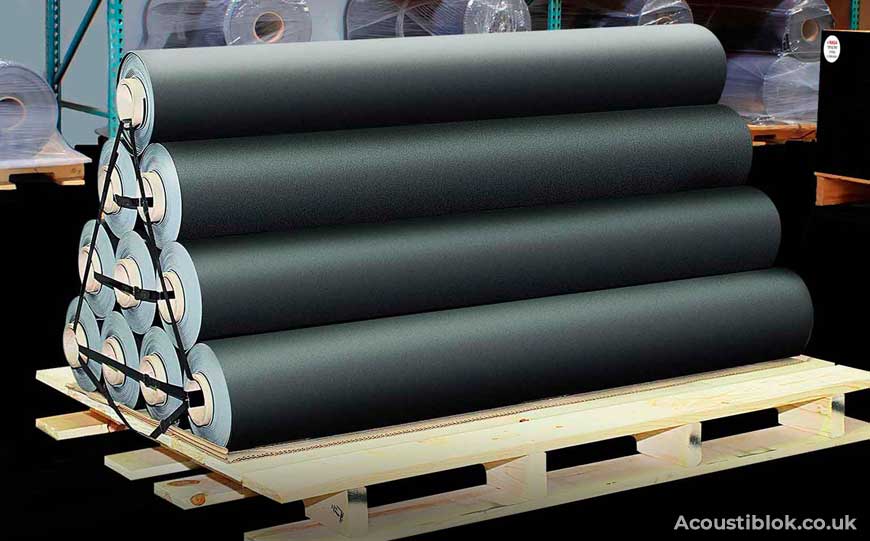
However, if you’re still confused or unsure of how to approach your own project, contact us today to speak to a member of our technical team.

How to Soundproof a Stud Wall
Blog

How to Soundproof a Stud Wall

Living next to a busy road or sharing a party wall with noisy neighbours is an unpleasant experience which can cause unwanted stress, restlessness and even lead to a number of health related problems.

If you’d like to restore some tranquility to your home, you may wish to consider learning how to soundproof a stud wall and other internal structures.

With proper stud wall sound insulation, you will be able to diminish sound transmission, and reduce impact as well as airborne sounds.

However, it is important to identify key factors relating to stud wall soundproofing to ensure that the results achieved are optimal.

1. Identify Weak Points

Speaker Woofer Through Hole in Wall

Tackling sound is a tricky business.

Sound travels at very high speeds, and is able to pass through walls more easily if it finds a weak point where there’s least resistance.

Hence, the most important first step is to identify weak points, as you are only as strong as the weakest points.

Any acoustic treatment will rely highly on whether you’ve fully found and remedied areas where sound transmission may occur.

Even if you line the entire wall with high grade soundproofing material, sound will manage to pass through even the smallest gaps, cracks or weak points if left untreated.

It’s very important to consider any obvious gaps or cavities, as well as columns, structural supports or anything else which could offer a pathway or flanking route for the sound to travel through.

2. Types of Noise

Colours of Noise

Image source: https://upload.wikimedia.org/wikipedia/commons/6/6c/The_Colors_of_Noise.png

Did you know there are different types and colours of noise?

Hence, you need to be aware of the various types of noise you could be dealing with specifically when you come to soundproof a stud wall.

This will greatly improve your chances of achieving far better results.

Airborne Sound

Airborne noise refers to any sounds that are transmitted through the air.

This includes noise such as overhearing conversations or music being played next door.

The sound waves are picked up and carried by the air.

Whilst moving through the air, the sound waves collide with any object in their path.

When the sound hits a stud wall for example, the collision will cause vibrations to pass through that wall, as well as into the spaces beyond.

Hence the noise can travel through the wall and into your rooms.

Structural/Structure-Borne Sound

This type of sound transfer results from impacts or vibrations that occur within a building’s fabric.

Consequently, the sound is radiated from an adjacent surface, which will vibrate as a result.

To better understand this type of sound, a good example is the sound made by footsteps going up or down stairs.

These sounds are heard due to the fact that the initial impact of footsteps made on the stairs leads to vibrations, which manage to be overheard through the construction of the stairs and transferred through the building’s structure.

Impact Sound

Impact noise is similar to the previous type of noise, but in this case the sound is created when an object impacts another.

This leads to the generation of sound and its subsequent transmission from another surface.

3. Reducing Flanking Noise

Large Crack in Concrete Wall

Sound can travel through any gaps it finds and along or within structures, such as walls or structural steels for example.

These could be minor cracks in walls or larger cavities such as floor cavities.

When soundproofing a stud wall, it’s essential to consider the importance of reducing the chances of flanking sound transfer through the structure, the stud frame, the coupling to the floor below and ceiling above as well as associated floor cavities between floor joists.

This may be quite difficult, as in many circumstances floor joists are shared by your neighbouring property.

As a result, it soon becomes apparent how easily sound is transferred from one property to another when such weak points are present.

Thus, if you’re going to soundproof a stud wall, you need to look not only at the wall itself but also whether your floor joists run through to any party walls with your neighbour’s house.

An easy way to do this is to check which direction the floorboards run.

In cases where the floorboards run parallel (in the same direction as the wall), it’s most likely your floor joists are running perpendicular into the wall, thereby increasing flanking sounds transferred between your house and your neighbours through the joists.

The simplest and most effective way to reduce amplification of sound within floor cavities and flanking sounds from passing through the floor cavities, is to add sound insulation between the floor joists.

In order to do this you will need to remove some floorboards.

Then start to infill cavities against the wall using open cell acoustic insulation such as Acoustiblok QuietFibre.

It is very versatile and comes in different thicknesses to include 25mm, 50mm 75mm and varying densities from 45kg/m3, 60kg/m3, 80kg/m3, 100kg/m3.

It’s best to come back into the room at least around 600mm, or approximately the width of the slab but of course filling the full length of each cavity will be greatly beneficial both acoustically and thermally.

An additional measure to insulate the joists themselves to reduce vibration and flanking transmissions through their own rigidity, would be an installation of an isolation membrane such as Acoustiblok 6mm Isolation Membrane over the top of the joists.

This could be either in strips over the joists or for a better acoustic level fitted across the entire floor.

4. Soundproofing a Stud Wall

Stud Wall Insulation

When it comes to soundproofing a stud wall, it would be advisable to employ a number of techniques.

Your main aim is to increase acoustic value and thereby reduce sound transmission.

Firstly decide the preferred approach and whether you wish to open up the existing stud wall to gain access to the stud frame and cavity by removing the existing finishing board.

Alternatively add additional materials to the existing wall which may prove to be less invasive that doesn’t involve removal of any existing plasterboard or drywall.

The fact that there is a sealed stud in between makes these walls susceptible to sound transmission through amplification of sound within open cavities.

This is because the sound waves will reverberate/echo and become considerably louder due to the cavity, as they will be bouncing and vibrating around inside the space.

A key deciding factor as to the required approach may be to establish if the existing cavity has cavity insulation in between the stud frame.

These cavities need to be filled with open cell insulation to provide an absorption of acoustic energy to reduce resonance.

Either of the approaches above will ultimately result in an open stud wall/cavity space which can be filled as described.

Following this would typically be an application of Acoustiblok 3mm Isolation Membrane to the stud frame.

This unique material in simple terms converts acoustic energy into heat energy by way of thermal conversion and achieves the highest levels of effect of any material or principle, mm for mm.

Where at all possible, apply on the noise source side of the assembly.

Where appropriate incorporate material to both sides of the walls to achieve even better results.

When applying the membrane, it is also important that all the heads of the fixings are properly countersunk.

It is highly recommended that you apply silicone sealant to the heads in order to soften and further reduce any impact and flanking sound transmissions.

Mass, density and absorption are all important to mitigating sound waves and consequently preventing them from making their way any further and traveling through the walls.

To add more mass to stud walls, you can either add more drywall to the existing walls, or opt for a double layer of sound insulation membrane.

The latter is more costly but more effective than drywall as it is not simply relying upon density, rather very cleverly converting from a problematic sound into a less problematic trace element heat energy.

5. Finishing

Filling Drywall Gaps

As noted earlier, there are various steps involved in ensuring your stud walls are properly soundproofed.

You want to make sure that the entire stud wall is sound tight.

Hence you need to make sure that all finishes applied and products used are the most suitable in terms of their soundproofing capabilities.

This includes the acoustic insulation as well as the sealants, caulks and jointing tapes used throughout the procedure.

You need to ensure that you seal any areas of potential weakness, to prevent any possibility for sound to pass through, no matter how tiny the gap may be.

Conclusion

By following the steps outlined above, you should be able to effectively increase the acoustic levels of your stud walls and reduce sound transmission from neighbouring rooms and properties.

The principles of mass, decoupling and sound dampening need to be observed with care, and the use of suitable sound insulation products is of the essence in achieving the desired results.

Soundproof Fence Noise Barrier Membrane
Blog

How to Soundproof a Fence with Noise Barrier Membrane

After a hard week at work, nothing beats the seclusion and tranquility of your own garden or outdoor space to relax and unwind.

Whilst you may have made a considerable financial investment in creating your idyllic retreat, there’s still one thing that’s really bothering you – noise coming from adjoining land.

Be it road traffic, passers-by, or noisy neighbours in their gardens, you’re not managing to get the peace you yearn for.

Persistent noise pollution can lead to increased levels of stress and even lead to life threatening health conditions.

If this problem sounds familiar, have you ever considered how to soundproof a fence to reduce the noise pollution?

Let’s discuss this in more detail below.

1. Types of Noise

Attenuation Diagram

Noise can vary a great deal and it can be especially tricky to deal with if you’re a novice to soundproofing.

Sound waves move in all directions and can be affected by a variety of factors, including atmospheric pressures, and the objects they hit as they travel from the source.

Traffic noise for example can vary greatly in terms of power, frequency and speed.

So you need to take into account these important considerations before choosing the best method to soundproof a fence or perimeter barrier.

These three main approaches are:

Acoustic Deflection

The main concept here is to deflect the unwanted sounds in another direction.

As soundwaves travel towards your boundary, you want the fence to deflect them in an opposite direction, instead of allowing them to make their way into your garden through weak points or non-deflective materials.

For acoustic deflection to work well, it’s important that the fence is of sufficient density and critically as high as possible, surrounding the entire perimeter of the garden.

Acoustic Absorption

Where sound deflection may not be enough to deal with nuisance noise, sound absorption is another suitable consideration.

The boundary in this case will absorb the sound energy, thereby reducing the power and pressure of the soundwaves.

This will in turn reduce sound propagation.

The sounds will become muffled and dampened.

It’s important to take into account the need for a dense barrier, which will be able to mitigate across frequencies both high and low.

Acoustic Energy Conversion

Finally, there is also the opportunity to convert sound into trace heat energy.

When the sound-waves hit the fence, the molecules in the acoustic material will start vibrating, thereby creating friction that is converted into trace heat.

2. Choosing Suitable Noise Barriers

Soundproofing Materials

It’s very important that you choose the most suitable noise barriers in relation to the type and level of noise you’re dealing with.

There are also various other factors to consider, namely, the height and length of boundary required, your budget and any potential construction issues.

Needless to say, the higher and thicker the barrier, the more effective it is going to be at blocking or deflecting noise.

The materials used are also of utmost importance.

Some materials are better than others, so it’s best to seek professional advice from an acoustic consultant to establish which materials would work best for your situation.
Bear in mind that even the slightest gaps will allow sound to pass through.

In the case of fences, you will have different options and considerations.

Besides the type of fence in terms of construction, there’s also the material to be used.

The following are some of the main options, and key considerations in relation to each of them.

Brick Wall

A brick wall may be the first option that comes to mind, especially if the noise you’re experiencing is quite problematic.

Needless to say a brick wall is durable, and can be thick and robust.

You will not need to worry about the effect of short term weather erosion, and maintenance is minimal.

One of the main things to consider is the density and the mass of the wall, as well as its height.

Having a high, thick wall is however going to lead to other issues, such as increased costs, as well as the fact that a high wall can make you feel enclosed.

Bear in mind that you are going to have to pay contractors to construct the wall, and the structural footings will need to be properly set.

In some cases, you might need to seek permission from local authorities.

Timber Fence

A fence made from timber is another popular option.
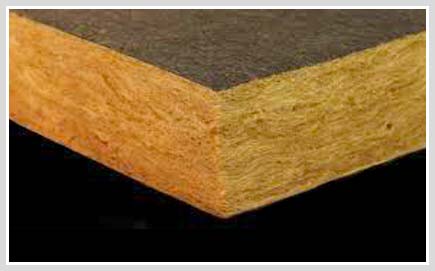
It can work well as a sound barrier and arguably, is not as difficult to erect as a brick wall.

Hence a timber fence can be considered a more feasible and cost effective alternative.

Having said that, it’s important to take into account the fact that a standard timber fence will have several weak points.

These weak points will undoubtedly allow sound to pass through, rendering it only as a very basic sound barrier.

Timber fences also require regular maintenance to prevent a deterioration of structural stability .

It’s recommended that for best results, a timber fence has a suitable noise barrier membrane overlaid to increase its soundproofing qualities.

This is specifically designed to significantly reduce noise, and is easy to install for even basic DIYers.

Alternatively, you can install an acoustic fence, but soundproofing qualities are again mixed.

Metal Fence

Another option is to erect metal fencing.

This is an ideal option in case you want to factor in security, as otherwise a metal fence is not that aesthetically pleasing.

You should avoid metal fences that have several gaps in them.

Chain link fences for example, are useless at soundproofing for obvious reasons!

In case of metal fences, you could opt for a structure onto which an acoustic barrier membrane can be fitted.

Or you could instead purchase and erect specialist all weather soundproof panels, specifically designed for this purpose.

These however tend to be used when dealing with higher power and higher acoustic pressure values.

Acoustic Fence

Acoustic fences are a very effective option to block noise.

These are specifically constructed for this reason, as they are dense and thick.

In most cases, they are designed with a tongue and groove design to ensure an integral joining of materials to eliminate gapping.

The timbers in these fences are interlocked to each other, thus decreasing any potential gaps and increasing the acoustic effectiveness.

Having said that, acoustic fences tend to be rather expensive.

Besides the material itself, such a fence would need to be constructed and erected by a professional.

Acoustic Membrane

In cases where you already have a boundary fence in place, you may wish to keep it and improve its acoustic effectiveness.

In such cases, you can easily overlay a noise barrier membrane onto the existing structure.

This type of specialist acoustic noise barrier membrane will work as an extremely effective barrier against any unwanted noise that’s bothering you.

It can be hung easily, either by attaching it to the fence perimeter, or by affixing it to the support posts.

3. Common Misconceptions

Bench & Hedgerow

Image source: https://pixabay.com/photos/wooden-bench-bench-seat-sitting-3392273/

The following are some common misconceptions that people have when it comes to blocking or reducing noise pollution.
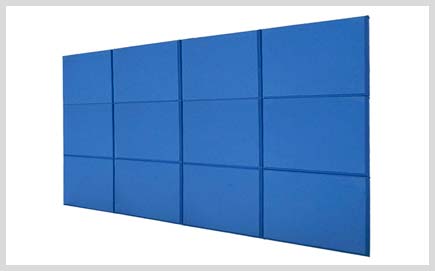
We’re going to cover these to help you understand why you should avoid the following principle or methods as they may ultimately prove ineffective.
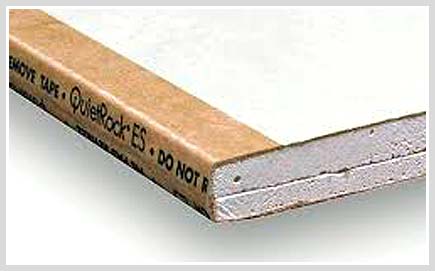
Hedging & Trees

Many people decide to plant hedges or trees as they think that they will help dampen the noise coming from outside.

The main idea is generally more related to keeping it green.

Whilst it’s definitely nice to have trees and hedges all along the perimeter of the garden, it’s important to understand that they are not going to block noise that effectively.

First of all, it’s important for the hedges to be very dense, and this requires a lot of time to grow as well as maintenance to achieve.

With a foliage only option, you cannot realistically hope to block all unwanted sound as there are countless little gaps through which soundwaves can pass.

Water Features

Water features may be beautiful, but they are not going to be an effective solution when it comes to noise.

The theory that the gentle sounds of water can somehow distract from a significant level of nuisance noise and mask the initial source ignition, could be viewed as optimistic.

They will only work well in deflecting your attention possibly as you hear the sound of the water rushing or splashing.

But the nuisance noise, if severe enough in the first place, is still going to make its way into your garden regardless.

Wind Chimes

Much like water features, the same applies to wind chimes.

White noise can only work well to a certain point.

But without actually creating an effective noise barrier to deflect, absorb or convert sound, wind chimes will only act as a minor distraction.

4. Before Installation

Let us discuss some key factors to consider when it comes to installing your acoustic fence.

Acoustic noise barrier membrane usually come in rolls.

To make things easier, it’s highly recommended that prior to installation you unroll the membrane and leave for a short while to give them time to flatten out.

This will help you hang them straighter and reduce bunching.

It’s also a good idea to use some chalk to mark the locations where the screws and washers will be placed.

Many contractors choose to brace the membrane onto the fence with use of thin timber battens, which in effect clamp the materials in place.

Trellis work (crossing battens) are very common and very effective.

They provide even loading with less fixings and also provide a platform onto which to grow foliage such as trailing plants or climbers.

In such a way you can achieve a more even distribution of the membrane across the surface of the fence.

A very important rule is to ensure fixings are a distance of at least 50mm from the edges when you start attaching the membrane.

You should avoid attaching it too close to the edges.

5. Installing Fencing Membrane

Attaching Fence Membrane

As always, it’s best to have a professional contractor take care of the installation.

But in case you prefer to do this yourself, make sure to follow these steps:

  • Mark where the fixings will be secured.
  • Re-roll the membrane, and start making your way slowly and carefully by fixing the membrane to the structure.
  • The solution always needs to touch the ground and you need to make sure there are no gaps whatsoever anywhere. It’s better if you have someone to help you.
  • Start screwing at regular distances to ensure proper weight distribution.
  • Overlap the membrane as every new row overlaps the other row.
  • At the end of the fence secure well to the fence. Always ensure that the screws are penetrating properly in the membrane.
  • Add soil to the bottom to ensure there are no gaps at the base and there is solid contact.

Conclusion

Noise barrier membrane is an effective option which can really help reduce the noise passing through boundary fences.

It is also extremely cost effective and maintenance free.

So if you have an existing fence that is not adequately blocking sound from entering your space, speak to a professional about installing acoustic noise barrier fencing membrane.